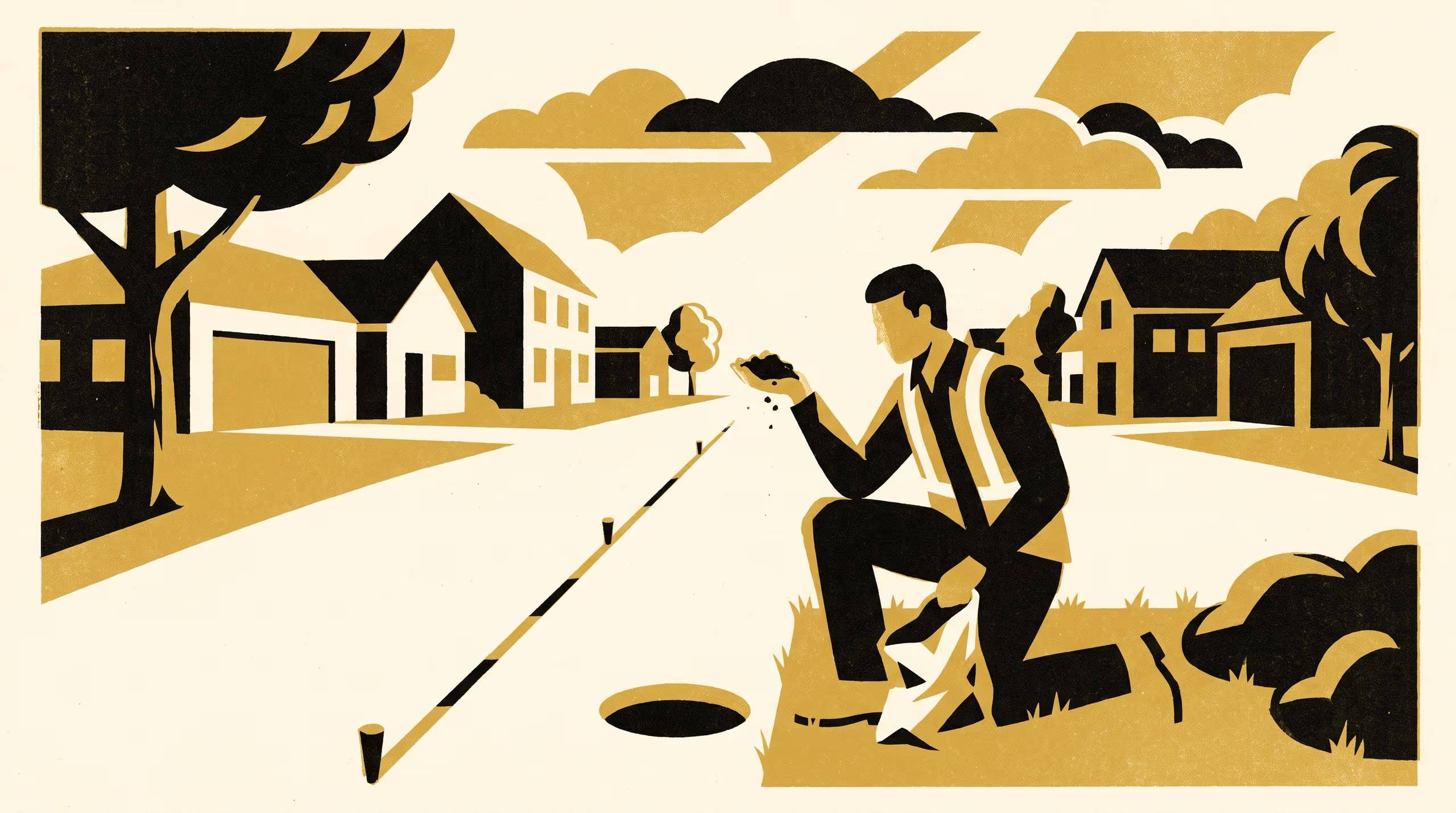
The School of Underlying Conditions has published In Area, a civic brochure inviting community services to have their catchment boundaries walked and described by the School's survey teams.
A civic brochure brings soil-survey boundary practice to the catchment lines of community services
Civic partnership has become one of the School of Underlying Conditions’ quieter commitments, and a new brochure sets out what it involves. In Area invites the services that draw a line around the people they serve, including the catchment of a community mental health service, to have that line walked on foot by the School’s survey teams and described, household by household, on both sides.
The brochure was prepared by Dr Brynjar Obiora, Senior Research Fellow, with Dr Vigdis Emenike, Senior Lecturer, and Associate Professor Ragnhild Uzoma, Lead of the Basement Relations Group.
Our teams have walked boundaries for the ground’s sake for as long as the School has existed. This brochure asks them to walk a few for the neighbours on either side, and I have yet to meet a surveyor who said no.
— Dr Brynjar Obiora, Senior Research Fellow, School of Underlying Conditions
At its centre is a practice the School has long applied to soil maps: a boundary is pegged, walked and written up before it is described, so that the line arrives at a partner’s desk accompanied by an account of the ground it crosses. The brochure situates that practice within the School’s wider engagement with the paperwork and patterns of access, from close readings of referral correspondence to the ways people return to support after time away, and points readers to six published outputs from across the University.
Dr Emenike described the brochure as “an invitation that only works if somebody is home when the visitor knocks”, adding that the School intends to be.
The publication marks the School’s fullest account yet of the civic role an earth sciences school can play in the life of its town, and the University is pleased to see that role written down.
The full brochure is available from the University’s research repository under an open licence, doi:10.5555/slop.1bqe5d.