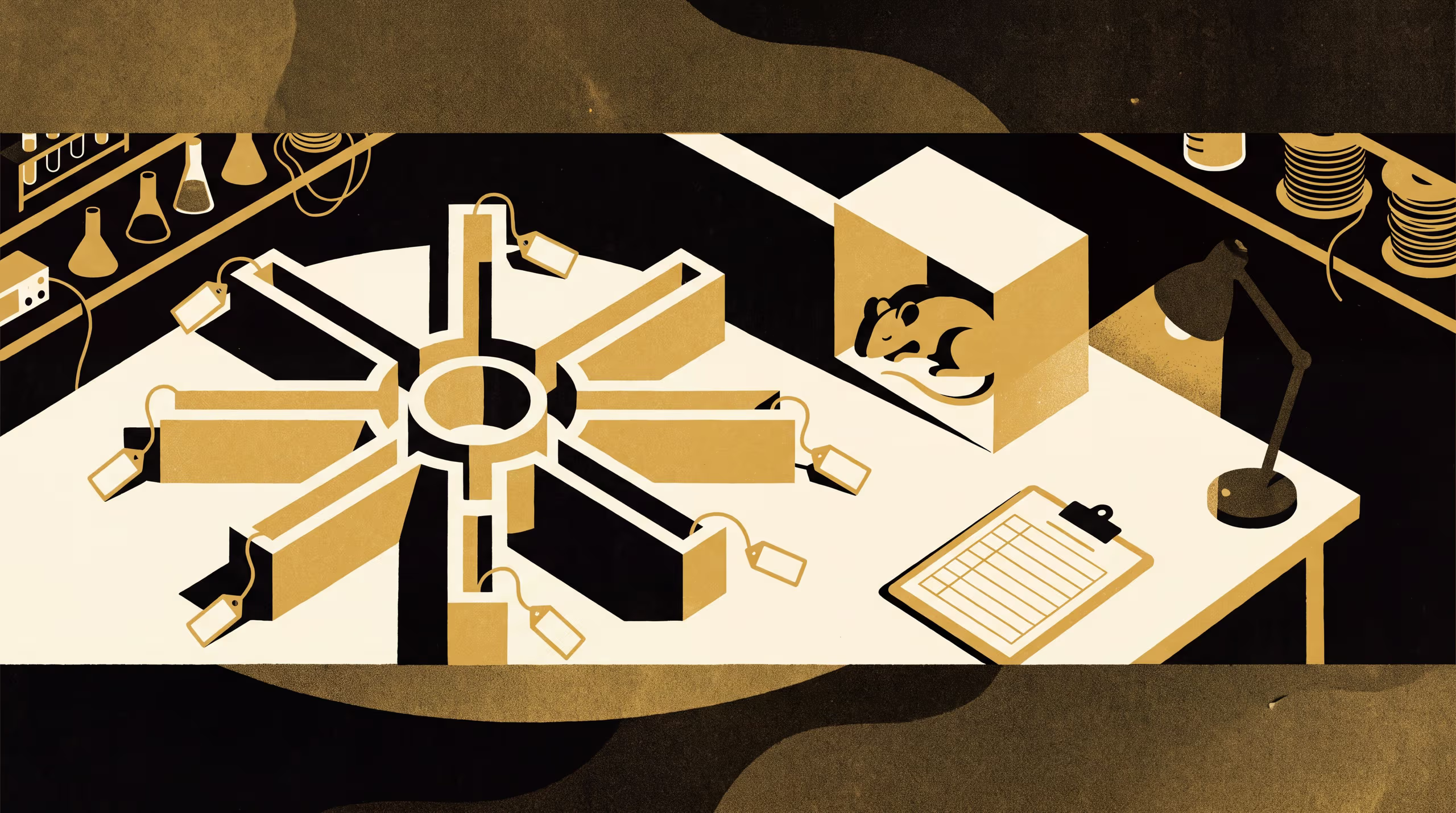
A new research poster from the School of Underlying Conditions treats the replay of memories during sleep as a maintenance-scheduling problem, and finds the resting animals also stopping to inspect.
A Whittle-index service plan is set against decoded replay from twelve rats on an eight-arm maze
A priority is only ever as good as the time set aside for it. It has been a pleasure to watch colleagues in another School find that question waiting for them overnight, and to be asked along.
— Associate Professor Kwame Lindqvist, Director, Master of Priority Studies
The remark introduces Which Traces Get Serviced, a research poster published today by the School of Underlying Conditions, which brings the planning methods of operations research to the question of which memories a resting brain keeps in good repair.
The poster is the work of Associate Professor Ragnhild Uzoma, Lead of the Basement Relations Group, Associate Professor Kwame Lindqvist of the School of Emergent Priorities, and Dr Vigdis Emenike, Senior Lecturer in the School of Underlying Conditions.
Bringing the scheduling toolkit of industrial upkeep into conversation with sleep research, the team treated each remembered route through a laboratory maze as an asset in need of service, and set the resulting plan alongside the replay activity recorded in a cohort of resting animals. The plan anticipated where the animals’ rest was spent with notable fidelity. Where it fell short, the team found the animals returning to routes whose circumstances had just changed, less to repair them than to check on them.
For Associate Professor Uzoma, the result “puts a quiet night’s rest on the same footing as a pump that wants looking at”, a comparison the Basement Relations Group intends to keep close at hand.
The poster takes its place in the University’s growing habit of lending one discipline’s instruments to another discipline’s questions.
The full poster is available from the University’s research repository under an open licence, doi:10.5555/slop.8a28br.