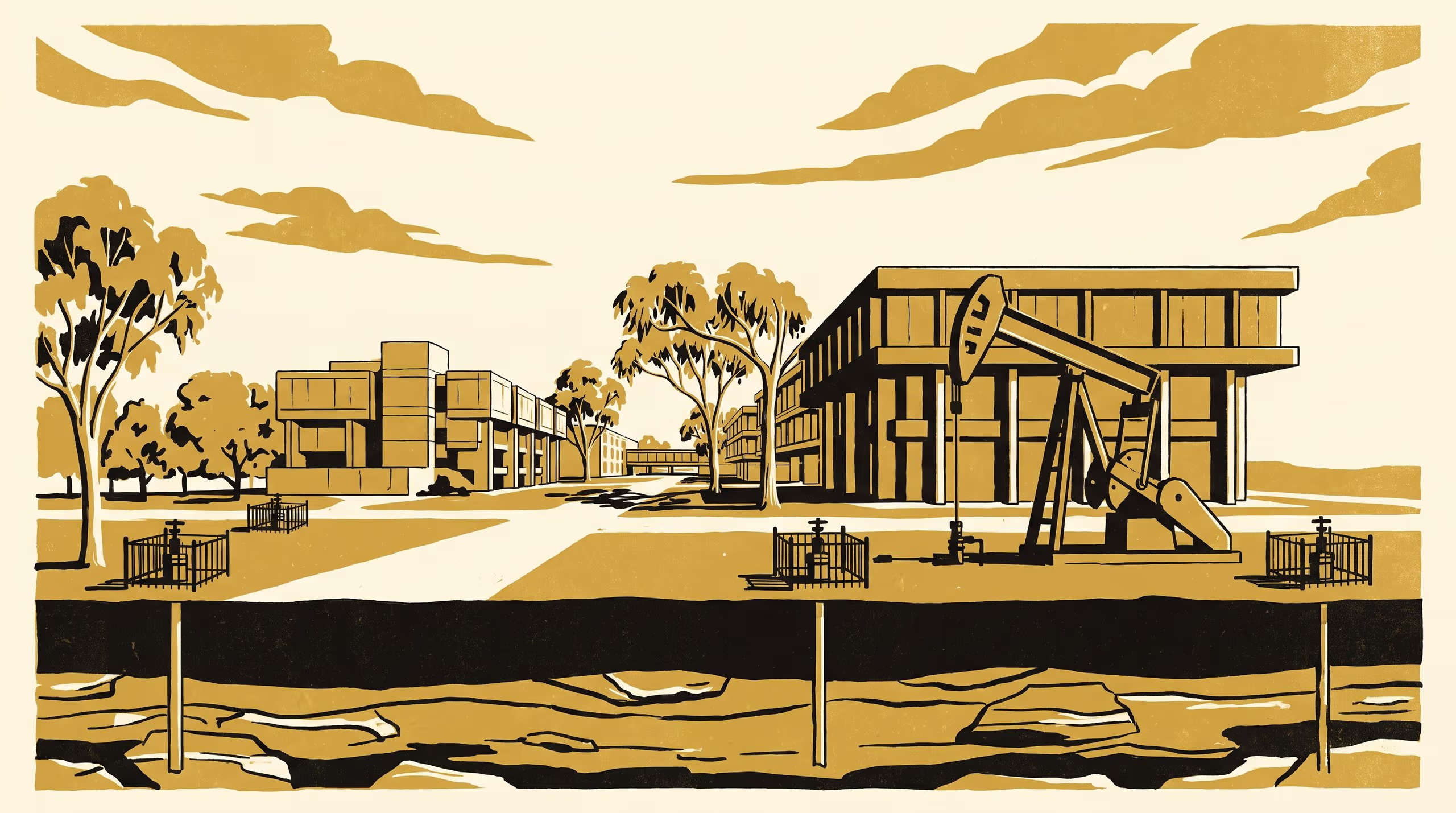
The University's Strategic Plan 2026-2031 treats the wells of the retired oil and gas field beneath its campus as research infrastructure, a teaching resource and a continuing obligation.
Three priorities commit the University to finding, caring for and teaching from the legacy wells under its lawns
Slop University has adopted a Strategic Plan for 2026–2031 that begins below the surface. The Ground We Stand On sets out how the University will meet its inheritance from the oil and gas field that worked its land for most of a century before the campus arrived, and whose closed wells still sit beneath its lawns, courtyards and teaching buildings.
The Plan was prepared by Dr Brynjar Obiora, Senior Research Fellow in the School of Underlying Conditions, with Ms Ylva Ogunbanjo, Doctoral Candidate in the School of Emergent Priorities, and Signy Okpara, Doctoral Candidate in the School of Continuous Improvement.
Most of this work will be done by people who have not yet joined the University. We have tried to write the Plan they will want to inherit, with the field sheet left open at the right page.
— Dr Brynjar Obiora, Senior Research Fellow, School of Underlying Conditions
Reframing the campus as a field site in its own right, the Plan aligns near-surface survey, records stewardship and long-horizon monitoring into a single institutional posture, organised around three priorities: knowing what lies beneath, care without an end date, and a campus that teaches from its own ground. Five published studies from across the University anchor its evidence base.
“Every well will have a named steward, and every steward will one day hand it on,” said Okpara, who expects students to reach the wells before the paperwork does. “I would like the handover note to be the best-written document we keep.”
In committing itself to a responsibility longer than any planning cycle, the University has chosen to plan as patiently as the ground requires.
The full Strategic Plan is available from the University’s research repository under an open licence, doi:10.5555/slop.8y93it.