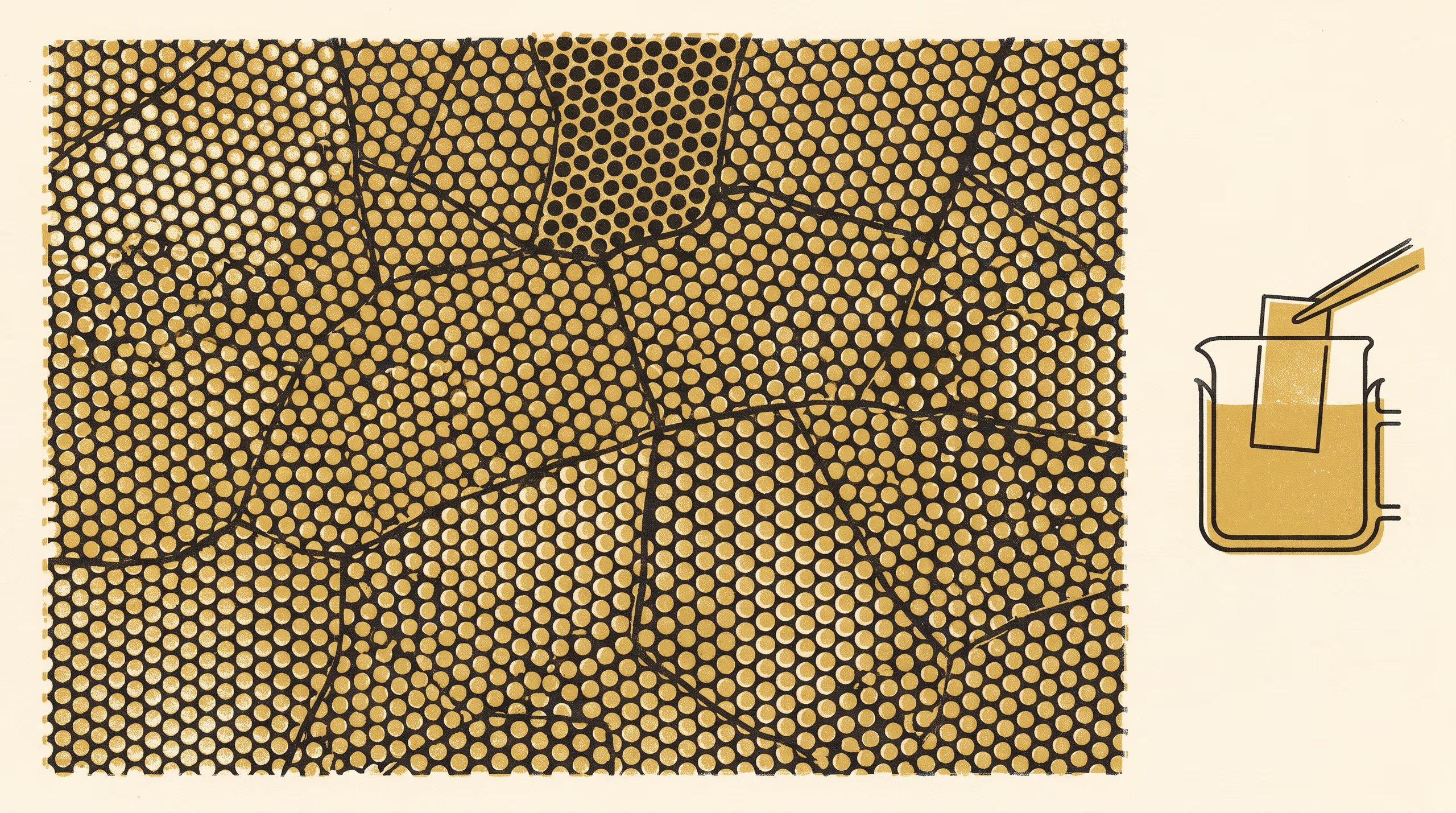
A paper from the School of Underlying Conditions carries the misorientation statistics of rock fabric analysis to porous anodic alumina, and finds the shallow boundaries between ordered pore domains disappearing first.
A four-day time series of oxalic-acid films finds low-angle domain boundaries clearing out well ahead of high-angle ones, in the manner of subgrains in rock
Geologists have long sorted the boundaries inside a rock into two kinds, the gentle seams between subgrains and the sharp edges between grains, and read a rock’s history from which of them survives. Subgrains in the Pore Lattice, a paper released today by the School of Underlying Conditions, puts the same question to the honeycomb of pores that forms when aluminium is anodised, and finds that the gentle seams go first.
The paper is by Associate Professor Ragnhild Uzoma, Lead of the Basement Relations Group, and Dr Brynjar Obiora, Senior Research Fellow in the School.
Sorting boundaries in a thin section is something our students learn in their second year. It turns out the habit travels, and we have tried to be good guests in a field that has been looking at these films far longer than we have.
— Associate Professor Ragnhild Uzoma, Lead, Basement Relations Group
Bringing petrographic fabric analysis, electron microscopy and the crystallography of the underlying metal into a single frame, the study follows 24 aluminium foils across anodising runs of up to four days and more than 22 million pore positions, building an integrated account of how an ordered surface settles into its final pattern.
Dr Obiora, whose own work concerns where one mapped soil ends and the next begins, said the team had spent “more time than any of us expected deciding where one patch of pores stops”, and was glad the answer had held up however the line was drawn.
The release extends the School’s earth-science methods into materials research, a direction the University is pleased to see taking shape at the laboratory bench.
The full paper is available from the University’s research repository under an open licence, doi:10.5555/slop.icm3da.