Low-Angle Domain Boundaries Disappear First During Long First-Step Anodisation of Aluminium in Oxalic Acid
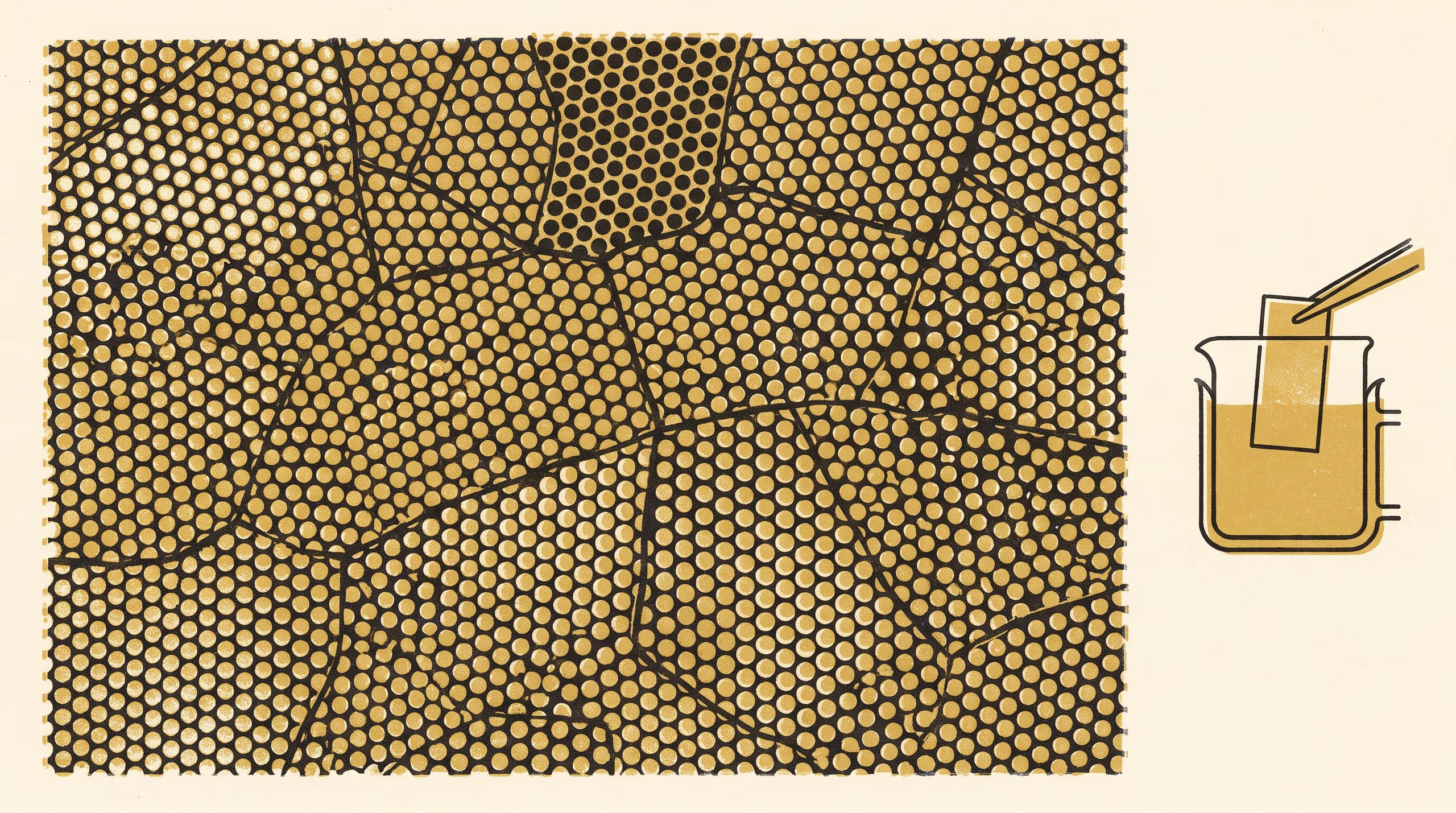
A paper from the School of Underlying Conditions anodises 24 aluminium foils in oxalic acid for between 1 and 96 hours, locates 22.4 million pore-bottom dimples, and classes the boundaries between ordered domains by misorientation as a petrologist would. Domains coarsen as the 0.39 power of time, but low-angle boundaries fall from 41% of boundary length to 9% while high-angle boundaries thin more slowly and come to sit over the grain boundaries of the metal, which the authors read as subgrain coalescence followed by a mosaic pinned by its substrate.
| Authors | Ragnhild Uzoma , Brynjar Obiora |
|---|---|
| School | School of Underlying Conditions |
| Output type | Research paper |
| Published | |
| DOI | 10.5555/slop.icm3da |
| Pages | 6 |
| Version | 1.0 |
| Licence | CC BY 4.0 |
Cites
Cite as
@misc{slop_icm3da,
  author       = {Ragnhild Uzoma and Brynjar Obiora},
  title        = {Subgrains in the Pore Lattice: Low-Angle Domain Boundaries Disappear First During Long First-Step Anodisation of Aluminium in Oxalic Acid},
  year         = {2026},
  publisher    = {Slop University},
  doi          = {10.5555/slop.icm3da},
  url          = {https://slop.university/outputs/slop-paper-subgrains-in-the-icm3da/},
  version      = {1.0},
  note         = {Research paper},
}