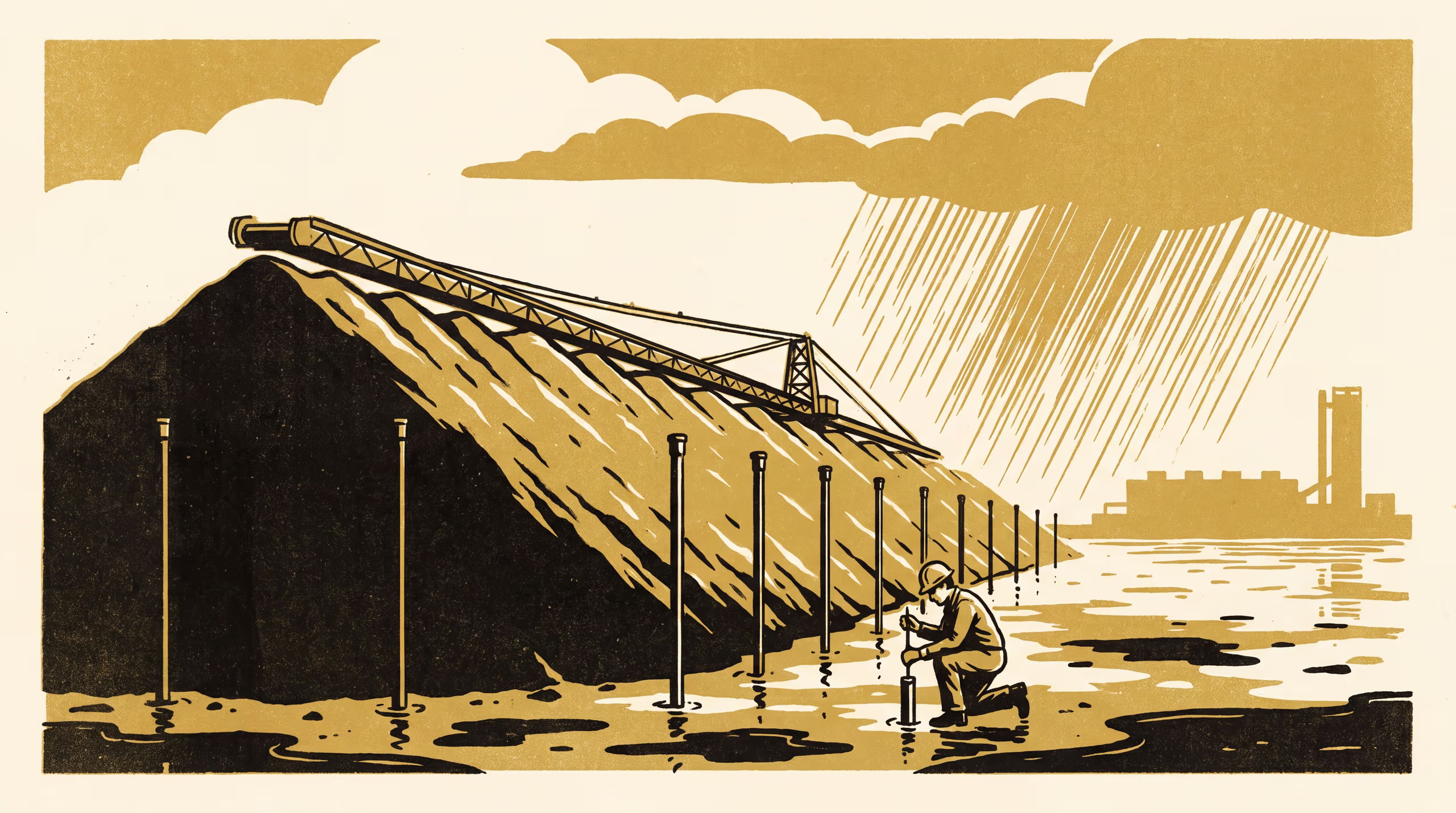
A research poster from the School of Underlying Conditions follows rainwater through a working coking-coal stockpile and finds its fines-rich core holding water days after its flanks have drained.
Eight standpipes, eleven rain events and one chevron-stacked pile at an inland coke works
A coal stockpile does not dry out all at once. After rain, its coarse ends shed their water within a day, while the fine coal at its centre is still draining on the third day. That is the central finding of Still Draining on Day Three, a new research poster by Dr Vigdis Emenike, Senior Lecturer, and Dr Brynjar Obiora, Senior Research Fellow, both of the School of Underlying Conditions.
A school set up to study what lies beneath the ground has learned a good deal from ground that someone stacked on purpose. We are still working out what that says about us, and we are glad to be working it out in the open.
— Dr Vigdis Emenike, Senior Lecturer, School of Underlying Conditions
The project brings the School’s groundwater fieldwork to bear on the materials pathway behind cokemaking. It aligns standpipe monitoring, drainage timing and charge-quality records into a single account of how moisture moves through a working pile, and translates that account into a reclaim posture fitted to the pile’s own structure. Across 41 matched reclaims, the poster finds that most charges arriving outside the oven’s moisture window had been drawn through the core too soon after rain.
The work extends a line of School inquiry into the industrial settings where earth science meets everyday operations, and it shows the School’s field methods travelling comfortably beyond their usual terrain.
“Every season brings another pile and another sky,” said Dr Obiora. “We expect the questions to keep arriving, and we intend to be standing beside the pile when they do.”
The full poster is available from the University’s research repository under an open licence, doi:10.5555/slop.j5td1g.