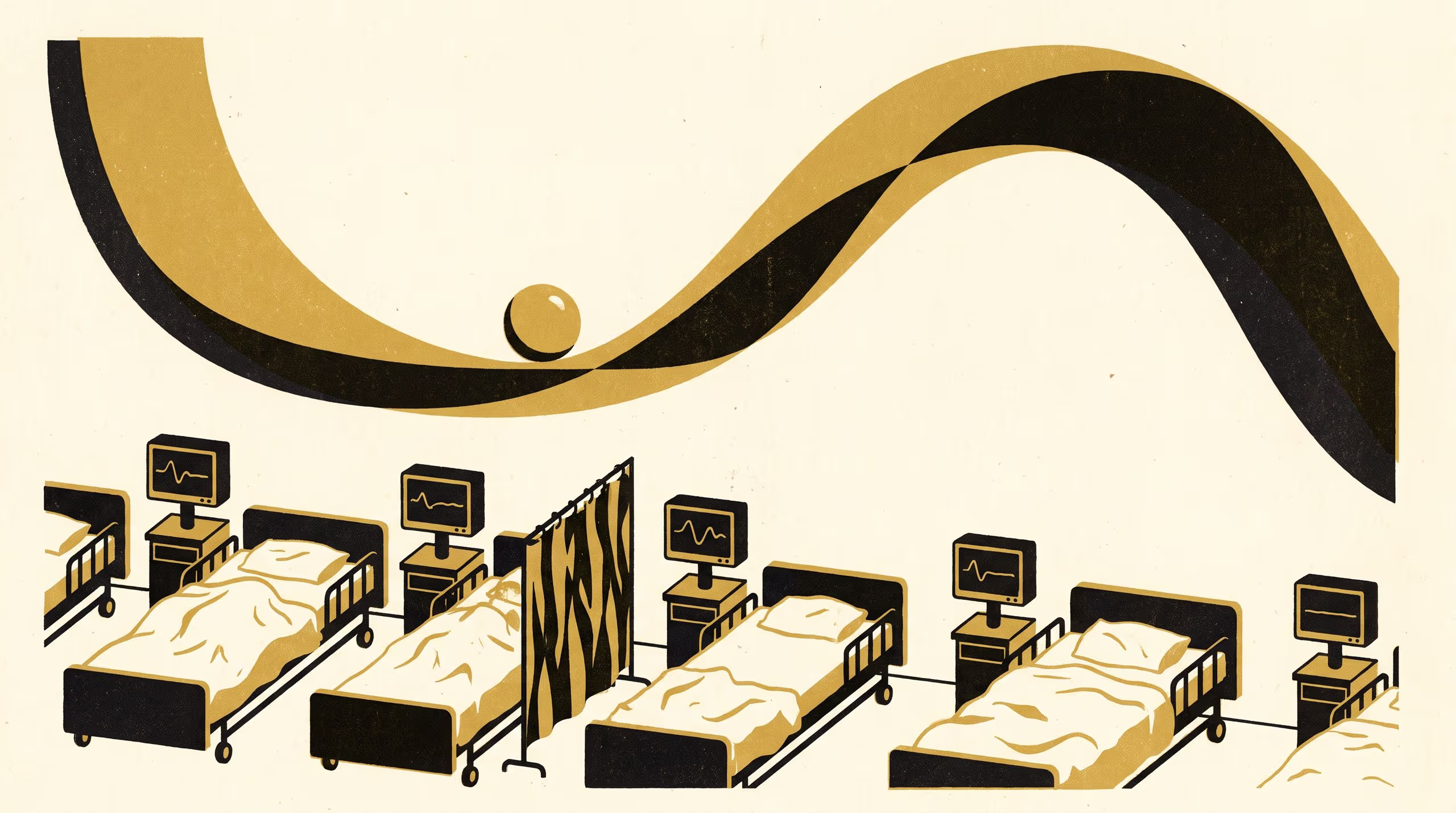
Lead-time ceilings for learned early-warning scores from stochastic normal forms of decompensation
A research poster from the School of Underlying Conditions derives how far ahead any learned early-warning score can see a collapse in the noisy saddle-node normal form, testing five model classes and a Bayes-optimal filter on 240,000 simulated trajectories per route. When the system's reserve drifts towards the fold the ceiling reaches about 18 relaxation times; when collapse is a noise-driven Kramers escape it falls to about 1.8, and no model class exceeds it.
| Authors | Ragnhild Uzoma , Fenna Okoro , Vigdis Emenike |
|---|---|
| School | School of Underlying Conditions |
| Output type | Research poster |
| Published | |
| DOI | 10.5555/slop.no33sj |
| Pages | 1 |
| Version | 1.0 |
| Licence | CC BY 4.0 |
Cites
Cite as
@misc{slop_no33sj,
  author       = {Ragnhild Uzoma and Fenna Okoro and Vigdis Emenike},
  title        = {The Horizon Is Set by the Route: Lead-time ceilings for learned early-warning scores from stochastic normal forms of decompensation},
  year         = {2026},
  publisher    = {Slop University},
  doi          = {10.5555/slop.no33sj},
  url          = {https://slop.university/outputs/slop-poster-the-stochastic-normal-no33sj/},
  version      = {1.0},
  note         = {Research poster},
}