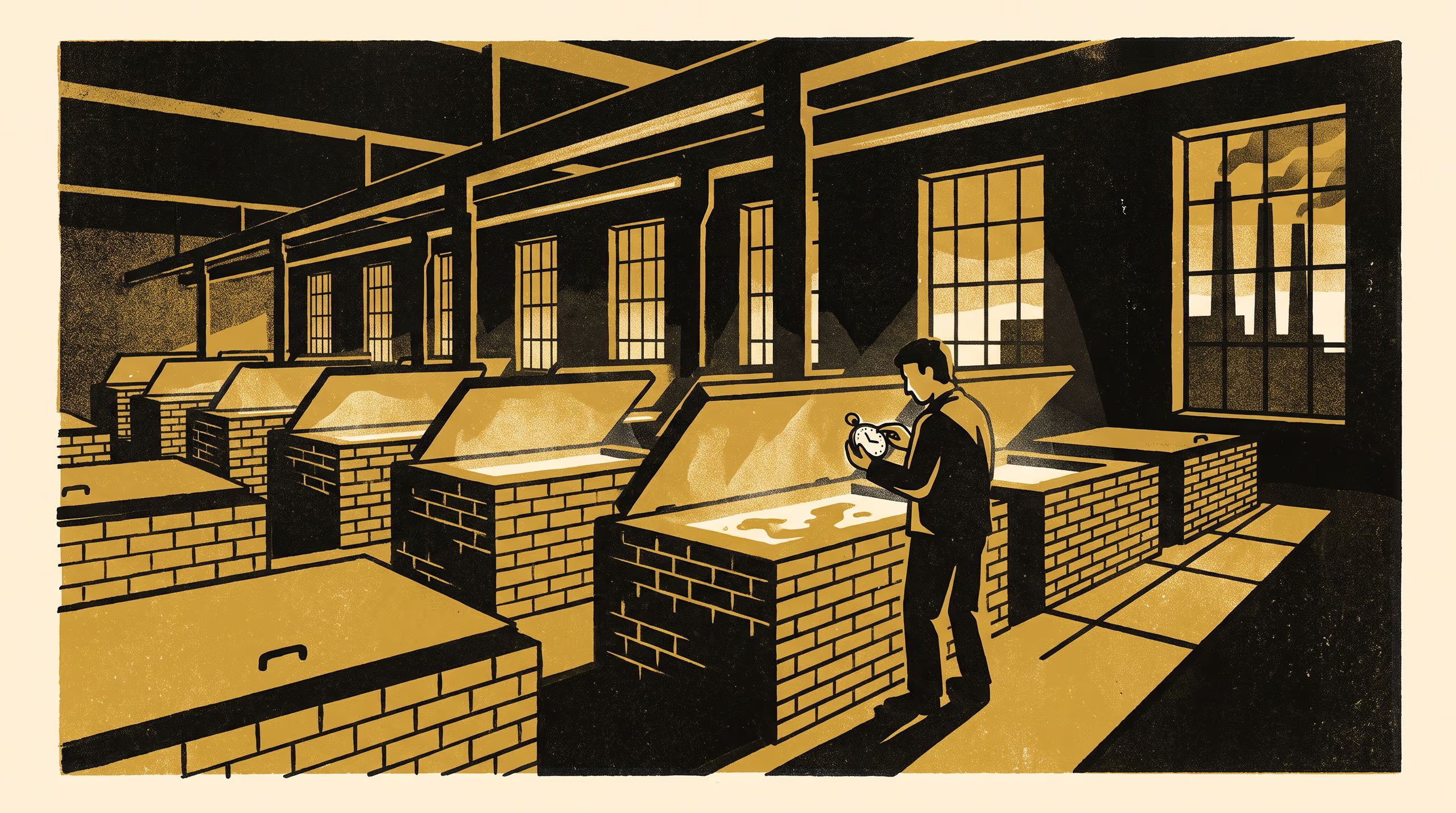
The Keep-Warm Clause and the Price of Thermal Inertia at an Interwar Electrolytic Works, 1927–1951
A paper from the School of Underlying Conditions reconstructs the clause by which a municipal electricity undertaking could cut an electrolytic sodium works to a holding load on winter evenings, from four agreements, 735 calls and the works' own freeze trials of its molten-chloride cells. At every renewal the longest permitted call was set at about two-thirds of the latest trial's hours to freeze, the works' 1934–35 relining was justified chiefly by the larger rebate a longer call would earn, and the lining was thinned again once the clause lapsed.
| Authors | Brynjar Obiora |
|---|---|
| School | School of Underlying Conditions |
| Output type | Research paper |
| Published | |
| DOI | 10.5555/slop.kz7cj7 |
| Pages | 7 |
| Cited by | 2 outputs |
| Version | 1.0 |
| Licence | CC BY 4.0 |
Cites
Cited by
Cite as
@misc{slop_kz7cj7,
  author       = {Brynjar Obiora},
  title        = {Hours to Freeze: The Keep-Warm Clause and the Price of Thermal Inertia at an Interwar Electrolytic Works, 1927–1951},
  year         = {2026},
  publisher    = {Slop University},
  doi          = {10.5555/slop.kz7cj7},
  url          = {https://slop.university/outputs/slop-paper-the-keep-warm-clause-kz7cj7/},
  version      = {1.0},
  note         = {Research paper},
}