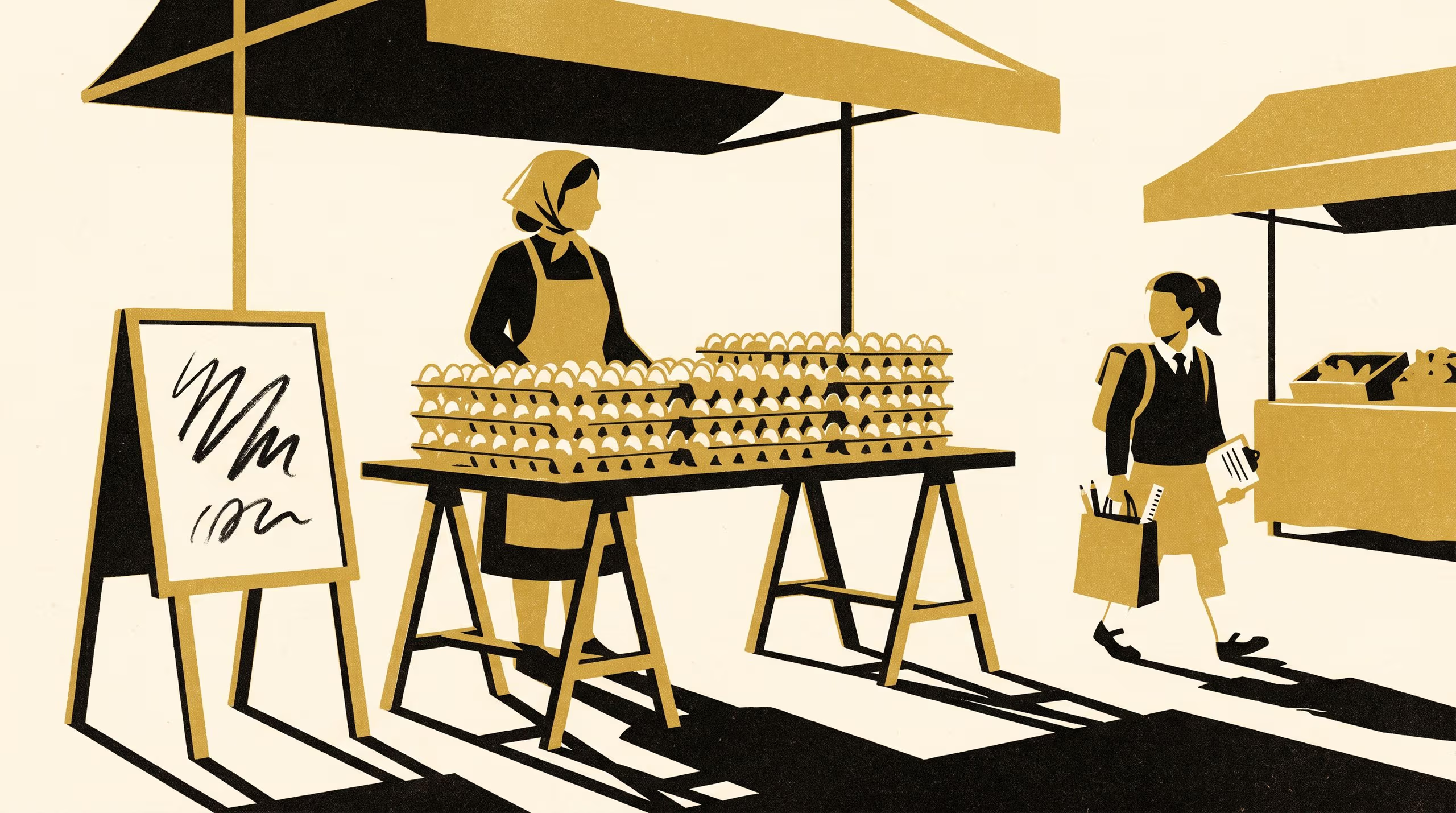
Examination Timing and the Incidence of a Demand Shock at a Rural Periodic Market
A paper from the School of Emergent Priorities uses the year-to-year movement of a national school-leaving examination across a seven-week window to trace an exam-week demand shock for eggs through eleven years of a rural weekly market's levy ledgers and price survey. The price of a tray rises 11.4 per cent on the examination market day and 3.8 per cent the week before, as sellers hold trays back; purchase diaries show households without a candidate buying 6.0 per cent fewer eggs that week and, because they still buy two-thirds of the eggs sold, paying about two-thirds of the premium.
| Authors | Petra Umbile , Sunniva Balogun , Kwame Lindqvist |
|---|---|
| School | School of Emergent Priorities |
| Output type | Research paper |
| Published | |
| DOI | 10.5555/slop.4md22o |
| Pages | 5 |
| Version | 1.0 |
| Licence | CC BY 4.0 |
Cites
Cite as
@misc{slop_4md22o,
  author       = {Petra Umbile and Sunniva Balogun and Kwame Lindqvist},
  title        = {Who Pays for the Candidate's Breakfast?: Examination Timing and the Incidence of a Demand Shock at a Rural Periodic Market},
  year         = {2026},
  publisher    = {Slop University},
  doi          = {10.5555/slop.4md22o},
  url          = {https://slop.university/outputs/slop-paper-the-incidence-of-4md22o/},
  version      = {1.0},
  note         = {Research paper},
}