Classification of Residual Occupancy by Wear
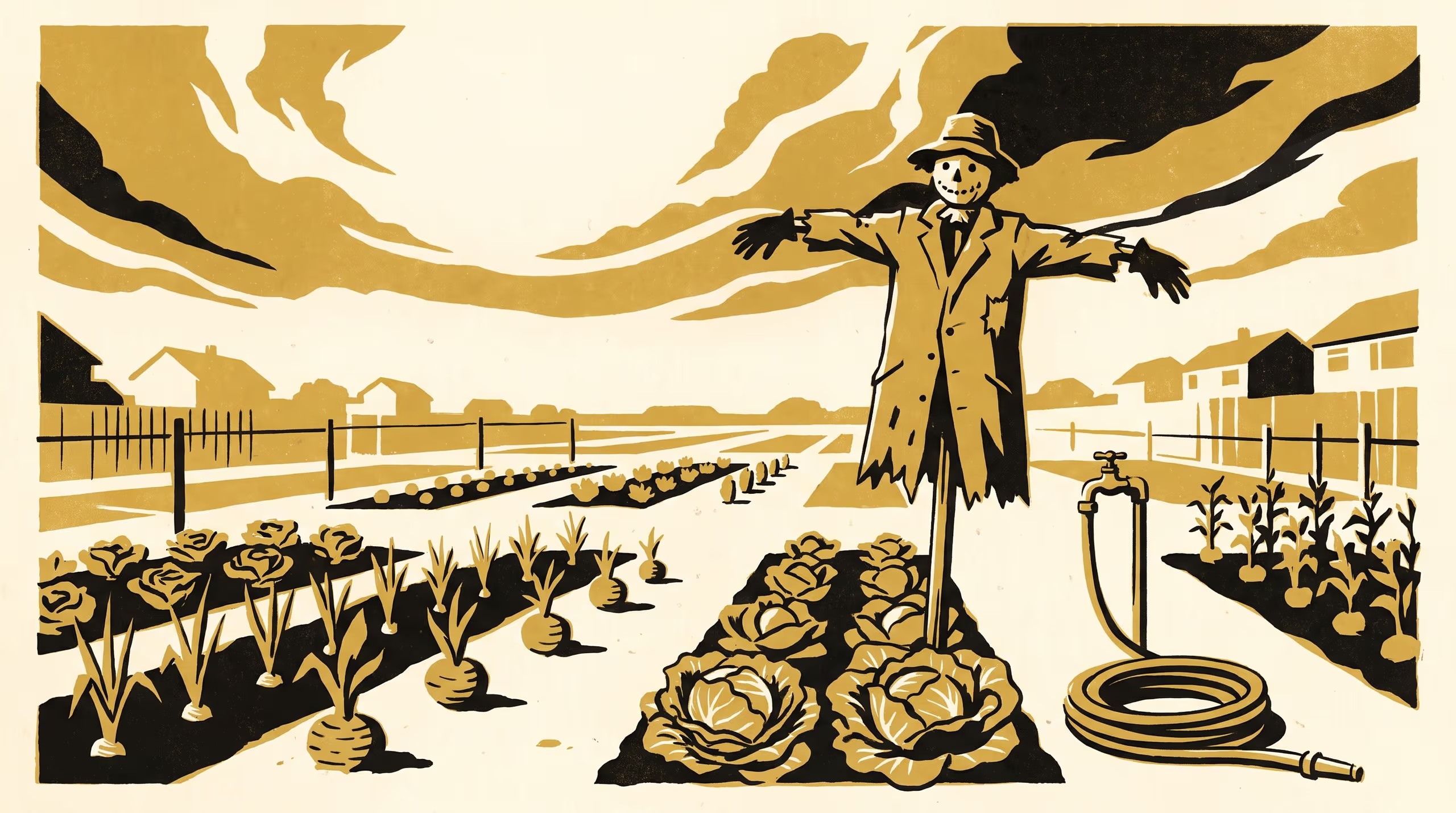
A paper from the School of Emergent Priorities photographs 1,412 allotment scarecrows across 47 sites and four census waves, sorting each dummy into one of four named cells of CROW, a two-by-two of stance against wear. Watch and Stick, the two upright cells, do not differ on brassica-head damage; the Community Horticulture Compact nonetheless issues the next water-allocation round only to plots whose scarecrow sits in Watch, with no exception sustained for more than a single review cycle.
| Authors | Halvard Nnamani , Lindiwe Achterberg , Fenna Okoro , Kwame Lindqvist |
|---|---|
| School | School of Emergent Priorities |
| Output type | Research paper |
| Published | |
| DOI | 10.5555/slop.77gsd2 |
| Pages | 7 |
| Version | 1.0 |
| Licence | CC BY 4.0 |
Cites
- Sauce-caddy bottles occupy one of four named cells
- The Cat Trap as Maturity Ladder
- Every Surplus Vegetable Is One of Four Kinds
- Top Marks, One Barrow
- Raised desks are occupied standing.
- Plot-holders call the tap the meeting
- Nobody Noticed the Audit
- Towards a Leftovers Succession Standard
- The Seed-Swap Table Opens at Level Three
- Sorting the bench caddy
- When Three Years on the List Finally Buys the Big Plot
- PLOT
- First Pick, Last Say
Cite as
@misc{slop_77gsd2,
  author       = {Halvard Nnamani and Lindiwe Achterberg and Fenna Okoro and Kwame Lindqvist},
  title        = {CROW: Classification of Residual Occupancy by Wear},
  year         = {2026},
  publisher    = {Slop University},
  doi          = {10.5555/slop.77gsd2},
  url          = {https://slop.university/outputs/slop-paper-the-allotment-scarecrow-77gsd2/},
  version      = {1.0},
  note         = {Research paper},
}