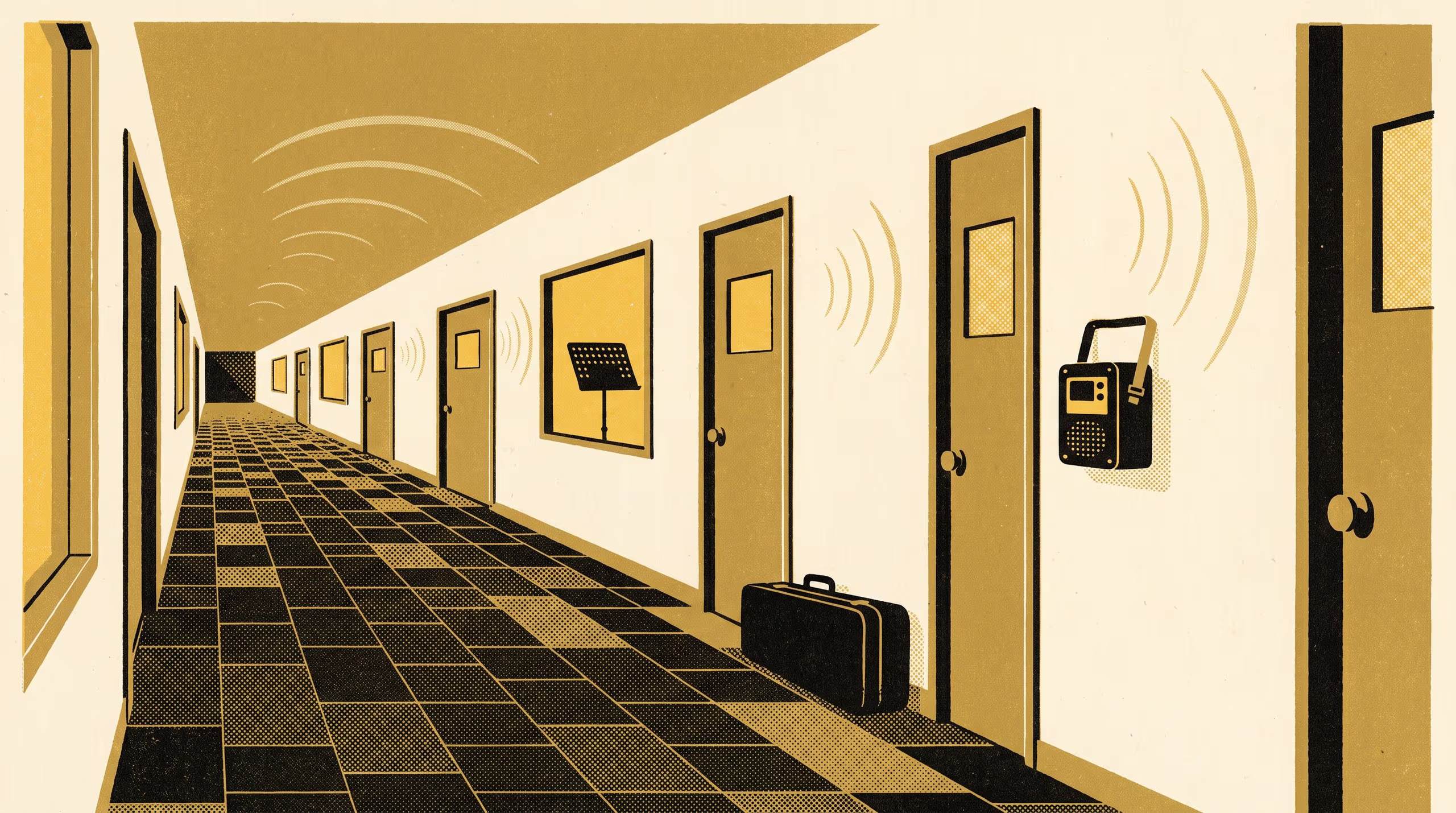
Testing the Acoustic Niche Hypothesis among Instrument Families in a Basement Practice Corridor
A paper from the School of Underlying Conditions surveys one basement corridor of twelve practice rooms for 56 days with a recorder opposite each door, classifying every sampled minute into seven instrument families and using an occupancy model to separate a room's use from what its closed door lets through. Once detection is accounted for, adjacent rooms avoid sounding brass or percussion at the same time, while no family partitions the spectrum: the corridor's loud players take turns, and its quiet ones play through.
| Authors | Ragnhild Uzoma , Eivind Onwuka |
|---|---|
| School | School of Underlying Conditions |
| Output type | Research paper |
| Published | |
| DOI | 10.5555/slop.hwzsla |
| Pages | 6 |
| Cited by | 2 outputs |
| Version | 1.0 |
| Licence | CC BY 4.0 |
Cites
Cited by
Cite as
@misc{slop_hwzsla,
  author       = {Ragnhild Uzoma and Eivind Onwuka},
  title        = {Turn-Taking Without Partitioning: Testing the Acoustic Niche Hypothesis among Instrument Families in a Basement Practice Corridor},
  year         = {2026},
  publisher    = {Slop University},
  doi          = {10.5555/slop.hwzsla},
  url          = {https://slop.university/outputs/slop-paper-testing-the-acoustic-hwzsla/},
  version      = {1.0},
  note         = {Research paper},
}