Recovering the Quarry Bed Order of a Fossiliferous Limestone Forecourt from the Fossils in Its Slabs
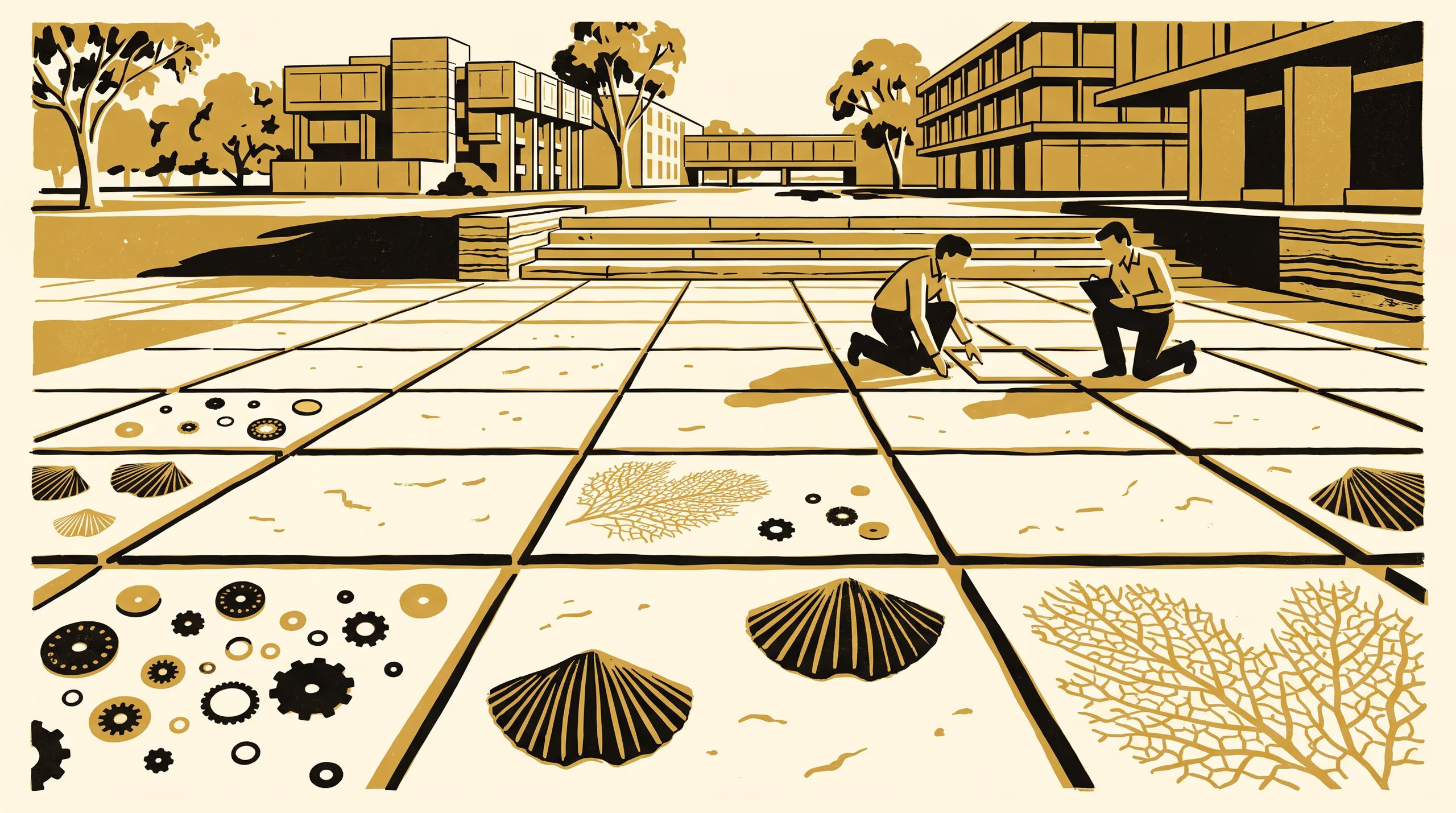
A paper from the School of Emergent Priorities counts bioclasts on the exposed faces of the 439 original limestone slabs paving one of the University's older forecourts, resolves 420 of them into seven bed groups, and orders the groups by correspondence-analysis seriation constrained by nine bed contacts in the forecourt's step and kerb risers. The order describes a shallowing-upward succession, and the floor's laying path recovers it independently and inverted (Spearman ρ = −0.96): the quarry was worked from the top down, and the bed nearest the door is the top of the section.
| Authors | Anouk Mensah , Hedvig Anyanwu |
|---|---|
| School | School of Emergent Priorities |
| Output type | Research paper |
| Published | |
| DOI | 10.5555/slop.9p7v0u |
| Pages | 5 |
| Cited by | 1 output |
| Version | 1.0 |
| Licence | CC BY 4.0 |
Cites
Cited by
Cite as
@misc{slop_9p7v0u,
  author       = {Anouk Mensah and Hedvig Anyanwu},
  title        = {A Section Laid Flat: Recovering the Quarry Bed Order of a Fossiliferous Limestone Forecourt from the Fossils in Its Slabs},
  year         = {2026},
  publisher    = {Slop University},
  doi          = {10.5555/slop.9p7v0u},
  url          = {https://slop.university/outputs/slop-paper-recovering-the-lost-9p7v0u/},
  version      = {1.0},
  note         = {Research paper},
}