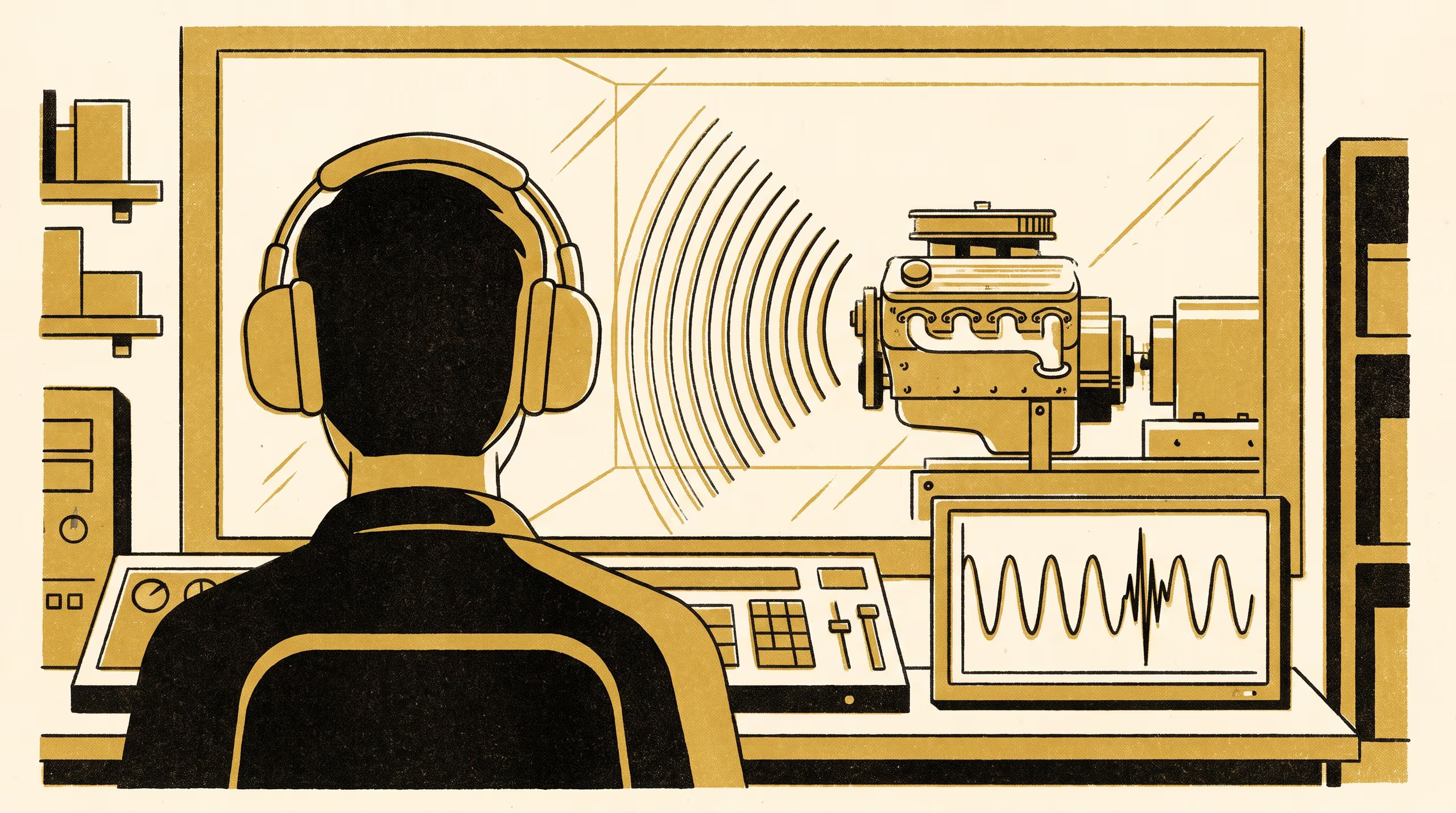
Listening, Looking and Calling Knock Onset in Engine Calibration Test Cells
A paper from the School of Continuous Improvement follows eleven calibration engineers and test-cell operators through 41 spark-timing sweeps at three facilities, finding that the call to back the spark off is usually made by ear, taught in pairs at the control-room glass, and written up afterwards in the cylinder-pressure trace. In a replay study with nine participants, cell audio and a sonified display probe both brought knock-onset calls earlier and into closer agreement than the trace alone, though the most experienced listeners turned the probe down.
| Authors | Dagny Okafor , Mirela Hanke , Edda Nwafor |
|---|---|
| School | School of Continuous Improvement |
| Output type | Research paper |
| Published | |
| DOI | 10.5555/slop.i8hjc6 |
| Pages | 6 |
| Version | 1.0 |
| Licence | CC BY 4.0 |
Cites
Cite as
@misc{slop_i8hjc6,
  author       = {Dagny Okafor and Mirela Hanke and Edda Nwafor},
  title        = {An Ear on the Cylinder: Listening, Looking and Calling Knock Onset in Engine Calibration Test Cells},
  year         = {2026},
  publisher    = {Slop University},
  doi          = {10.5555/slop.i8hjc6},
  url          = {https://slop.university/outputs/slop-paper-listening-for-knock-i8hjc6/},
  version      = {1.0},
  note         = {Research paper},
}