Homotopy-Class Chatter in Corridor Navigation and a Hysteresis Rule That Suppresses It
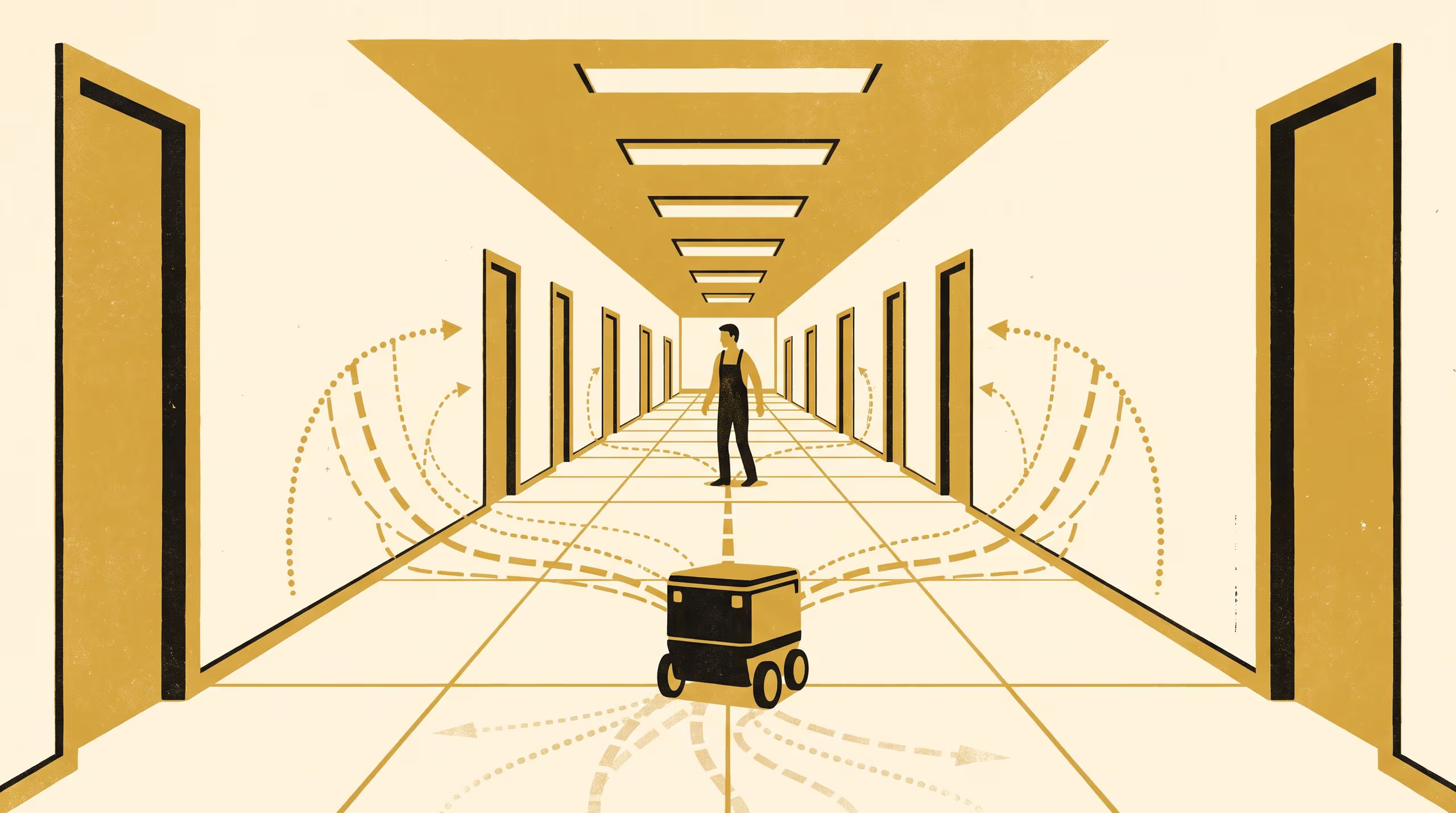
A paper from the School of Emergent Priorities and the School of Continuous Improvement measures how often a layered mobile-robot planner switches the side on which it passes a pedestrian as its replanning rate rises from 0.5 to 20 Hz, in 24,000 simulated corridor passes and 412 passes on four robots of the University's shared campus fleet. Reversals grow with the rate as a sign-change model of correlated tracker noise predicts, and a commitment rule that changes side only on a fractional cost advantage held past a minimum dwell keeps them near 0.13 per pass at every rate, at a cost of 3 to 4 cm of fifth-percentile clearance when a walker crosses late.
| Authors | Anneke Tolan , Mirela Hanke , Joost Nwosu |
|---|---|
| School | School of Emergent Priorities |
| Output type | Research paper |
| Published | |
| DOI | 10.5555/slop.jw8dzm |
| Pages | 6 |
| Version | 1.0 |
| Licence | CC BY 4.0 |
Cites
Cite as
@misc{slop_jw8dzm,
  author       = {Anneke Tolan and Mirela Hanke and Joost Nwosu},
  title        = {Replan Fast, Commit Slowly: Homotopy-Class Chatter in Corridor Navigation and a Hysteresis Rule That Suppresses It},
  year         = {2026},
  publisher    = {Slop University},
  doi          = {10.5555/slop.jw8dzm},
  url          = {https://slop.university/outputs/slop-paper-how-often-a-jw8dzm/},
  version      = {1.0},
  note         = {Research paper},
}