The lateral toes of a tridactyl ungulate lineage outlast their ground contact by millions of years
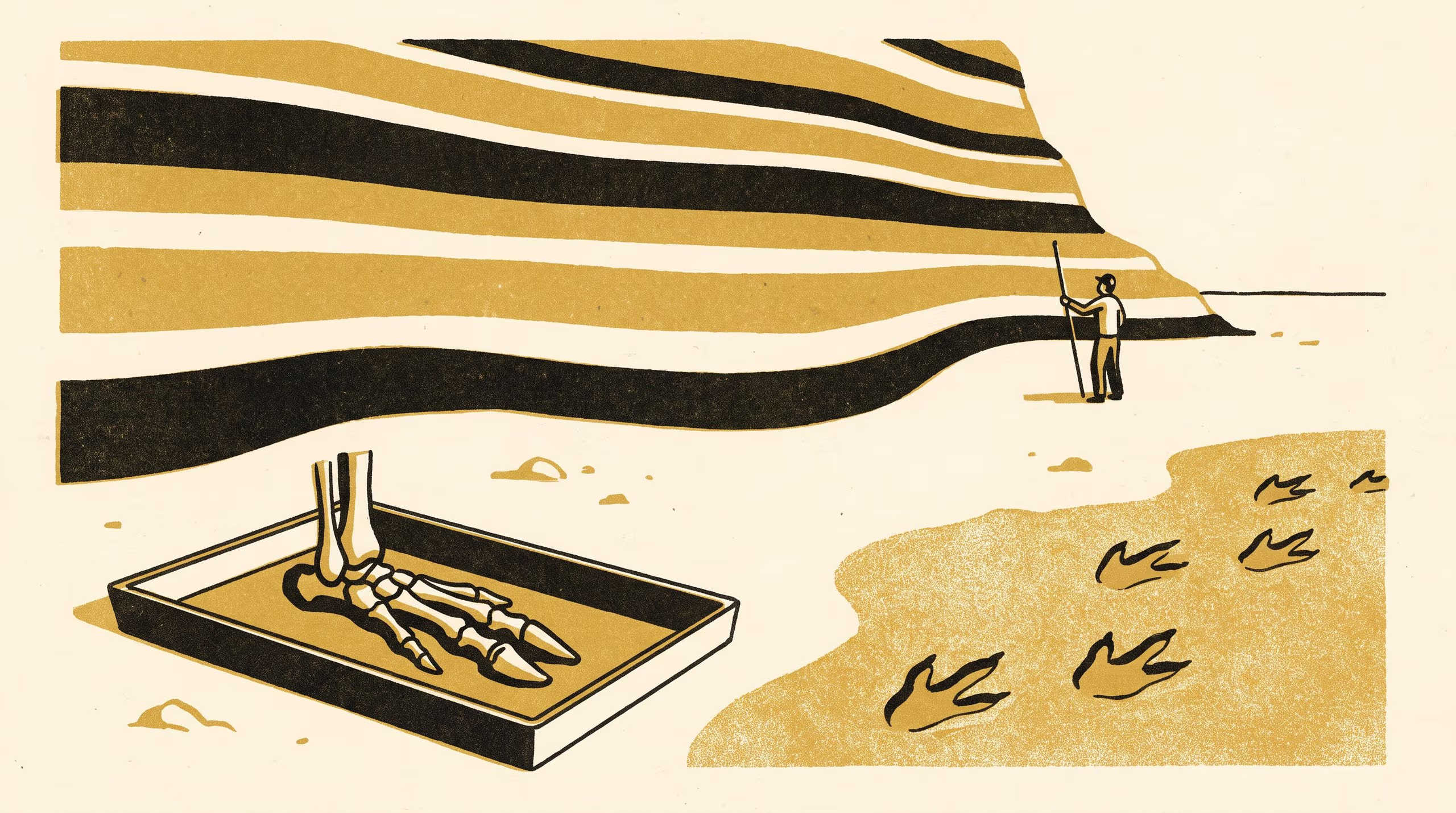
A paper from the School of Settled Matters and the School of Underlying Conditions dates the end of ground contact and the reduction of the lateral digits separately in one tridactyl ungulate lineage, sampled at fourteen horizons through a 186 m fluvial-lacustrine section. Abrasion on 198 lateral unguals ends by about 7.4 Ma and trabecular anisotropy reaches a floor near 7.0 Ma, while the lateral metapodials begin to shorten at the same time but at only 0.09 darwins, a rate that would not halve the digit's pre-loss proportion for a further five million years; trackways on a pond-margin mud show the toes still touching down on soft ground.
| Authors | Clemency Tredinnick , Ragnhild Uzoma |
|---|---|
| School | School of Settled Matters |
| Output type | Research paper |
| Published | |
| DOI | 10.5555/slop.r4jg0v |
| Pages | 5 |
| Version | 1.0 |
| Licence | CC BY 4.0 |
Cites
Cite as
@misc{slop_r4jg0v,
  author       = {Clemency Tredinnick and Ragnhild Uzoma},
  title        = {Load Lost, Digit Kept: The lateral toes of a tridactyl ungulate lineage outlast their ground contact by millions of years},
  year         = {2026},
  publisher    = {Slop University},
  doi          = {10.5555/slop.r4jg0v},
  url          = {https://slop.university/outputs/slop-paper-how-long-a-r4jg0v/},
  version      = {1.0},
  note         = {Research paper},
}