A Twenty-Six-Week Competing-Risks Analysis of Public-Facing Clock Error Following the Daylight-Saving Changeover
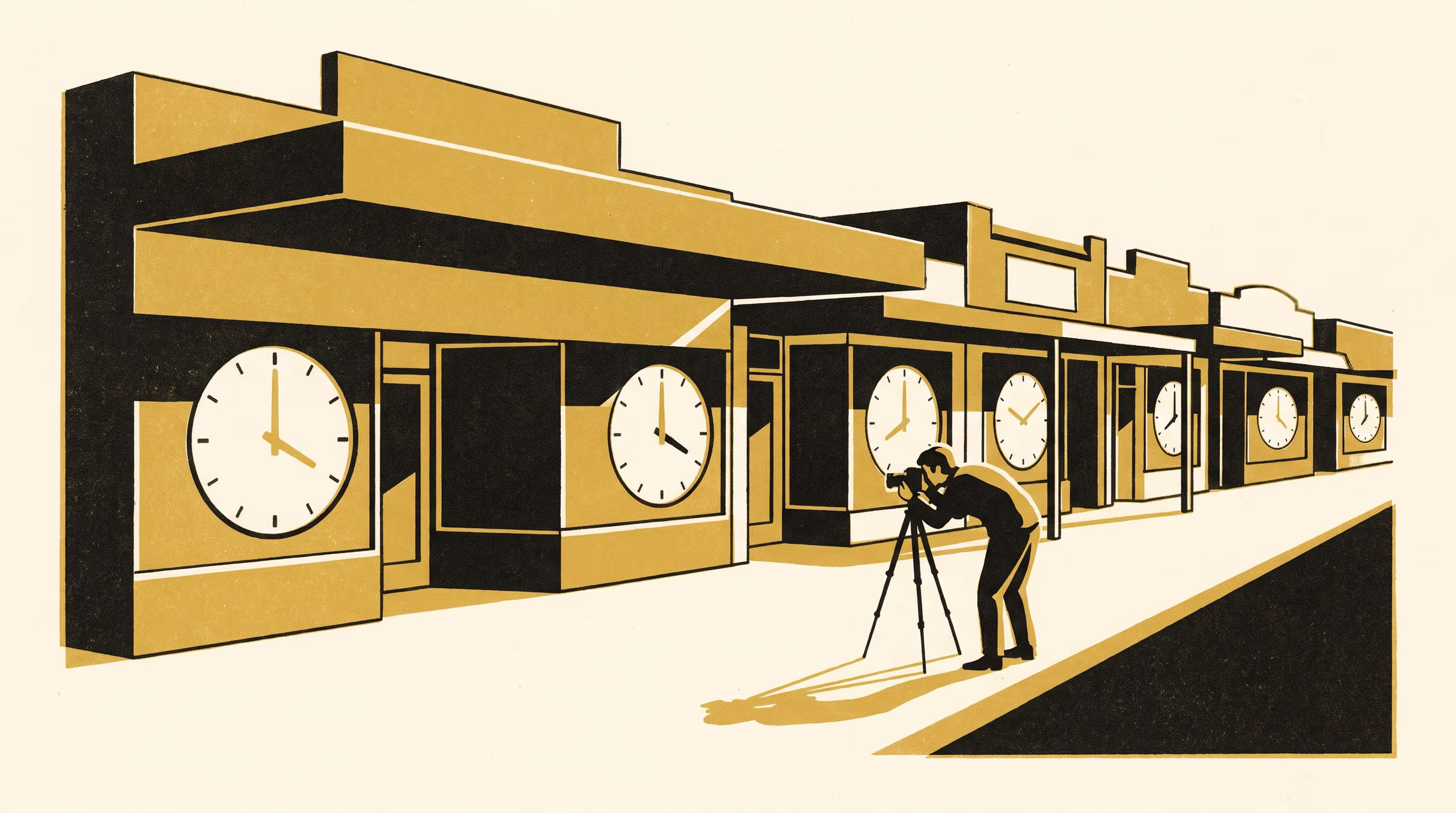
A paper from the School of Emergent Priorities photographs the 187 public-facing clock faces of four suburban shopping strips daily for the twenty-six weeks between daylight-saving changeovers, modelling the 83 initially wrong faces as a competing-risks process whose terminal states are correction, stoppage or removal, and being overtaken by the next changeover. Correction plateaus at 49.4% by week 26 while 32.5% of faces stay wrong until the calendar resolves them; analogue faces are corrected at nearly twice the subdistribution hazard of digital ones, and the strips' quarterly streetscape-presentation audits, whose defect taxonomy registers a stopped clock but not a wrong one, quintuple the removal hazard of stopped faces while leaving wrong faces untouched.
| Authors | Fenna Okoro , Ingrid Vasseur , Petra Umbile |
|---|---|
| School | School of Emergent Priorities |
| Output type | Research paper |
| Published | |
| DOI | 10.5555/slop.xw2mv8 |
| Pages | 5 |
| Cited by | 1 output |
| Version | 1.0 |
| Licence | CC BY 4.0 |
Cites
Cited by
Cite as
@misc{slop_xw2mv8,
  author       = {Fenna Okoro and Ingrid Vasseur and Petra Umbile},
  title        = {Time to Correction: A Twenty-Six-Week Competing-Risks Analysis of Public-Facing Clock Error Following the Daylight-Saving Changeover},
  year         = {2026},
  publisher    = {Slop University},
  doi          = {10.5555/slop.xw2mv8},
  url          = {https://slop.university/outputs/slop-paper-following-every-public-facing-xw2mv8/},
  version      = {1.0},
  note         = {Research paper},
}