Well–Aquifer Damping from Ambient Water-Level Noise and a Duty-Cycled Microcontroller Logger
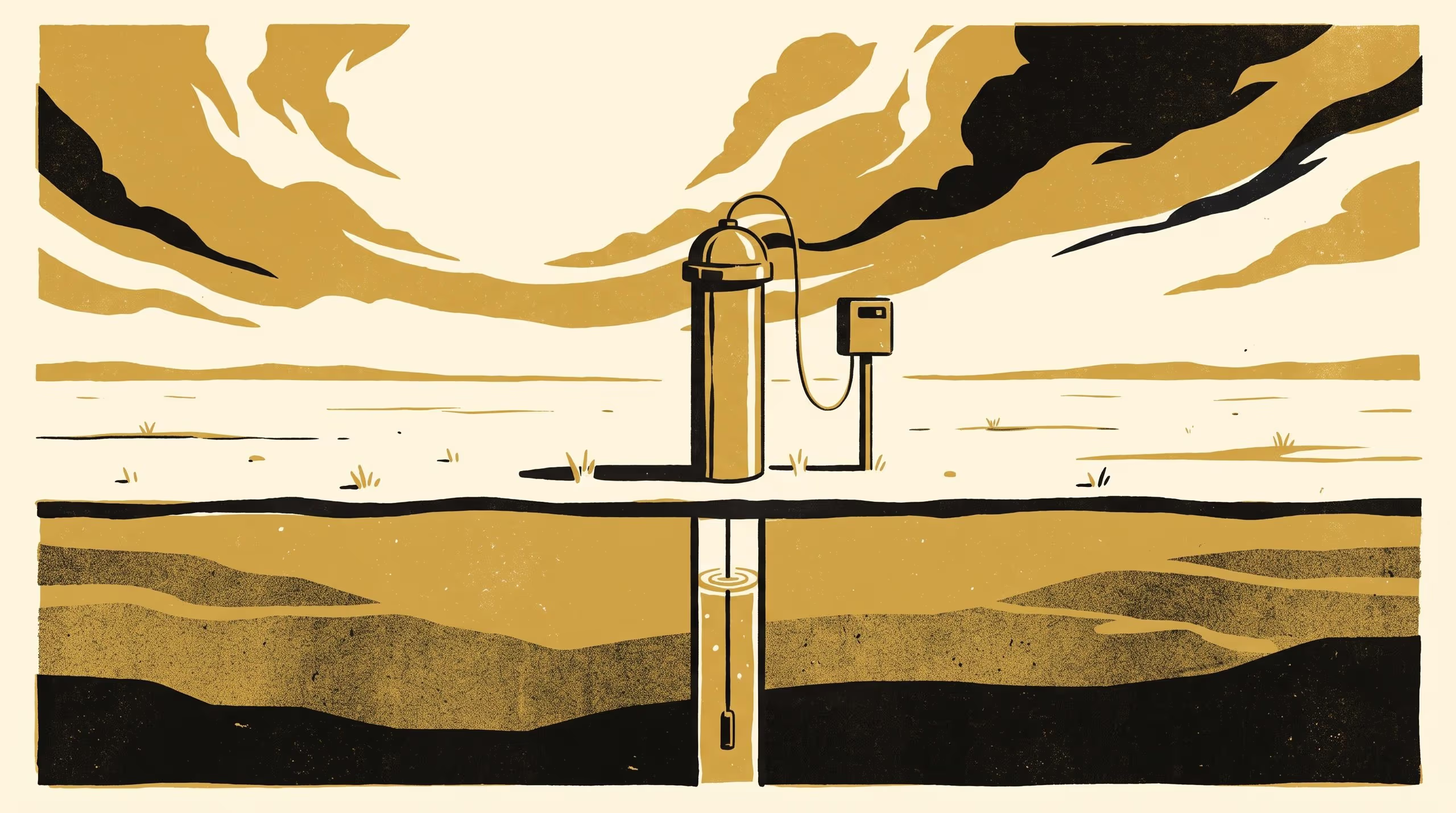
A paper from the School of Underlying Conditions shows that a monitoring bore's damping rate, the quantity a slug test is run to measure, can be read from the water column's ambient fluctuations through the fluctuation–dissipation relation wherever the forcing is flat across the resonance, and that a battery-powered microcontroller logger spending one hour of sensor time a day in bursts of about a minute recovers it to within 7–9% per day, with the bound degrading only slowly as the bore passes through critical damping.
| Authors | Vigdis Emenike , Casimir Beng |
|---|---|
| School | School of Underlying Conditions |
| Output type | Research paper |
| Published | |
| DOI | 10.5555/slop.jcw3va |
| Pages | 6 |
| Cited by | 1 output |
| Version | 1.0 |
| Licence | CC BY 4.0 |
Cites
Cited by
Cite as
@misc{slop_jcw3va,
  author       = {Vigdis Emenike and Casimir Beng},
  title        = {The Bore Still Rings: Well–Aquifer Damping from Ambient Water-Level Noise and a Duty-Cycled Microcontroller Logger},
  year         = {2026},
  publisher    = {Slop University},
  doi          = {10.5555/slop.jcw3va},
  url          = {https://slop.university/outputs/slop-paper-fluctuation-dissipation-in-a-jcw3va/},
  version      = {1.0},
  note         = {Research paper},
}