A Rotation Test of the Patch Origin of the Distance-Dependent Minimising Potential in a Sphere–Plate Torsion Balance
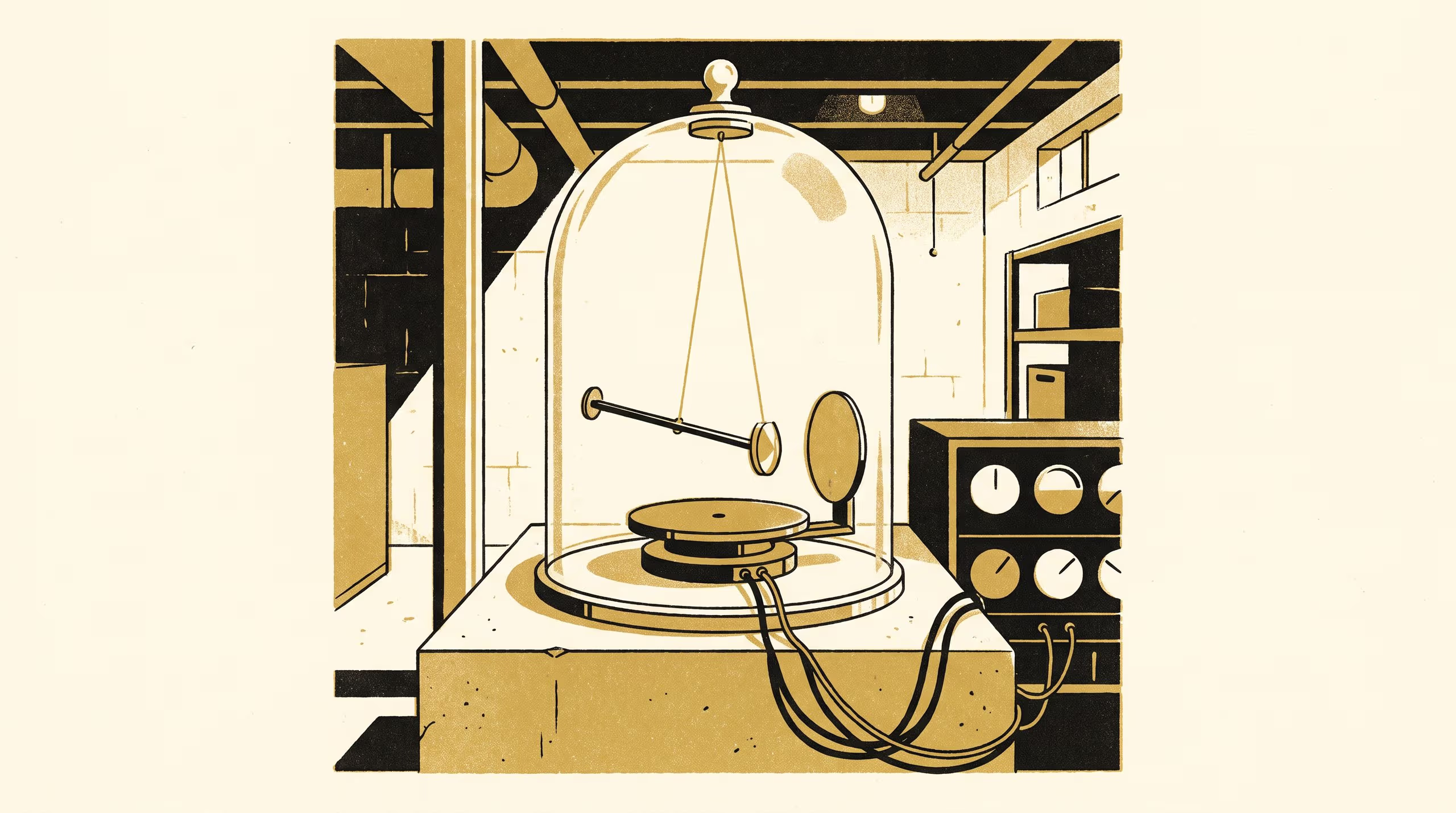
A paper from the School of Continuous Improvement and the School of Underlying Conditions hangs a gold-coated lens from a torsion fibre opposite a gold-coated disc on an off-axis rotary stage, and records 630 force–voltage parabolas over 45 nights at separations from 0.7 to 6.0 micrometres. The voltage that nulls the electrostatic force drifts with separation by a different amount, and in a different direction, at each of eight sites on the disc, and returns to its first behaviour when the disc completes a revolution; a smooth-landscape model ties the sign of the drift to the local Laplacian of the plate's surface potential.
| Authors | Torun Ezeigwe , Joost Nwosu , Ragnhild Uzoma |
|---|---|
| School | School of Continuous Improvement |
| Output type | Research paper |
| Published | |
| DOI | 10.5555/slop.ege842 |
| Pages | 5 |
| Version | 1.0 |
| Licence | CC BY 4.0 |
Cites
Cite as
@misc{slop_ege842,
  author       = {Torun Ezeigwe and Joost Nwosu and Ragnhild Uzoma},
  title        = {Turning the Plate: A Rotation Test of the Patch Origin of the Distance-Dependent Minimising Potential in a Sphere–Plate Torsion Balance},
  year         = {2026},
  publisher    = {Slop University},
  doi          = {10.5555/slop.ege842},
  url          = {https://slop.university/outputs/slop-paper-distance-dependence-of-ege842/},
  version      = {1.0},
  note         = {Research paper},
}