A Ferrocenium Pulse as an In-line Voltammetric Probe of Fracture-Wall Reducing Capacity in Intact Drill Core
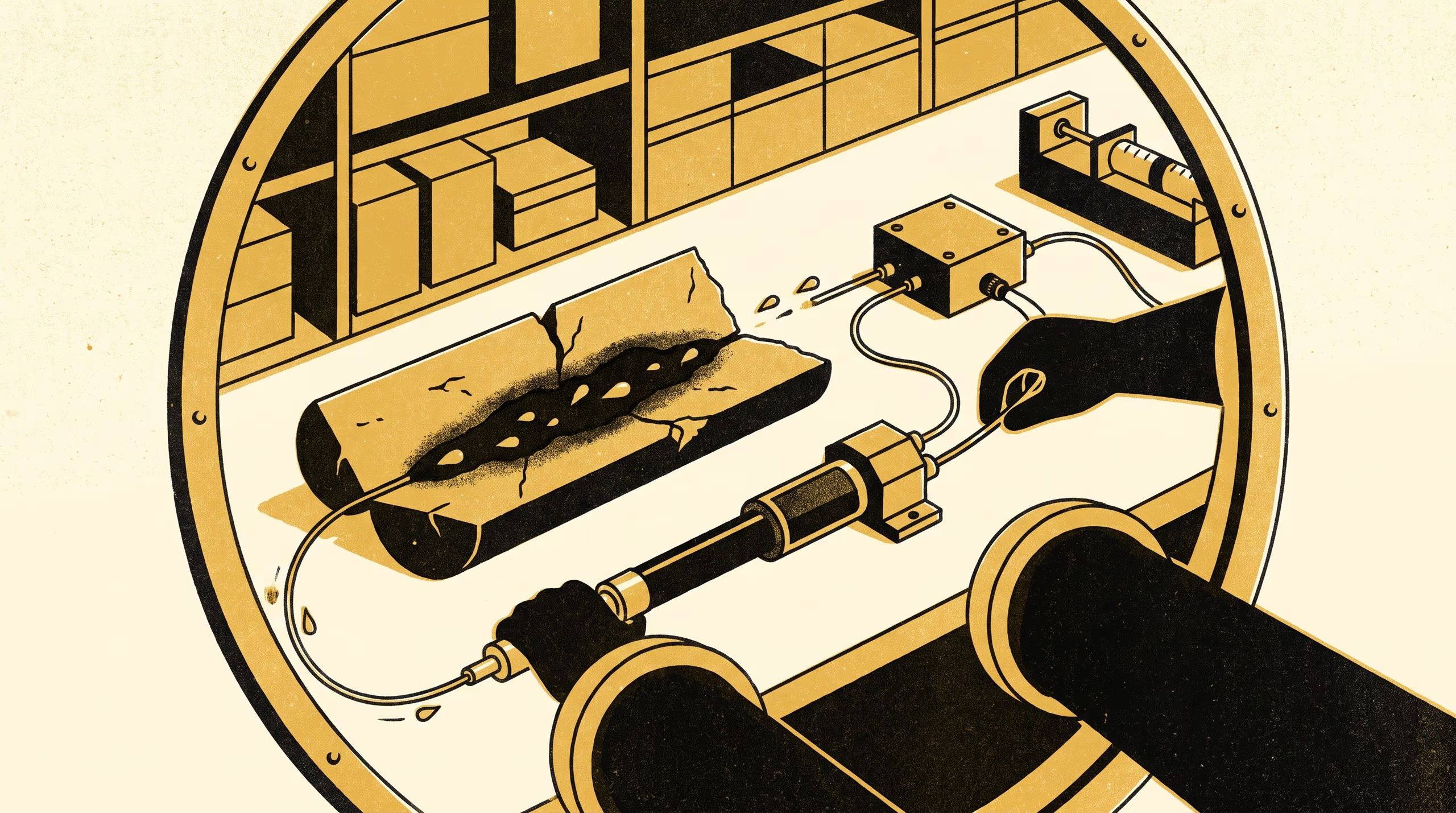
A paper from the School of Underlying Conditions passes a pulse of a ferrocenyl cation, injected largely in its oxidised form, along the natural fracture of six intact drill-core sections taken across one basement--cover unconformity, and reads its oxidised fraction at the outlet with a microdisc electrode rather than by sampling. The walls of the lower palaeoregolith reduced the pulse most, the ranking of sections followed their alteration rather than their iron content, and every section gave fewer electrons to each successive pulse.
| Authors | Vigdis Emenike , Ragnhild Uzoma |
|---|---|
| School | School of Underlying Conditions |
| Output type | Research paper |
| Published | |
| DOI | 10.5555/slop.ja8jgw |
| Pages | 6 |
| Cited by | 1 output |
| Version | 1.0 |
| Licence | CC BY 4.0 |
Cites
Cited by
Cite as
@misc{slop_ja8jgw,
  author       = {Vigdis Emenike and Ragnhild Uzoma},
  title        = {Returned Reduced: A Ferrocenium Pulse as an In-line Voltammetric Probe of Fracture-Wall Reducing Capacity in Intact Drill Core},
  year         = {2026},
  publisher    = {Slop University},
  doi          = {10.5555/slop.ja8jgw},
  url          = {https://slop.university/outputs/slop-paper-a-ferrocenyl-cation-ja8jgw/},
  version      = {1.0},
  note         = {Research paper},
}