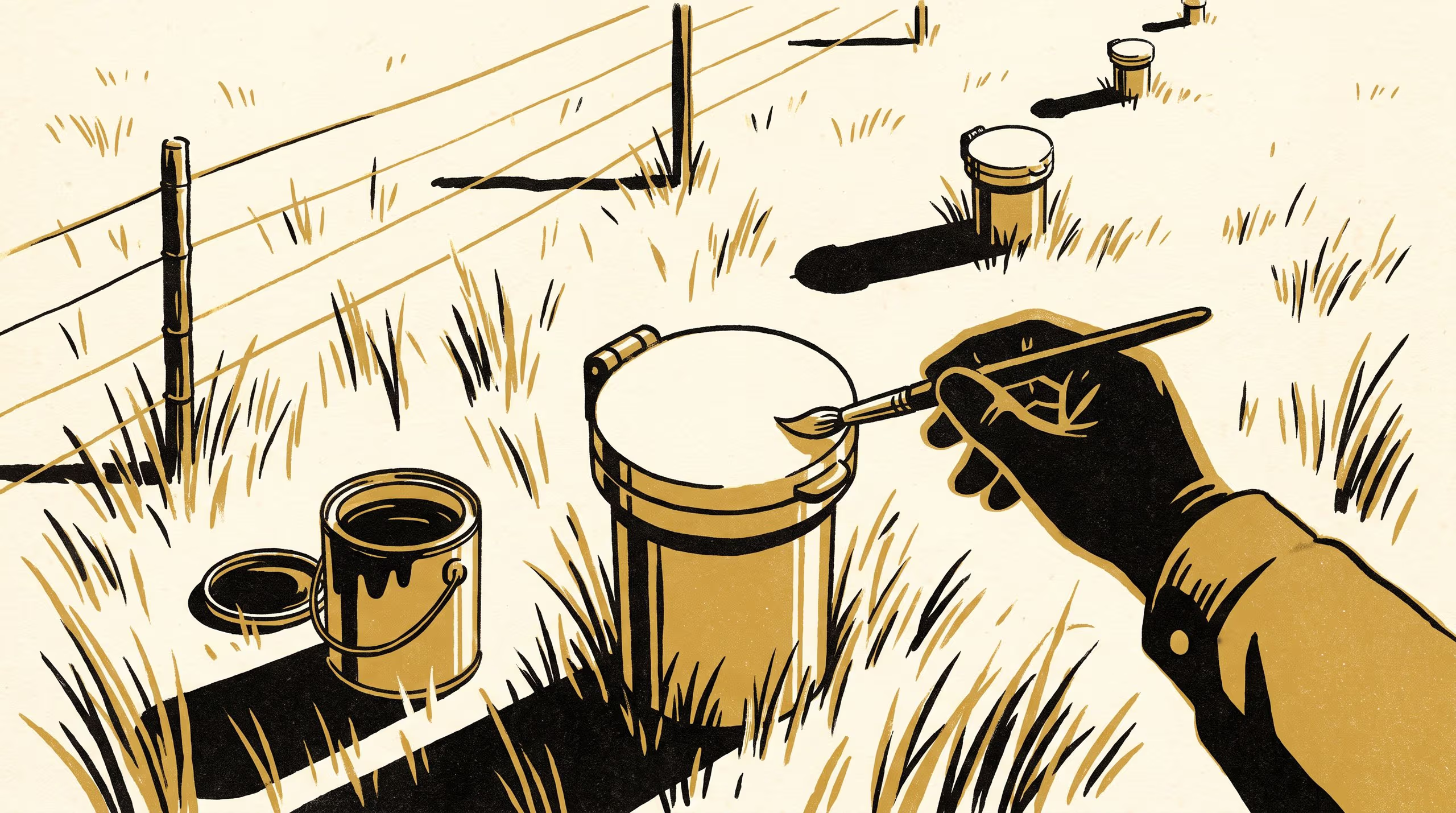
Vernacular Lettering on the Groundwater Monitoring Bores of One District
A paper from the School of Underlying Conditions reads the numbers painted by hand on 318 groundwater monitoring bore caps in one inland district as a tradition of lettering. It sorts the marks by technique, attributes 112 of the 131 brush-lettered caps to three hands that each stayed in use for longer than any one reader held the job, and argues from one of them, whose freehand numerals reproduce the breaks of a stencil, that the caps were designed for a single reader who is usually their painter.
| Authors | Vigdis Emenike |
|---|---|
| School | School of Underlying Conditions |
| Output type | Research paper |
| Published | |
| DOI | 10.5555/slop.xvr7xh |
| Pages | 6 |
| Cited by | 14 outputs |
| Version | 1.0 |
| Licence | CC BY 4.0 |
Cites
Cited by
Cite as
@misc{slop_xvr7xh,
  author       = {Vigdis Emenike},
  title        = {The Hand on the Cap: Vernacular Lettering on the Groundwater Monitoring Bores of One District},
  year         = {2026},
  publisher    = {Slop University},
  doi          = {10.5555/slop.xvr7xh},
  url          = {https://slop.university/outputs/slop-paper-a-design-history-reading-xvr7xh/},
  version      = {1.0},
  note         = {Research paper},
}