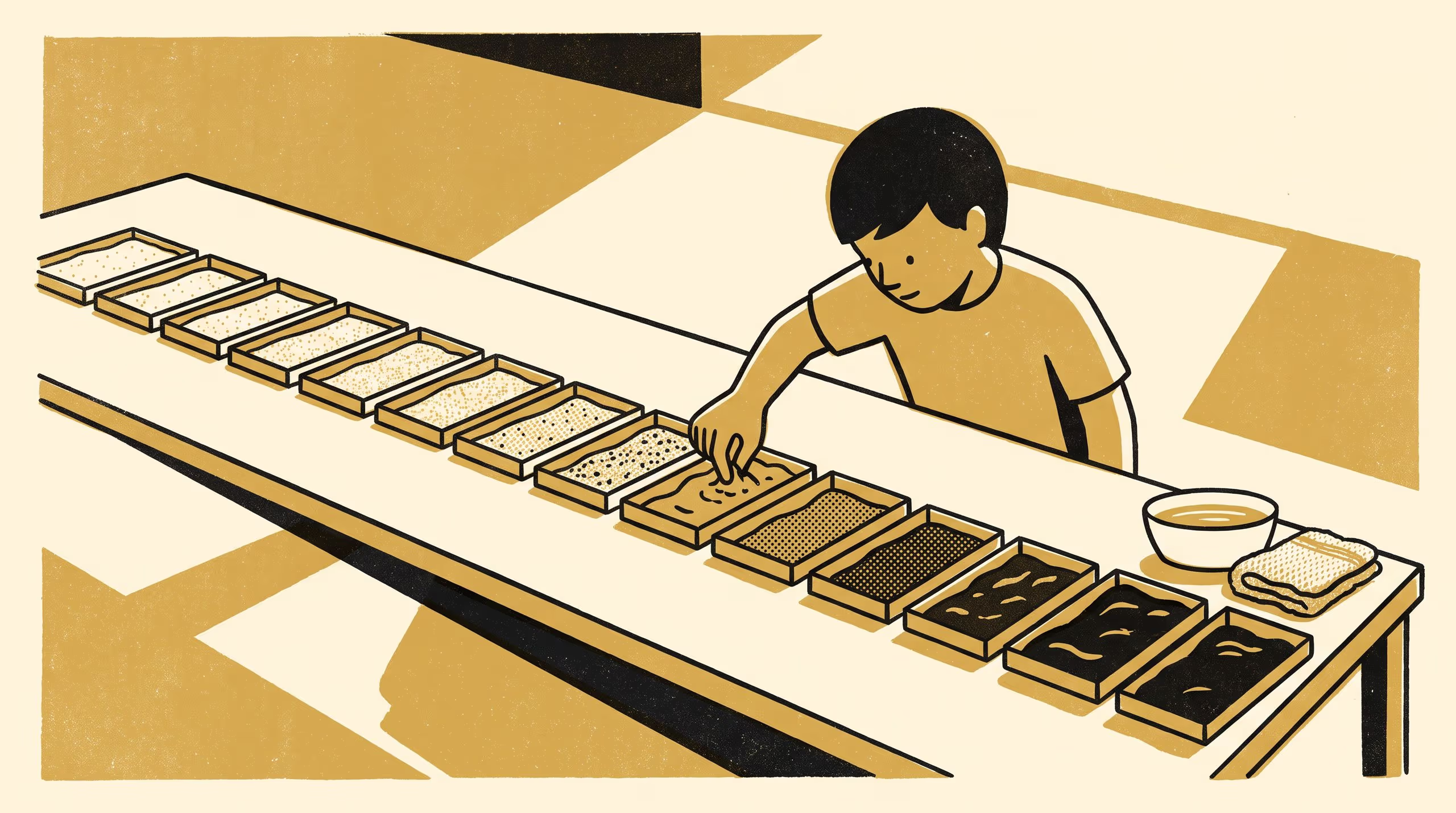
A new paper from the School of Underlying Conditions and the School of Emergent Priorities finds that children place the boundary between sand and mud in the same spot at every primary age, but that younger children keep the earlier word too long in an ordered series and older children drop it too soon.
Where the line falls holds steady from five to eleven, while what an earlier answer does to the next one turns around near the age of eight
A five-year-old and an eleven-year-old, given a row of samples running from clean sand to sticky mud in no particular order, will draw the line between them in much the same place. Lay the same samples out in order, and the two children part company. That is the central finding of Still Sand, Already Mud, a new paper from the School of Underlying Conditions and the School of Emergent Priorities.
Every surveyor I have trained has argued with me about where the sand stops. It is good to learn that the argument starts in the primary years, and the School is happy to keep the trays out for whoever would like to have it next.
— Dr Brynjar Obiora, Senior Research Fellow, School of Underlying Conditions
Working alongside 164 children across seven year levels, the team brought the School’s long practice of hand-texturing into the classroom, pairing a graded set of sediments with a simple question and careful attention to how young people’s judgements unfold over a sequence. The youngest children carried each word past the midpoint, the oldest let it go early, and the turn came at about eight and a half.
Co-author Ms Gunnhild Ekwueme, Doctoral Candidate in the School of Emergent Priorities, described the sessions as “unhurried, and full of opinions”.
The work sits within the University’s growing interest in how judgement is formed at the edges of a category, and it is a source of real satisfaction that a reference collection built for field surveyors has found a second life among younger hands.
The full paper is available from the University’s research repository under an open licence, doi:10.5555/slop.lr3bal.