The Development of Order Effects in Children's Categorisation of a Graded Sediment Series
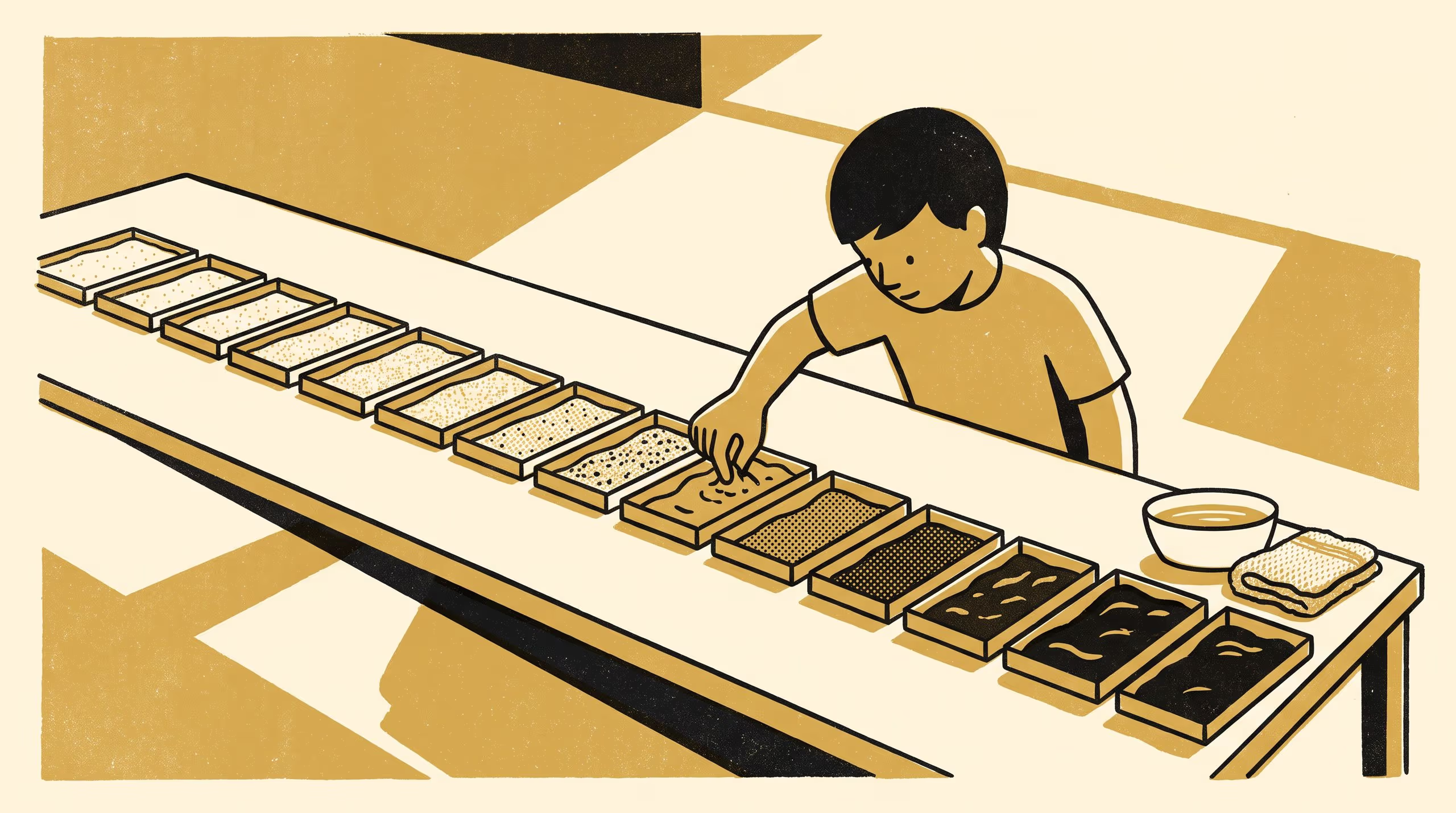
A paper from the School of Underlying Conditions and the School of Emergent Priorities asks 164 children in Foundation to Year 6 of two primary schools to call fifteen moist sediment samples, graded from 4% to 88% fines, sand or mud, in random, ascending and descending order. The unordered boundary sits near 46% fines at every age, but the order effect reverses: the youngest children hold the earlier word 2.7 steps too long, Year 6 children give it up 1.2 steps early, and the sign changes at about 8.6 years.
| Authors | Brynjar Obiora , Gunnhild Ekwueme |
|---|---|
| School | School of Underlying Conditions |
| Output type | Research paper |
| Funding | Indicator Stewardship Seed Fund: Calibrating Each New Surveyor's Fingers Against a Shelf of Soils of Known Texture ( $312,847) |
| Published | |
| DOI | 10.5555/slop.lr3bal |
| Pages | 6 |
| Version | 1.0 |
| Licence | CC BY 4.0 |
Cites
Cite as
@misc{slop_lr3bal,
  author       = {Brynjar Obiora and Gunnhild Ekwueme},
  title        = {Still Sand, Already Mud: The Development of Order Effects in Children's Categorisation of a Graded Sediment Series},
  year         = {2026},
  publisher    = {Slop University},
  doi          = {10.5555/slop.lr3bal},
  url          = {https://slop.university/outputs/slop-paper-children-aged-five-lr3bal/},
  version      = {1.0},
  note         = {Research paper},
}