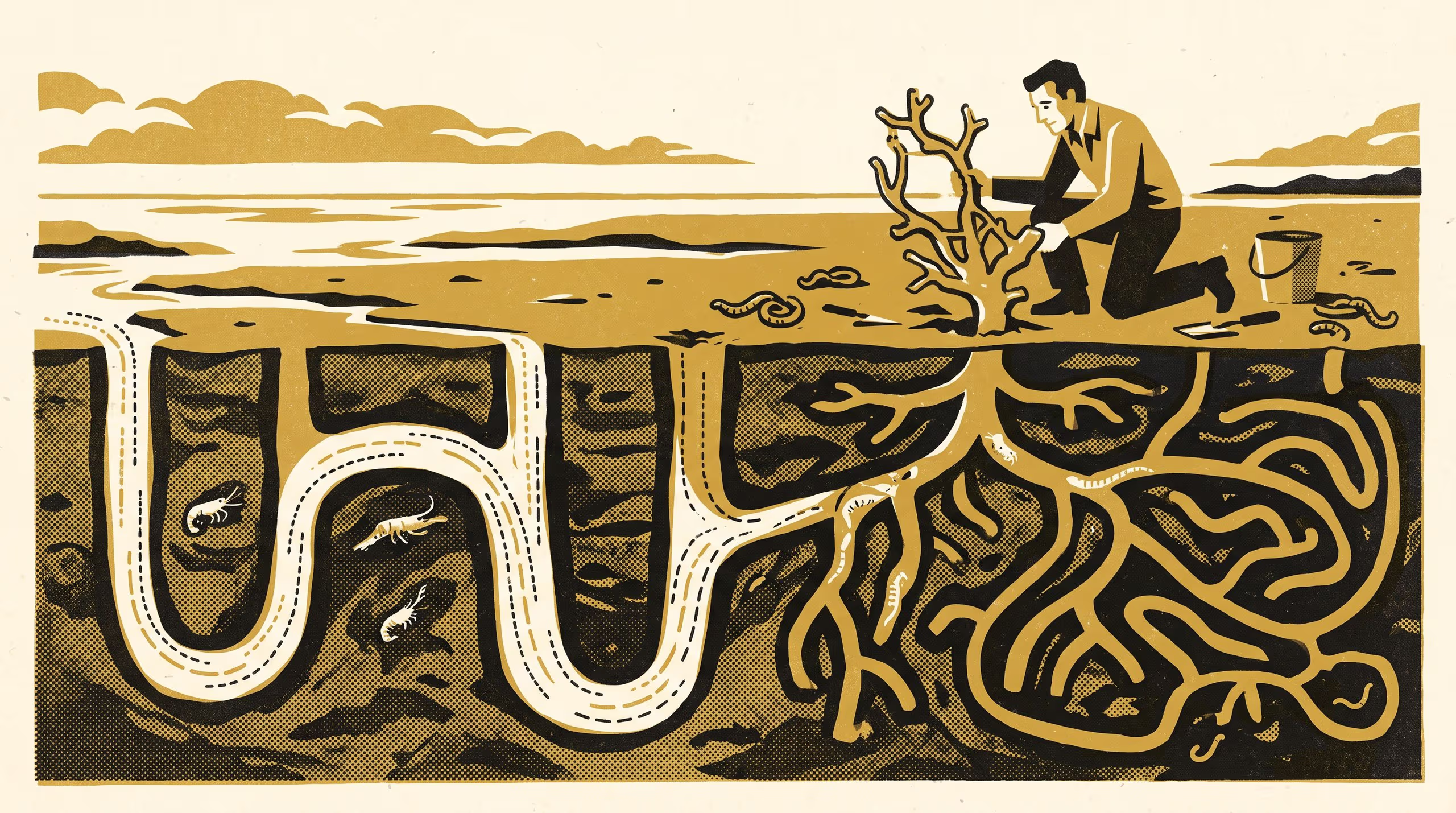
The School of Underlying Conditions has published a prospectus for students drawn to the animals that build, stir and settle the floor of the sea, and to the research across four Schools that studies them.
A new prospectus sets out the School's study of the sea floor's invertebrates, from the shell in the core to the crab at the bench
Prospective students wondering what an earth sciences school might want with a worm now have their answer in print. The Seabed Has Tenants, a new prospectus from the School of Underlying Conditions, invites them to study the marine invertebrates that make the ground beneath the sea.
The brochure is built around four strands of work: shells read in cores, burrowing animals in the mud, larvae settling on panels and piles, and physiology at the bench. Each strand connects field practice to the School’s established strengths in core, profile and survey, and each is anchored in research the University has already published, five studies of which appear in the prospectus by title and DOI.
I have always told students that a boundary is something you draw. On a mudflat a great many of them were drawn long before you arrived, by animals with no interest in your map, and I would like our students to meet the people who drew them.
— Dr Brynjar Obiora, Senior Research Fellow, School of Underlying Conditions
The University regards the prospectus as one more way of bringing the School’s attention to the ground out past the low-water mark. Associate Professor Ragnhild Uzoma, Lead of the Basement Relations Group, said she was pleased to see the core shed in a brochure at last. “It is where most of our students first realise how much of the record is alive, or was once, and we are happy to show it to anyone willing to hold a brush.”
The full brochure is available from the University’s research repository under an open licence, doi:10.5555/slop.a1eufh.