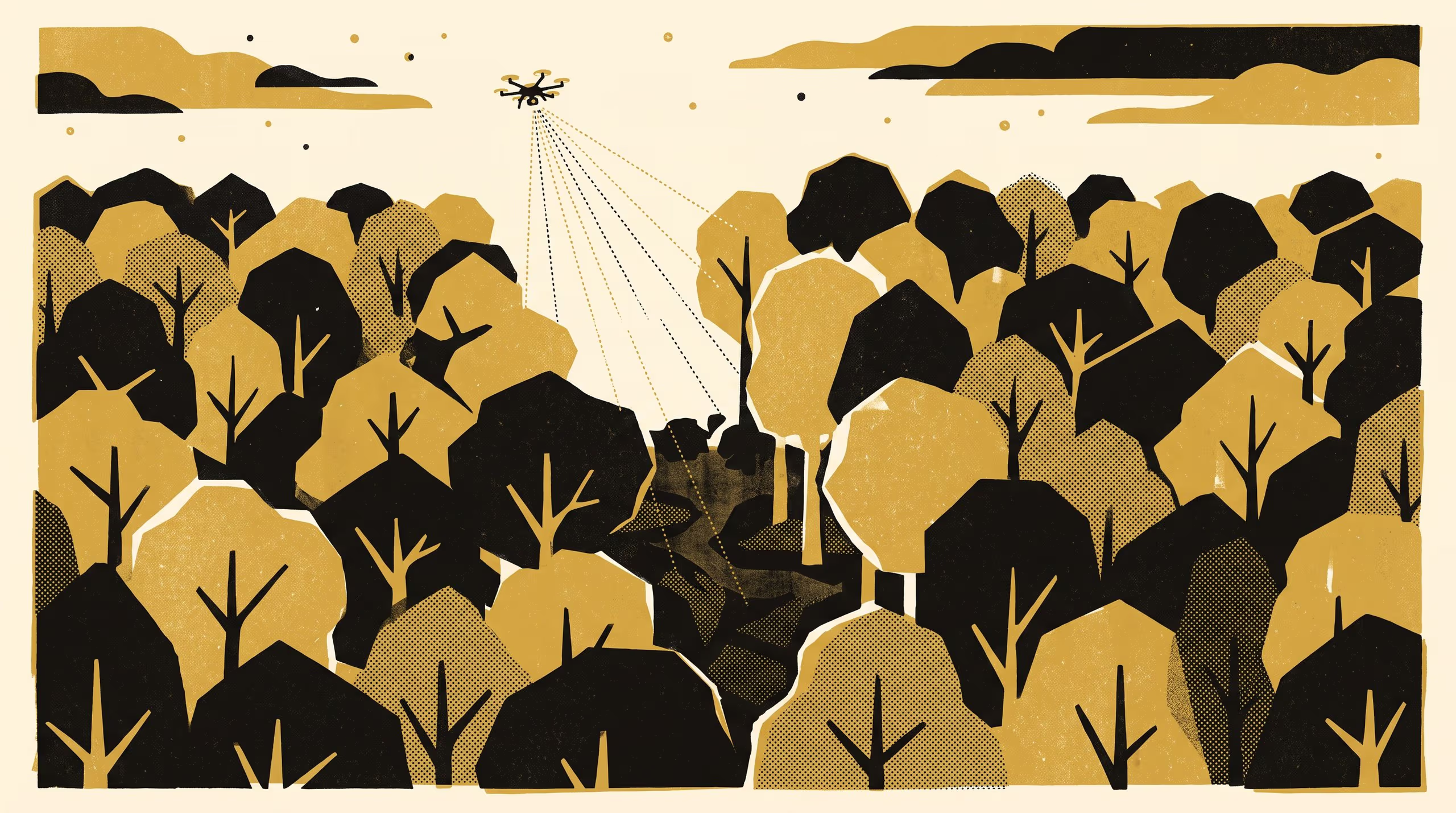
A new research poster from the School of Settled Matters follows a drone-borne single-photon lidar across nine flights and finds that the ground beneath a closed canopy comes back far more clearly once the sun has gone down.
A School of Settled Matters poster flies a single-photon lidar drone over one closed canopy through a full day and night
Nine flights, one stand of closed forest and a little over a day of waiting sit behind The Ground After Dark, the newest research poster from the School of Settled Matters. It is the work of Dr Odalys Penhallow with Associate Professor Casimir Beng of the School of Continuous Improvement and Associate Professor Ragnhild Uzoma of the School of Underlying Conditions.
Several colleagues gave up a night’s sleep so the School could find out what the ground looks like in the dark. We are grateful to every one of them, and I expect we shall be asking again.
— Dr Odalys Penhallow, Senior Lecturer and Lead, Received Readings Group, School of Settled Matters
The team flew a drone carrying a single-photon lidar over the same forest plot from one dawn to the next. Under the densest canopy, the night flights returned around eight times as much ground as the flight at midday, and a flight begun shortly after dusk did almost as well as the one at midnight. The poster brings airborne sensing, flight scheduling and survey on the forest floor into a single account of how the hour of a measurement shapes what an instrument can see beneath a closed canopy.
The University regards the poster as a fitting addition to the cross-school collaboration it has long encouraged, in which three Schools bring their own instruments and habits to a shared question. Associate Professor Beng described the project as “a patient piece of work, and a reminder that the University is still getting to know its own equipment.”
The full poster is available from the University’s research repository under an open licence, doi:10.5555/slop.1i3smr.