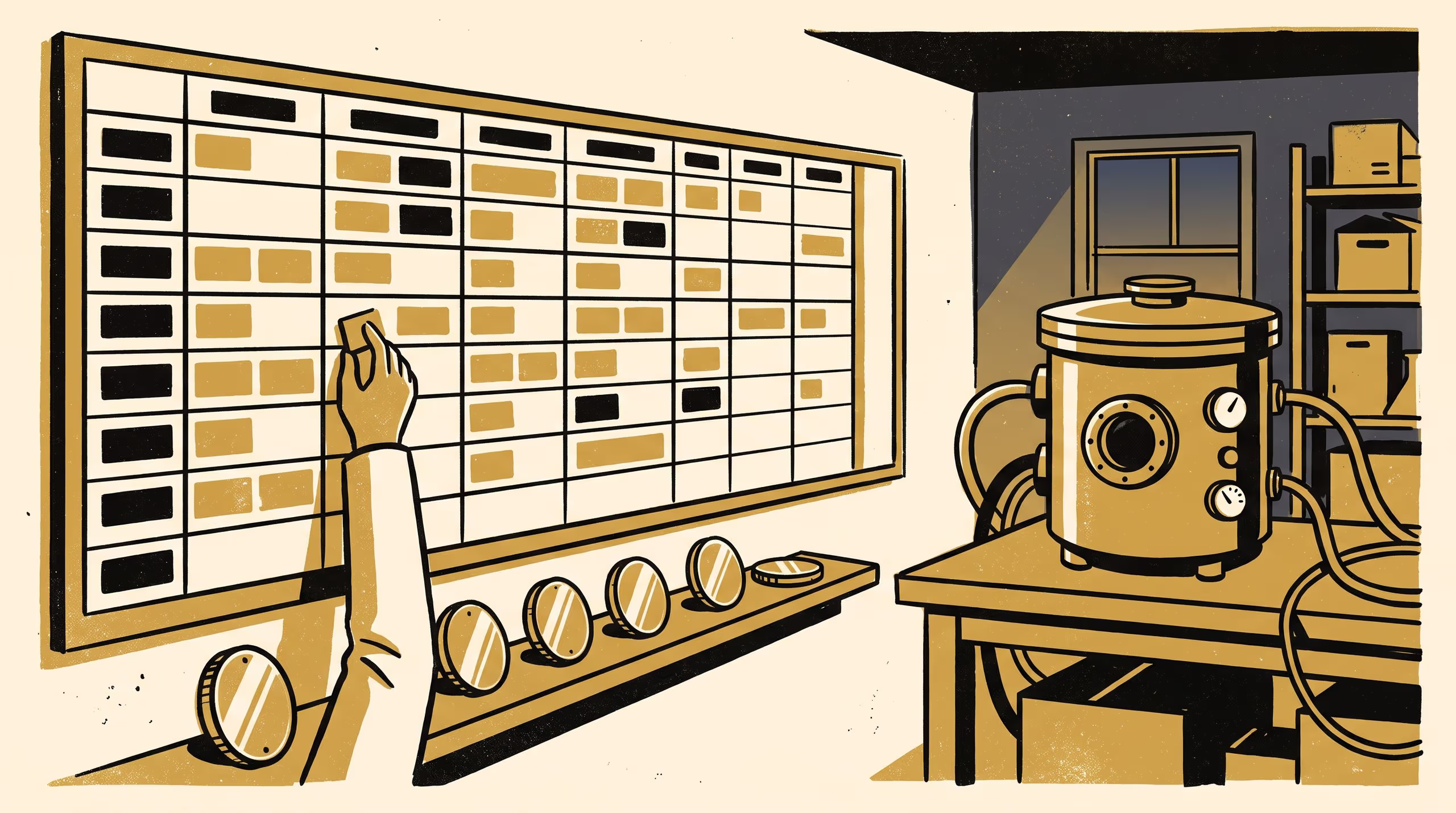
A new research poster from the School of Settled Matters models the weekly queue of a shared sputter coater as a travelling-salesman problem and finds that a better order recovers much of the time lost between runs.
Changeover time at a shared sputter coater falls by two-fifths once its runs are sequenced as well as booked
Every booking calendar knows how long a run will take. Far fewer know what that run will cost the one after it, and What the Chamber Still Carries, a research poster released today by the School of Settled Matters, sets out to answer the question for one shared sputter coater. The work is led by Dr Clemency Tredinnick with Dr Bram Ntuli of the School of Continuous Improvement and Dr Brynjar Obiora of the School of Underlying Conditions.
Scheduling is usually thought of as a question about time. This poster has persuaded the School that it is also a question about inheritance, and we are looking forward to a lively discussion of what else a shared instrument hands on.
— Dr Clemency Tredinnick, Lecturer, School of Settled Matters
The team assembled more than a year of the facility’s booking, pump-down and acceptance records into a changeover model spanning the coater’s six targets, then replayed each logged week in a better order while keeping every run inside its owner’s window. Fifty-four of 61 weeks improved, and total changeover time fell by 42%. Keeping first come, first served within each target gave back only a small share of that saving.
Dr Obiora said the study had “given the facility’s logbooks a second career”.
The School regards the poster as an early sign of its growing reach from the land register into the laboratory, and of the value of colleagues from three schools reading one set of records together.
The full poster is available from the University’s research repository under an open licence, doi:10.5555/slop.zjculo.