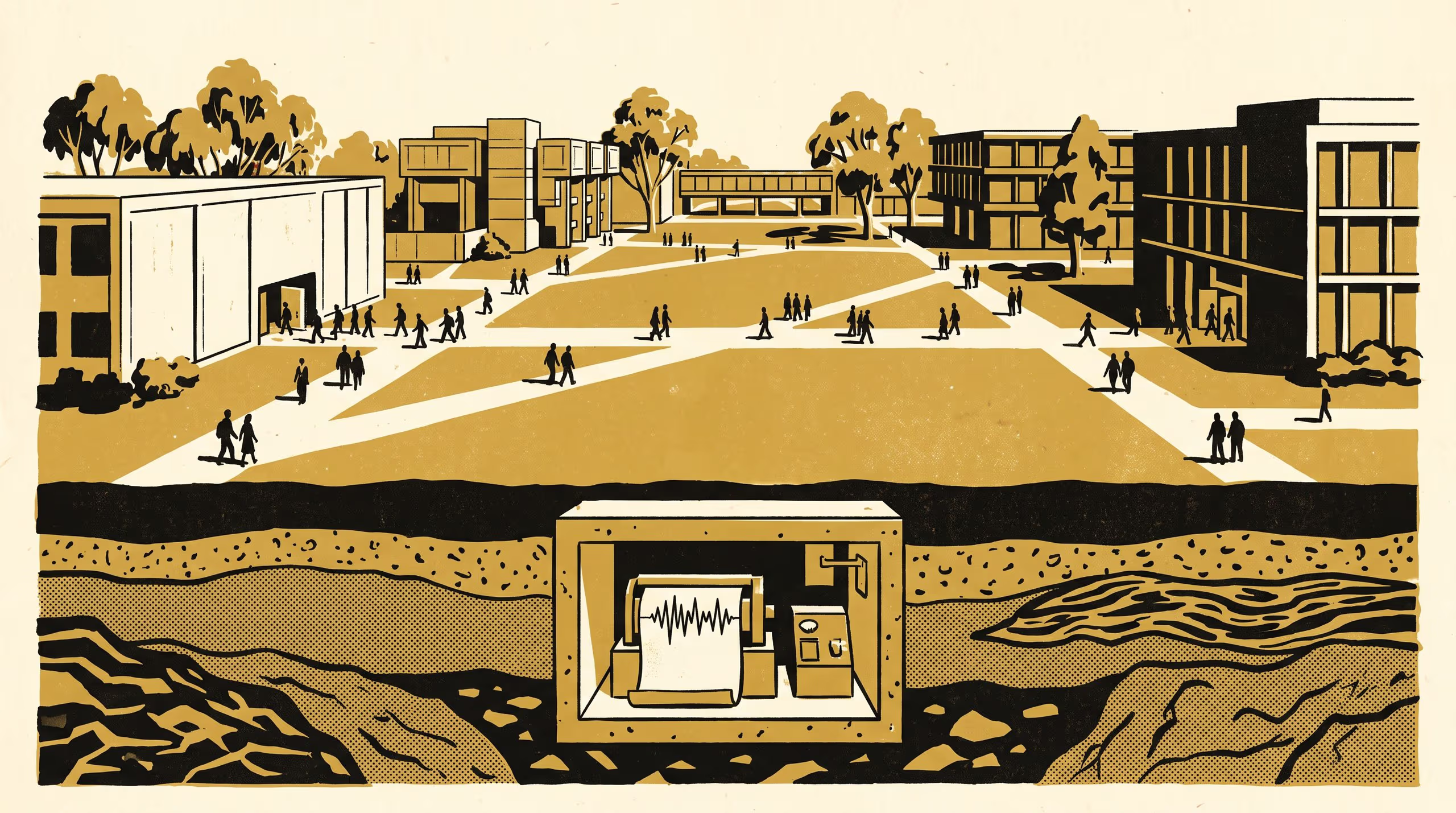
The Department of Policy Settings has answered five questions on its exposure draft to stagger the University's hourly class changeover by precinct, taken on notice by the Committee on Settings Oversight at its Spring hearings or lodged in writing after them.
Five answers on staggering the changeover by precinct cover the review behind the proposal, the new times and a seismic array beneath the campus lawns
At five minutes to every hour of the teaching week, the whole University walks somewhere else at once. The Department of Policy Settings has proposed that it stop doing so, and today it has tabled On the Hour, its written answers to the questions the Committee on Settings Oversight put on that proposal at its Spring hearings of 13 November 2026 and in the days after.
The questions came from Dr Anneke Tolan of the School of Emergent Priorities and from Dr Vigdis Emenike and Associate Professor Ragnhild Uzoma of the School of Underlying Conditions, who between them followed the changeover from the review that first examined it, through the paths it crowds, to an instrument vault beneath the lawns that has come to rely on it.
The Department is grateful to everyone who crosses the central paths at the change of the hour, and to the members who have taken such a close interest in how they do it. That interest will be carried forward as the determination is settled.
— A spokesperson for the Department of Policy Settings
In reply, the Department sets out the precinct schedule, the modelling behind it and the consultation now under way, bringing pedestrian movement, the teaching timetable and the University’s research infrastructure into a single line of sight. The bundle forms part of the Department’s continuing work to keep the University’s settings in step with the way its community actually moves.
The full answers are available from the University’s research repository under an open licence, doi:10.5555/slop.engd29.