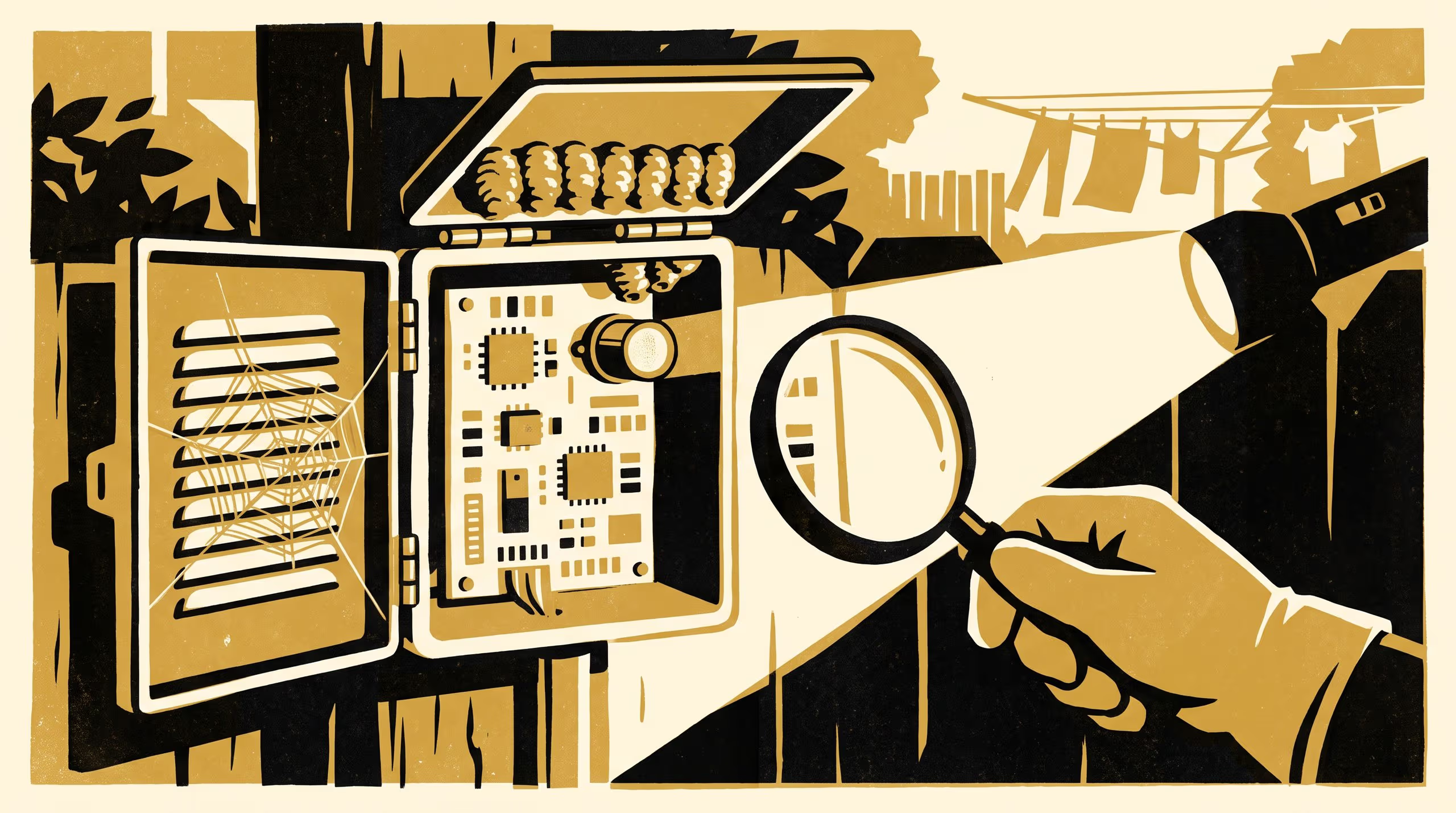
A new research poster from the School of Emergent Priorities surveys the backyard enclosures of a citizen-science air-quality network as a field ecologist would a set of nest boxes, and finds each kind of tenant leaves its own mark on the reading.
A two-season survey of 96 sensor posts finds spiders, wasps, ants and earwigs moving in, and the readings moving with them
Somebody has moved into the backyard air-quality monitor, and the School of Emergent Priorities would like to know who. Tenants of the Housing, a new research poster led by doctoral candidate Ms Ylva Ogunbanjo, brings the habits of the field survey to the small louvred boxes that a growing number of households now keep on a fence post.
Working with Dr Marit Osayande of the School of Continuous Improvement and Dr Runa Adegoke, Ms Ogunbanjo paired each open enclosure with a screened twin on the same post and returned every fortnight across two warm seasons to open the lids and record what she found. The result is a community-level account of instrument occupancy, setting web-builders, mud-nesting wasps, ants and earwigs alongside the calibration practices that had previously treated them as background.
An instrument is also a place, and places do not stay empty for long. I think of this poster as the first page of a longer field notebook, and the School will be keeping it open.
— Ms Ylva Ogunbanjo, Doctoral Candidate, School of Emergent Priorities
The poster sits comfortably within the University’s growing body of work on how instruments get along with the households and gardens around them, and it brings an ecologist’s patience to a question the sensor community has tended to approach from the bench.
Dr Osayande, Lecturer and Convenor, Living Dashboard, said the study would inform “how the University thinks about the next generation of always-on instruments, and about the neighbours they acquire.”
The full poster is available from the University’s research repository under an open licence, doi:10.5555/slop.fkyq3k.