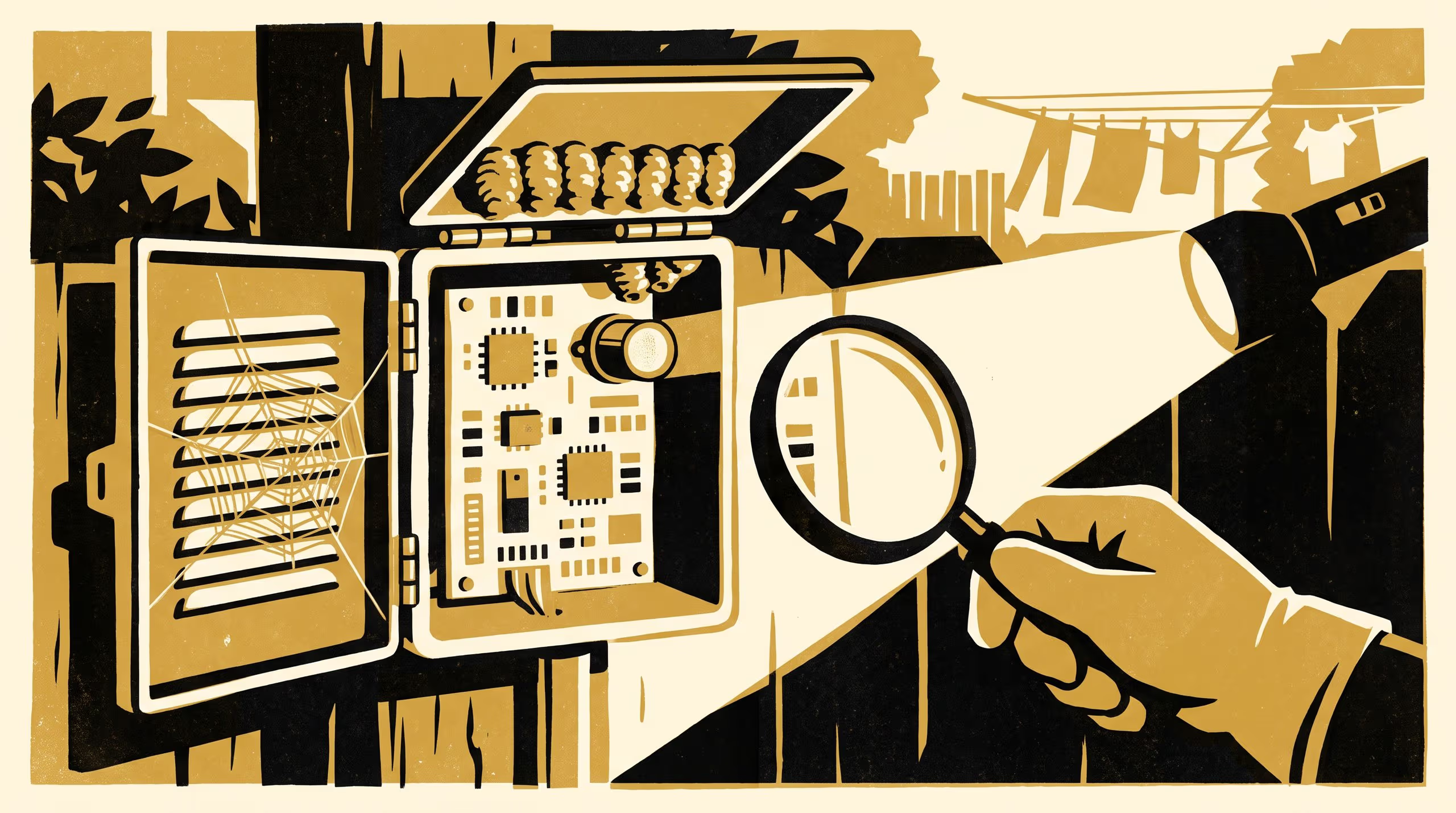
Invertebrate colonisation of backyard gas-sensor enclosures, and the drift that follows
A research poster from the School of Emergent Priorities surveys 96 backyard posts of a citizen-science NO₂ network fortnightly over two warm seasons as a field ecologist would a set of trap nests, pairing each open electrochemical enclosure with a mesh-screened twin. It records 112 colonisations of the open enclosures by web-building spiders, mud-nesting wasps, ants and earwigs, finds that the open sensor's reading shifts by guild (about −6 ppb under a wasp nest, −2.7 ppb under a web, +1.5 ppb under an ant nest), and notes that the network's automated quality checks flagged nine of the 112.
| Authors | Ylva Ogunbanjo , Marit Osayande , Runa Adegoke |
|---|---|
| School | School of Emergent Priorities |
| Output type | Research poster |
| Funding | Indicator Stewardship Seed Fund: Keeping the Laundromat's Available-Machine Board Honest After the Regulars Stop Reporting ( $158,439) |
| Published | |
| DOI | 10.5555/slop.fkyq3k |
| Pages | 1 |
| Version | 1.0 |
| Licence | CC BY 4.0 |
Cites
Cite as
@misc{slop_fkyq3k,
  author       = {Ylva Ogunbanjo and Marit Osayande and Runa Adegoke},
  title        = {Tenants of the Housing: Invertebrate colonisation of backyard gas-sensor enclosures, and the drift that follows},
  year         = {2026},
  publisher    = {Slop University},
  doi          = {10.5555/slop.fkyq3k},
  url          = {https://slop.university/outputs/slop-poster-tenants-of-the-fkyq3k/},
  version      = {1.0},
  note         = {Research poster},
}