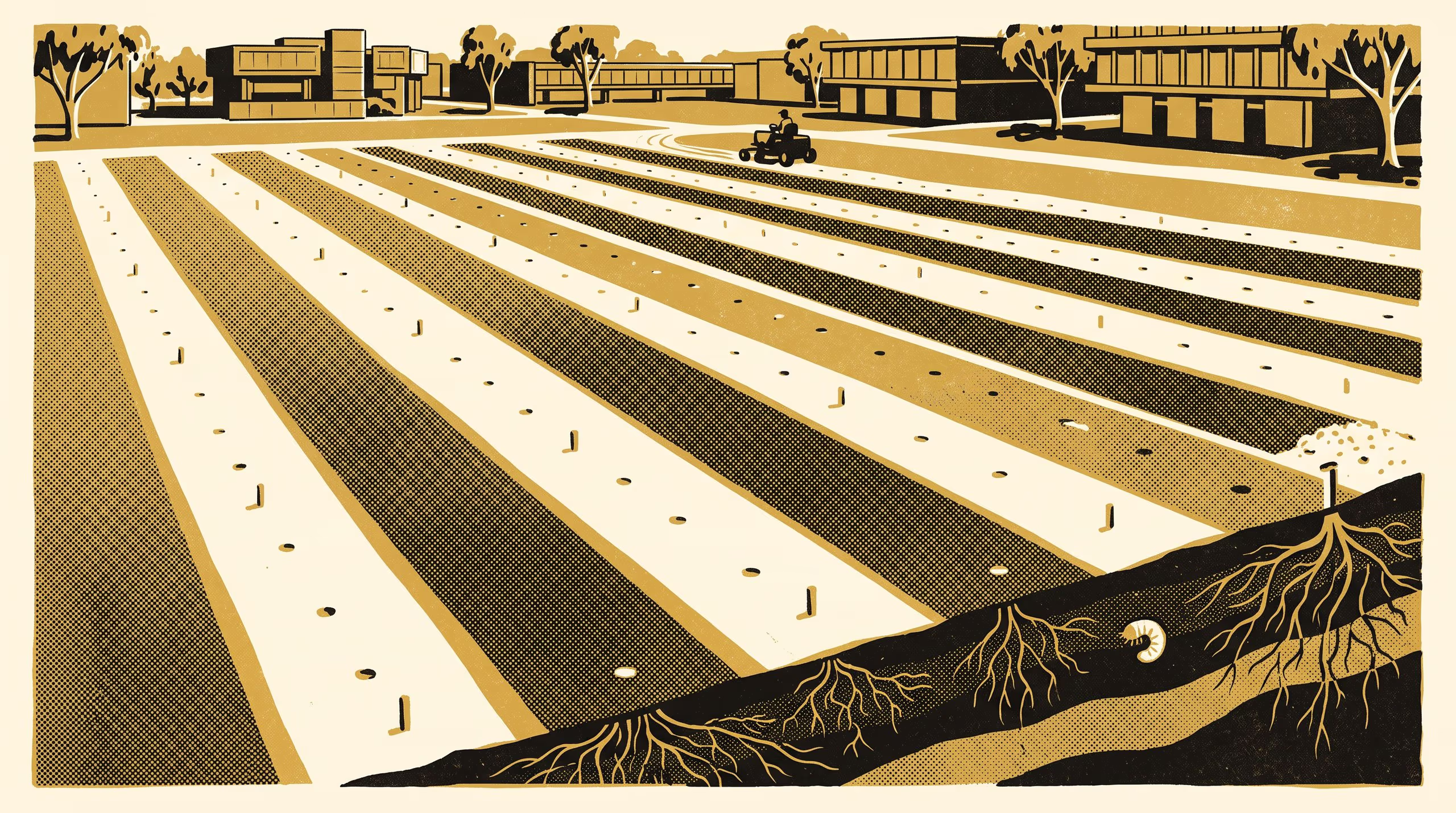
A new paper follows a single application of an insect-killing soil fungus to part of a campus lawn through three years of soil surveys, and finds the released strain persisting where it was put and spreading along the lanes the ride-on mower follows.
Three years after one application to a corner of a campus lawn, the released strain is still there, and has spread the way the lawn is mown
The School of Emergent Priorities has made its name on the things that carry on after the occasion for them has passed, and its newest paper takes that interest below the turf. Down the Mowing Lanes, by doctoral candidate Mr Tove Ilesanmi with Dr Brynjar Obiora of the School of Underlying Conditions, returns to a University lawn where a beneficial soil fungus was applied once, against root-feeding grubs, in the spring of 2022.
Over three annual surveys and 792 soil cores, the team combined insect baiting with genetic fingerprinting to separate the released strain from the fungi already living in the lawn. The strain remains in the treated block. Beyond it, the paper reports, it has moved in one direction only: along the lanes the ride-on mower follows, out to the far end of the lawn where the mower turns, and on the mower itself.
A lawn looks like the most finished thing on a campus, and it turns out to be keeping its own records. It has been a pleasure to bring the School’s way of looking to a stretch of ground that most of us only ever walk across on the way to somewhere else.
— Mr Tove Ilesanmi, Doctoral Candidate, School of Emergent Priorities
Dr Obiora described the soil survey as “a good season’s work in the University’s own front yard”.
The paper extends the University’s research footprint to the grounds it stands on, and the University is pleased to see its lawns join the list of places where its scholarship is done.
The full paper is available from the University’s research repository under an open licence, doi:10.5555/slop.fu4ux4.