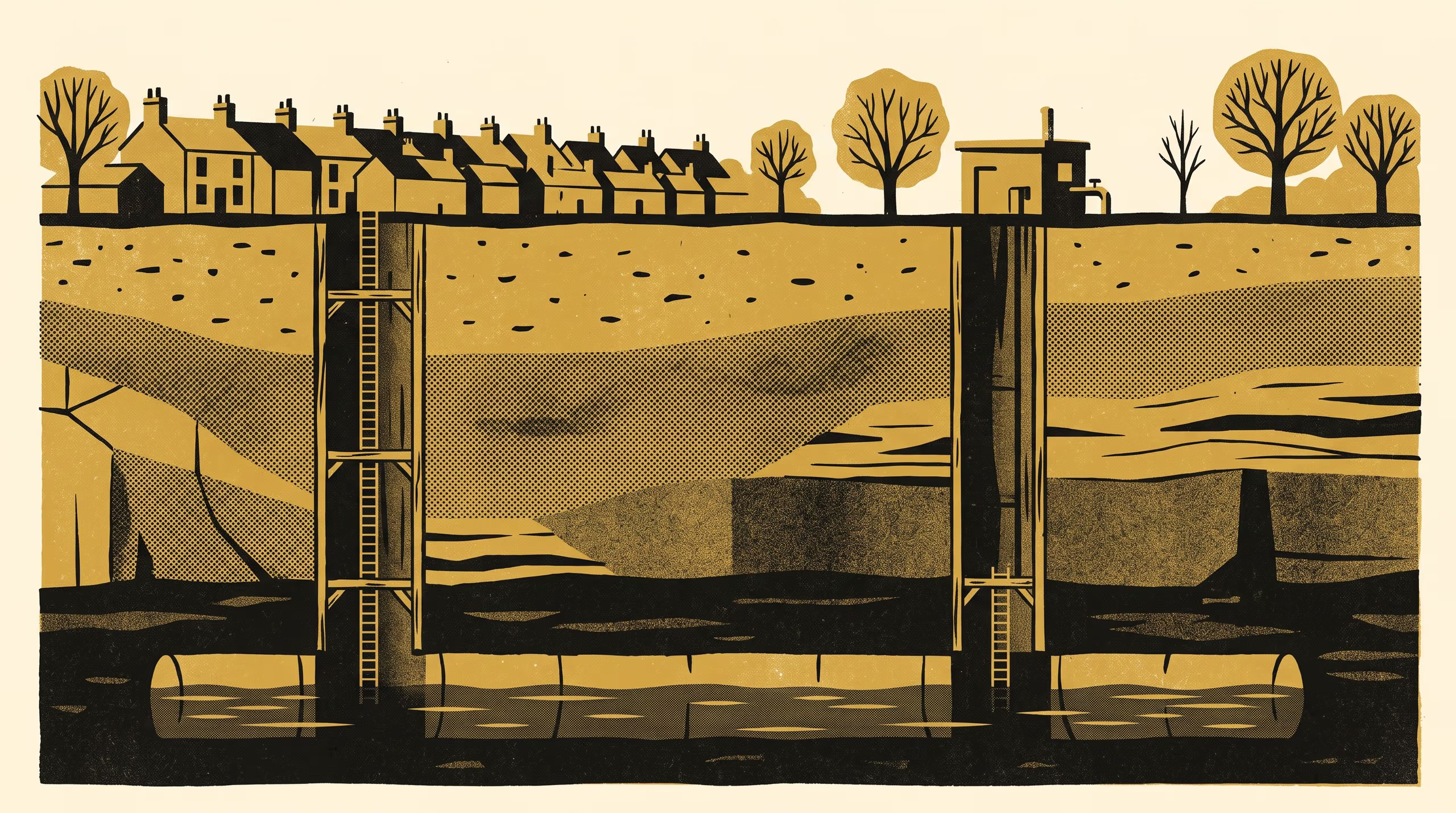
A new paper from the School of Underlying Conditions follows four heating seasons at a heat scheme drawing on a closed colliery's flooded workings, and finds that the cooled water it returned came back along a former haulage roadway well inside the scheme's design life.
Four winters at a two-shaft scheme beneath a small town find the returned water took the long way round, and arrived early
Four winters is a long time to keep a sampler running in a pumphouse, and the people who kept ours running did it with more care than the instrument ever asked of them. We are glad of the record, and gladder of the company.
— Associate Professor Ragnhild Uzoma, Lead, Basement Relations Group
With those thanks, Associate Professor Ragnhild Uzoma and Dr Vigdis Emenike of the School of Underlying Conditions introduce Cold by the Haulage Road, a paper on a heat scheme that warms a small town with water pumped from the flooded workings of its old colliery.
The paper brings together long-term temperature monitoring, a single tracer release and a calibrated model of heat moving between water and rock, aligning the School’s hydrogeological and core-laboratory capabilities behind one practical design question. It reports that the scheme’s water lost 2.6 K over four seasons, and that the cold returned not across the ground between the two shafts but along a disused roadway joining their bottoms.
The University counts the paper among a growing body of its work that takes the long view of the ground beneath the communities it serves.
“The School has spent a great deal of time measuring water that stands still,” said Dr Emenike. “It has been instructive to spend four winters with some that does not.”
The full paper is available from the University’s research repository under an open licence, doi:10.5555/slop.m7wq3k.