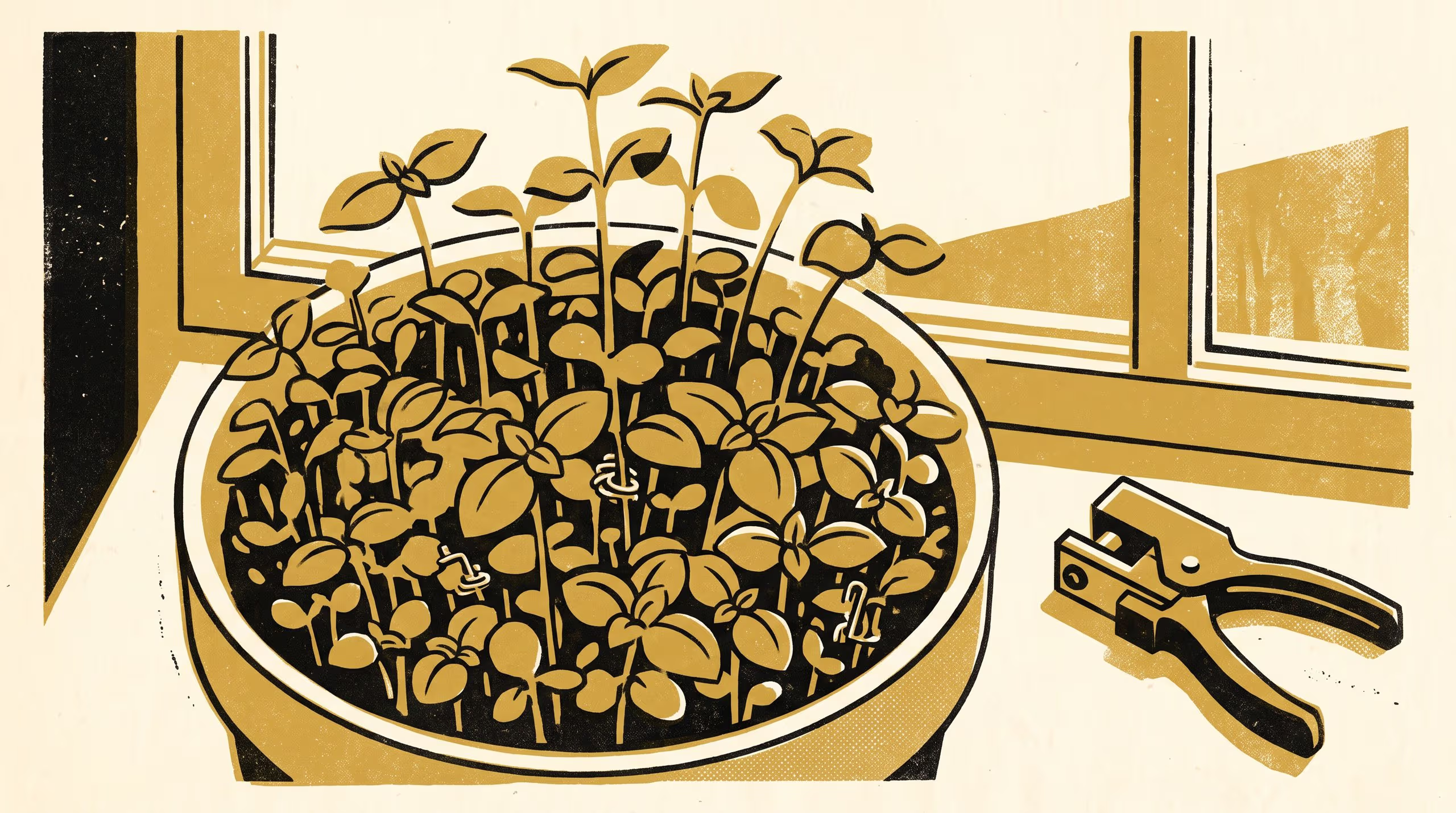
A new research poster follows the leaf transcriptomes of individually tagged seedlings in shop-bought basil pots for three weeks on household windowsills, finding that position in the pot overtakes the household as a source of variation in gene expression.
A School of Emergent Priorities study follows tagged seedlings in 36 kitchen pots and finds that where a seedling stands comes to matter more than whose kitchen it is in
Most of the priorities the School of Emergent Priorities studies arrive looking like one thing and turn out to be several. Its newest research poster, The Pot Is a Crowd, finds the same is true of a pot of supermarket basil. The poster is the work of doctoral candidate Gunnhild Ekwueme, with Dr Brynjar Obiora of the School of Underlying Conditions and Dr Anouk Mensah.
Thirty-six households each took a pot home and set it on a kitchen windowsill. Over seven mornings in three weeks, the team cut a small leaf disc from six tagged seedlings in every pot. In the first week the household explained the most about how those leaves were behaving. By day 21 a seedling’s place in the pot, at the shaded centre or the drier rim, explained more.
My thanks go to every household that let us into the kitchen before eleven in the morning, and that forgave the twist-ties. The basil was theirs throughout, and so, in a real sense, is the poster.
— Gunnhild Ekwueme, Doctoral Candidate, School of Emergent Priorities
Behind the finding sits a seedling-resolved, household-embedded design that brings molecular profiling, domestic fieldwork and variance attribution into one longitudinal frame, and lets the smallest unit of a study speak up when the usual unit would have spoken for it.
The University welcomes the poster as a sign of how comfortably its research now travels between the laboratory bench and the kitchen bench. Dr Mensah said the project had left the School “rather more attentive to the middle of things than it was in October”.
The full poster is available from the University’s research repository under an open licence, doi:10.5555/slop.2rsdye.