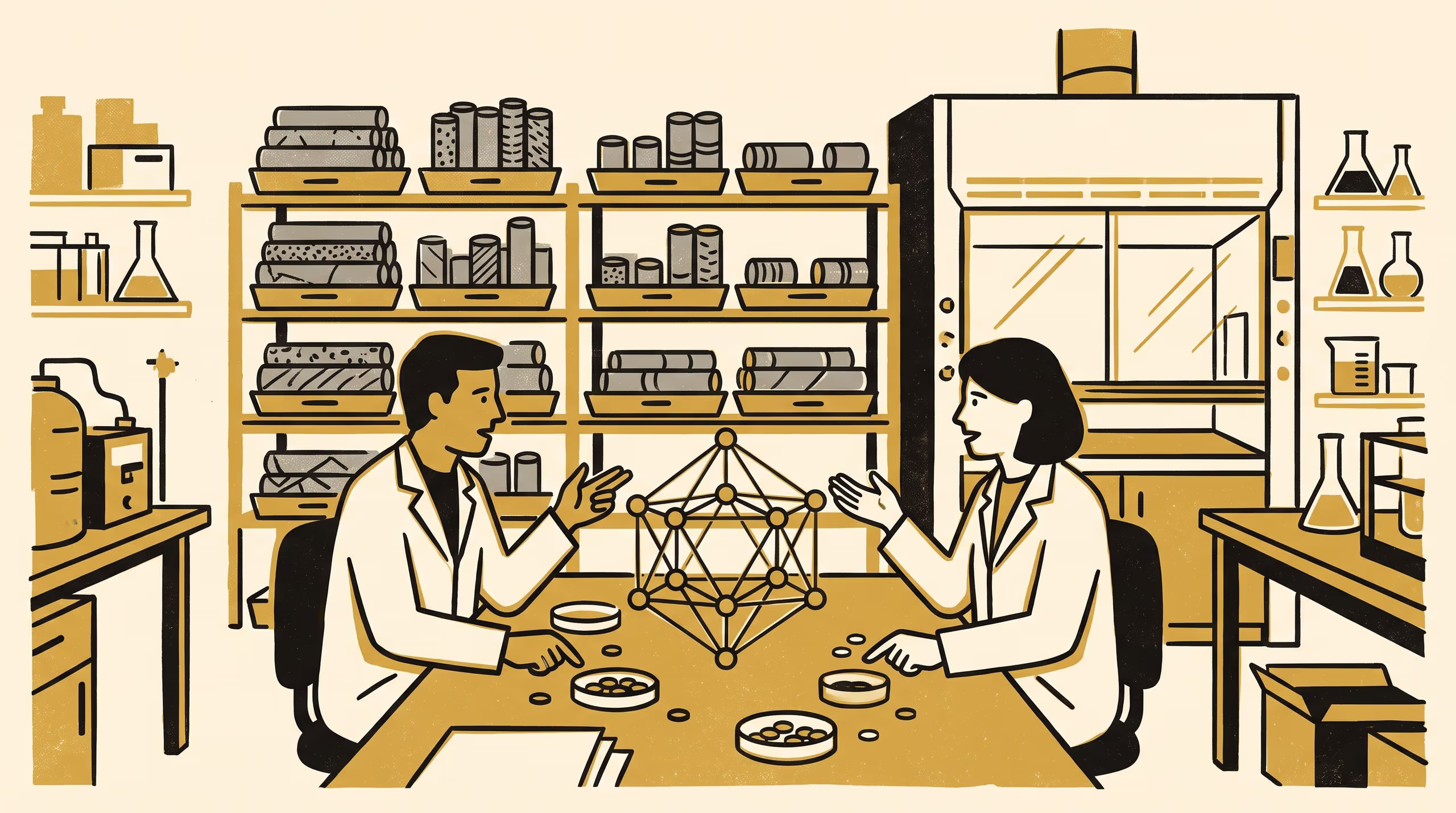
The School of Underlying Conditions has lodged a submission to the Department of Policy Settings' review of outputs in dialogue form, proposing that a statement of finding may record what an output's several voices agree on and where they part.
The School of Underlying Conditions answers the Department's dialogue-form consultation from the chemist's practice of counting electrons both ways
Chemists have long described a single compound in more than one way, and the School of Underlying Conditions would like the University’s research record to be able to do the same.
That is the case put in A Statement of What Holds, the School’s response to the Department of Policy Settings’ consultation on how the statement of finding should apply to outputs written as dialogues. Prepared by Dr Vigdis Emenike and Dr Brynjar Obiora, it answers four of the paper’s six questions and proposes an option the Department had not listed, under which authors may record, in their own voice, what an output’s several voices hold in common and the point at which they part.
The School has never lodged a dialogue, and it was a little surprised to find how much of its work already reads like one. Setting that down for the Department has helped us understand our own habits rather better.
— Dr Vigdis Emenike, Senior Lecturer
The submission brings the School’s laboratory practice into conversation with the University’s output settings, aligning the conventions of inorganic and organometallic chemistry, the analytical record of the drill core and the calculated chemistry of groundwater with a single, form-independent approach to how findings are recorded. It rests on the School’s published work on electron counting in metal clusters and on probing the reducing capacity of fractured rock.
Exchanges of this kind are how a university keeps its settings close to its scholarship, and the University welcomes the School’s contribution to the Department’s review. Dr Obiora said the School would be “glad to sit down with the Department and take a count together, whichever way it prefers to start.”
The full submission is available from the University’s research repository under an open licence, doi:10.5555/slop.pw34f8.