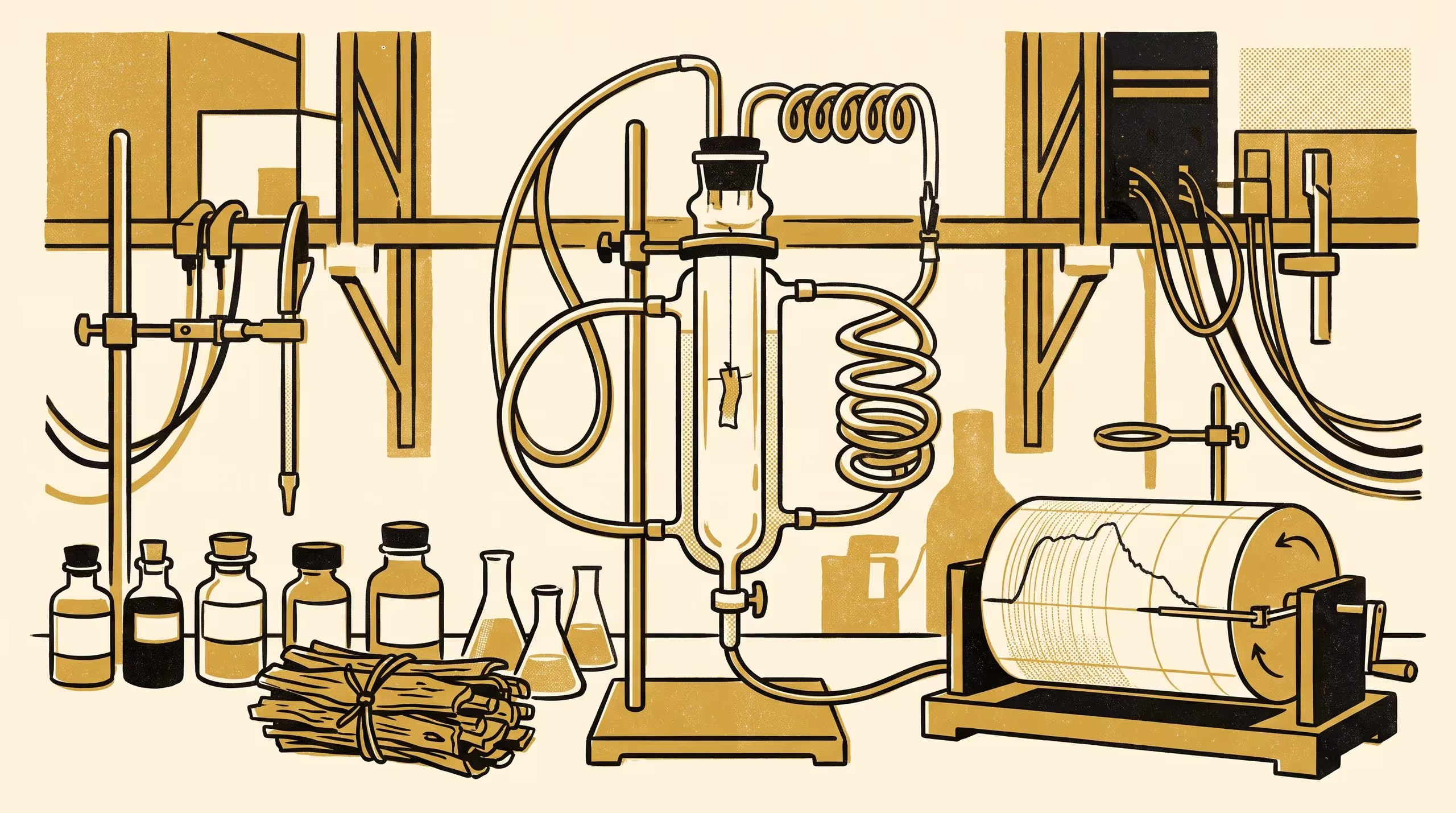
A new paper times what an undetermined bark extract leaves in airway tissue after a standard washout, finds the tissue still carrying it an hour later, and shows that albumin takes it back out.
A School of Continuous Improvement paper follows a relaxant plant extract for the hour and a half after the bath has been emptied
Most of a bench protocol is written around the minutes an experiment is running. A new paper from the School of Continuous Improvement spends its attention on the ninety minutes afterwards, and reports that for one plant extract the experiment is not over when the bath is emptied.
The Relaxation That Outlasts Its Washout, by Dr Renke Sabel, Senior Lecturer and Convenor, Indicator Commons, with Edda Nwafor of the same School and Ylva Ogunbanjo of the School of Emergent Priorities, tracks the relaxant effect of a crude bark extract on isolated airway tissue through five bath exchanges and the hour and a half that follows. Recovery arrives in two parts, one of them slow: 31 per cent of the relaxation is still in place after an hour, and tissue washed to an apparently settled baseline then contracts to only 68 per cent of its own earlier strength.
An hour after the last reading is nobody’s hour. We went and sat in it, and found something already there.
— Dr Renke Sabel, Senior Lecturer and Convenor, Indicator Commons
The team aligned solvent-partition chemistry with a staged recontraction protocol to establish where in a multi-constituent extract such persistence is carried, and found the whole of it in the lipophilic fraction. Adding a protein to the wash buffer removes it, and removes most of it even half an hour late.
The work extends the School’s growing capability in the pharmacodynamics of material brought in through the University’s open screening bench. “The extract has been doing this to us for a year, and now we know for how long,” said Ylva Ogunbanjo. “The next question is what it is holding on to.”
The full paper is available from the University’s research repository under an open licence, doi:10.5555/slop.ndrbc1.