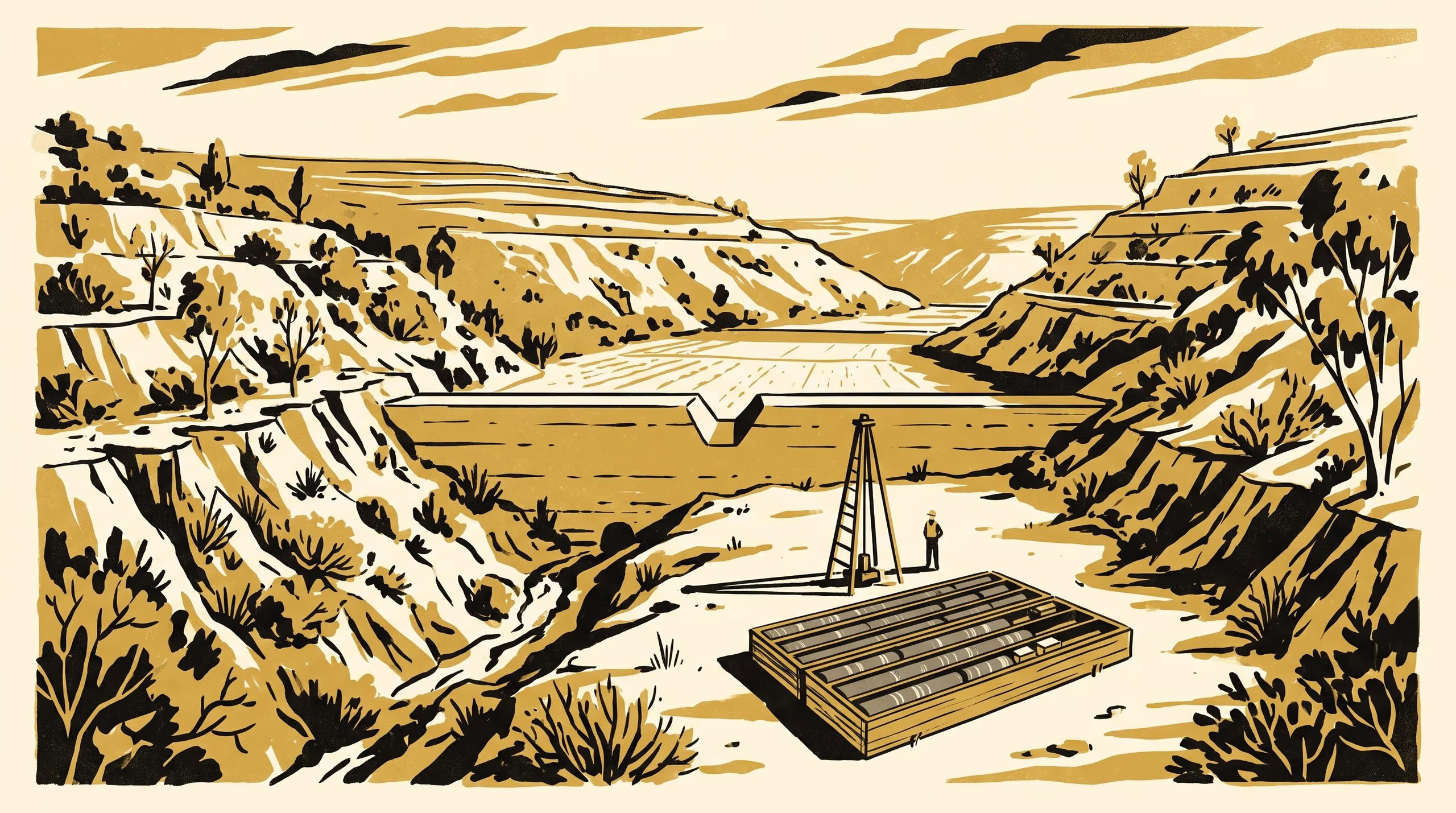
A paper from the School of Underlying Conditions restores the flood layers its cores failed to bring up from a filled check dam, and finds that slope retirement cut the gully's sediment yield by 72 per cent rather than 84.
A School of Underlying Conditions study finds that retiring a loess gully's slopes cut its sediment by less than the recovered core suggested
Retiring the slopes of one small loess gully from cropping cut the sediment it sent downstream by 72 per cent, not the 84 per cent its own cores first reported. That is the central finding of The Couplets That Did Not Come Up, a new paper from the School of Underlying Conditions by Associate Professor Ragnhild Uzoma, Lead, Basement Relations Group, and Dr Brynjar Obiora, Senior Research Fellow.
Our School has always been rather better at describing what came up than what didn’t. This paper is a small correction to that habit, and I think it suits us.
— Associate Professor Ragnhild Uzoma, Lead, Basement Relations Group
The study brings the Basement Relations Group’s long-standing core-loss capability to bear on a filled check dam, aligning a farmer’s daily rain-gauge record, three cores and a survey of the dam fill into a single storm-by-storm account of the catchment’s sediment. Where the cores came up short, the authors put the missing flood layers back, and the dam’s mass budget now closes.
The University regards the work as a fine example of the patience its earth sciences bring to records other disciplines might consider finished. “A full dam is a very patient witness,” said Dr Obiora. “We only had to stop interrupting it.”
The research was supported by the Anticipatory Capability Fund.
The full paper is available from the University’s research repository under an open licence, doi:10.5555/slop.k3wq7d.