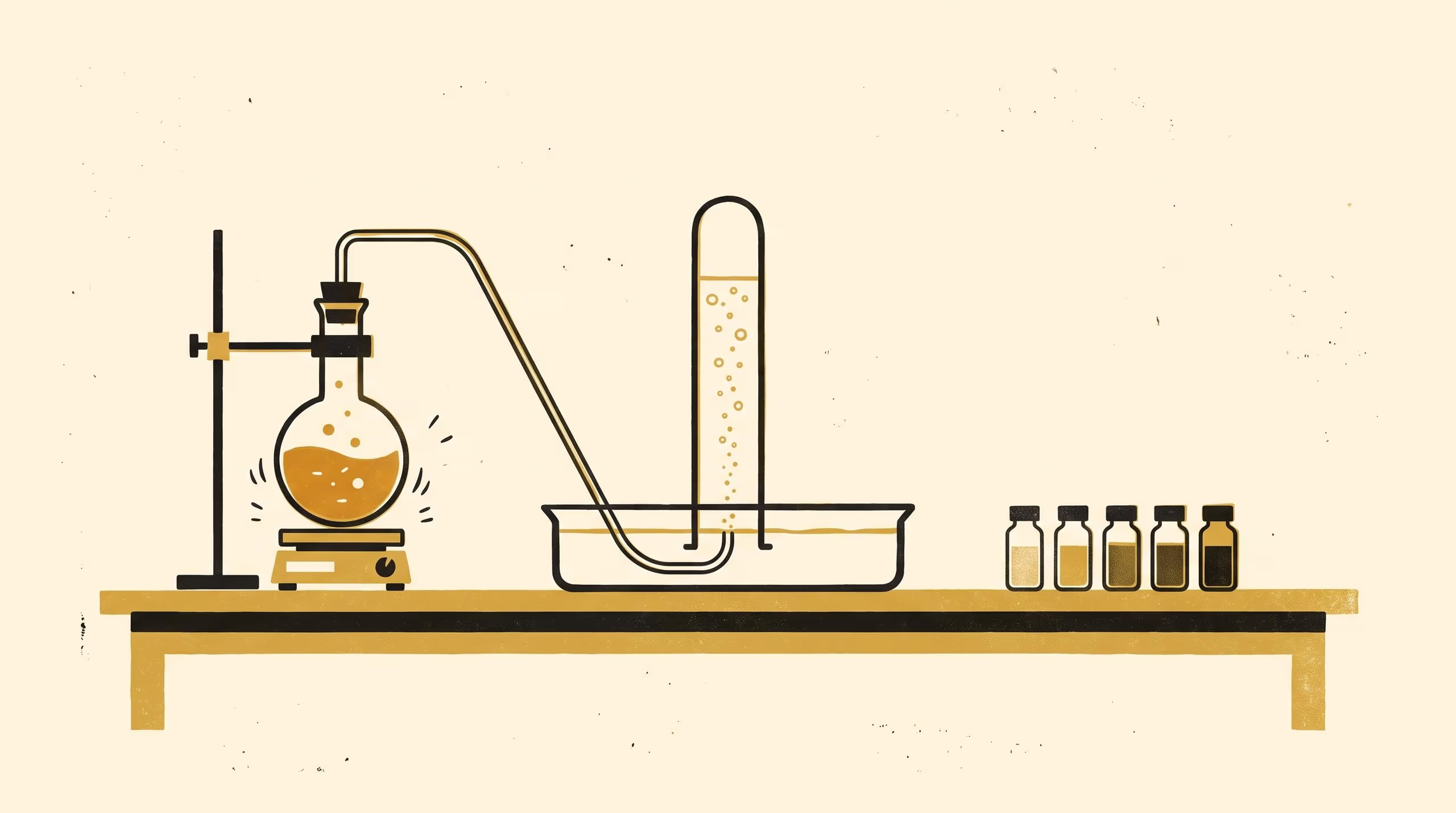
A new research poster follows the hydrogen peroxide a model vanadium catalyst consumes and finds that, when there is little for it to brominate, most of it leaves the flask as oxygen.
A research poster from the School of Continuous Improvement weighs bromination against the oxygen a haloperoxidase mimic gives off
For twenty-one runs of thirty minutes each, a small vanadium catalyst on a bench in the School of Continuous Improvement was given hydrogen peroxide, bromide and something to brominate, and asked to show where every peroxide went.
I came to chemistry late, and mostly by asking where things go. A round-bottom flask turns out to be a very good place to ask it, because nothing is allowed to leave without being written down.
— Dr Sten Okwuosa, Senior Research Fellow and Convenor, Impact Pathway Atlas
Where the Oxidant Goes, by Dr Sten Okwuosa, Signy Okpara and Edda Nwafor, reports that the share of spent peroxide ending up in the brominated product climbs from 22 per cent to 74 per cent as the catalyst is given more to work on, while the amount of peroxide it consumes barely changes. The remainder, the team finds, is given off as oxygen.
Rather than take the catalyst’s appetite as its output, the team brought peroxide assays, product analysis and gas collection together into a single closed ledger for each run, enabling a whole-of-reaction view of catalyst performance across a broad operating envelope.
The University is pleased to add a flask to the long list of places where the School has gone looking for the missing entry, and found it. “We kept a gas burette beside the flask for every run,” said Ms Okpara, Doctoral Candidate. “Next term it stays on the bench whatever we are measuring. It costs very little, and it has already told us more than we asked it.”
The full poster is available from the University’s research repository under an open licence, doi:10.5555/slop.ukcfoa.