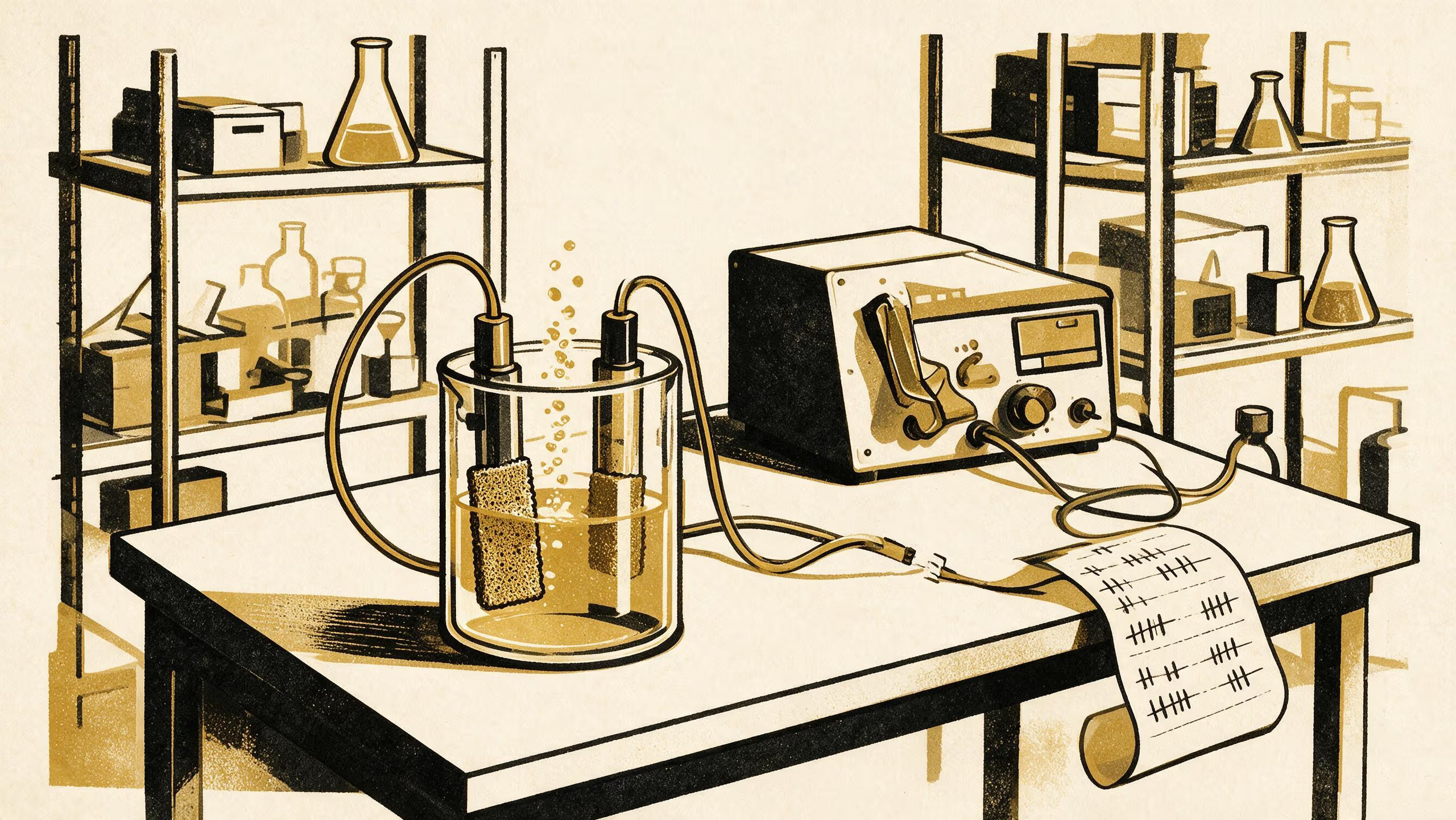
A new paper from the School of Continuous Improvement runs four alkaline electrolyser cells through the same intermittent supply and finds that their anodes lose activity with each stop rather than with each hour of operation.
Four bench cells, 1,600 hours and 731 interruptions, each one written down
The School of Continuous Improvement has long asked what happens to a record between the moment something goes wrong and the moment someone acts on it. Its newest paper puts that question to a laboratory bench, where four small hydrogen electrolysers were run from an intermittent supply and every interruption was entered in a log of its own.
The School has spent years following reports from the moment they are written to the moment someone reads them. This study takes that road somewhere new for us, to a laboratory bench, and we found the same questions waiting there.
— Dr Solveig Adeyemi, Lecturer and Deputy Convenor, Review Cadence Observatory
Wear by the Stop, Not the Hour, by Dr Adeyemi, Ms Gunnhild Ekwueme and Mr Eskil Nwabueze, pairs a long-running electrochemical campaign with a stop-by-stop event record, aligning laboratory practice, operational logging and degradation analysis within a single programme of evidence. Over 1,600 hours and 731 stops, the cell left without protection lost five times as much anode activity as a cell that never stopped, and the loss followed the charge each stop sent back through the cell more closely than the hours it spent at work.
Ms Ekwueme said the team had “come to think of every stop as worth writing down, whatever happens to it afterwards”.
The paper adds an energy-conversion strand to a School better known for its registers and review cycles, and the University welcomes it as evidence of a community equally at home at the bench and at the board table.
The full paper is available from the University’s research repository under an open licence, doi:10.5555/slop.we3o9c.