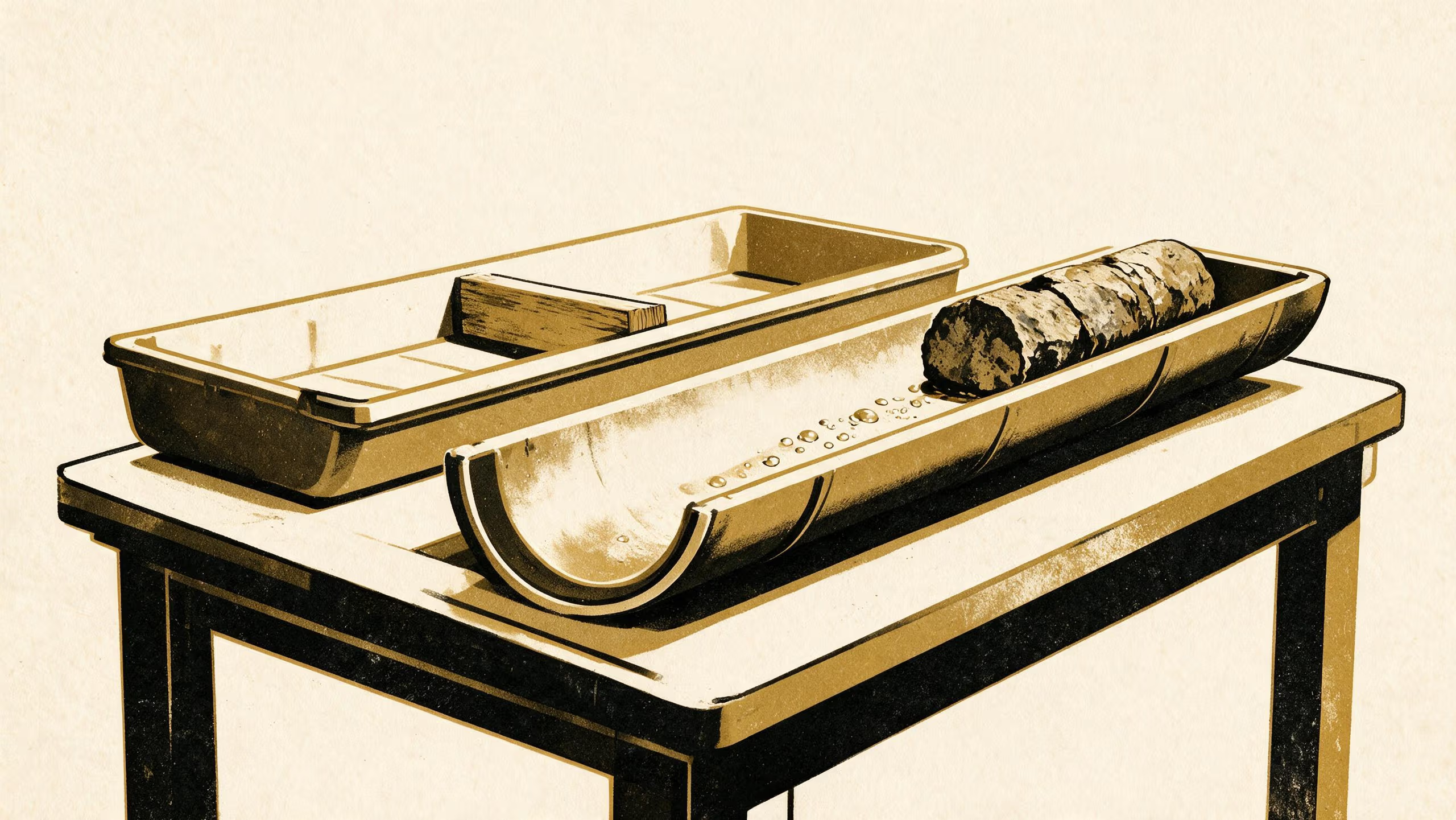
A research poster from the School of Underlying Conditions maps water droplets along the walls of split core liners and finds that most intervals logged as lost reached the barrel before they disappeared.
A research poster reads the inner walls of split drill-core liners to tell where a borehole's lost intervals went missing
Last month the Basement Relations Group was funded to cut its core-loss blocks before the drill reaches the ground they will stand in for. Its newest research poster turns to the other object that comes back from a short run: the plastic liner the core was meant to travel in.
Reading the Liner, by Associate Professor Ragnhild Uzoma of the School of Underlying Conditions, with Dr Odalys Penhallow and Ms Edda Nwafor, asks whether a liner wall remembers what touched it. Of the 61 intervals one borehole logged as lost, the team reports, 39 left a film on the wall: the rock arrived, and then it did not stay.
The School has always been careful to count what a hole fails to return. We are now learning to keep what it was lost in, and we expect the core store to need another row of shelving before long.
— Associate Professor Ragnhild Uzoma, Lead, Basement Relations Group
The team brings laboratory wettability measurement, blind classification and the drillers’ own run notes into one interfacial account of loss, positioning the discarded liner as a surface where drilling practice and the borehole record can at last meet. The poster adds a new material to the University’s long and patient engagement with ground nobody has seen.
Ms Nwafor described the study as “an invitation to look twice at the things a shed is about to throw away, which turns out to be most of them”.
The full poster is available from the University’s research repository under an open licence, doi:10.5555/slop.coytu9.