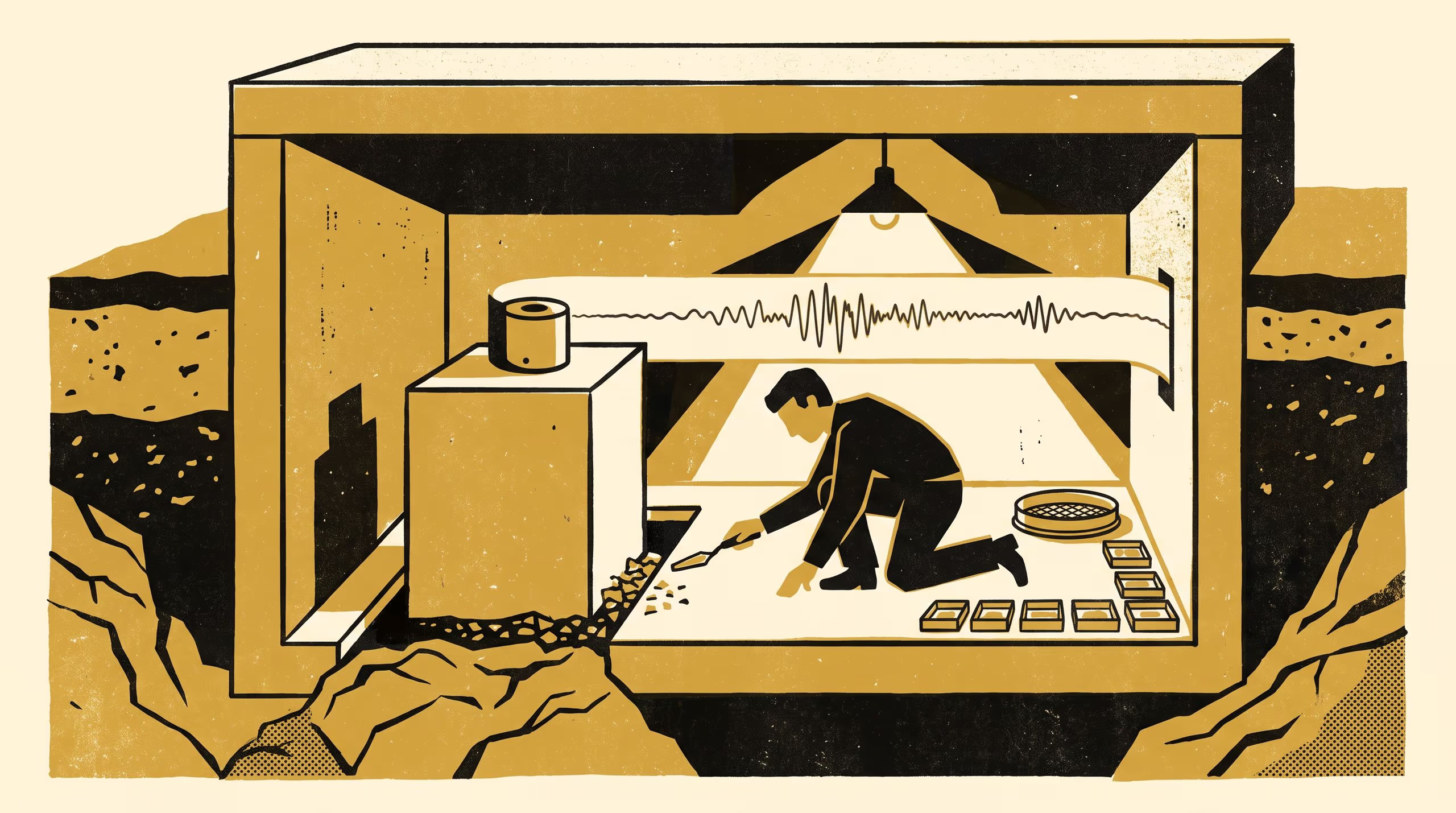
A paper from the School of Underlying Conditions excavates the narrow gap around a seismometer pier and finds that the station recorded, in its own seismograms, the two maintenance visits that filled it.
A School of Underlying Conditions paper reads the fill around an instrument pier against the station's own record of the visits that put it there
Archaeologists usually arrive long after anyone could tell them what happened. Here the instrument had been listening the whole time, and the question for us became how much of the dig it already knew.
— Dr Vigdis Emenike, Senior Lecturer, School of Underlying Conditions
That instrument stood in a small concrete vault on a granite outcrop for 43 years, on a pier separated from the floor around it by a gap meant to stay empty. In Footfall in the Fill, Dr Vigdis Emenike of the School of Underlying Conditions and Associate Professor Casimir Beng of the School of Continuous Improvement report what they found when they dug that gap out, sector by sector, and set the result beside the station’s continuous record of 287 service visits.
The gap had filled, and in two places it had filled solid. The footsteps of visiting technicians, as the pier heard them, grew louder in two steps, in 1996 and again in 2003, each time on the visit after a careful piece of maintenance whose offcuts the team later recovered from the fill.
In the paper’s account, the dig and the seismograms become two records of the same handful of afternoons, and the field station becomes a site that can help date its own deposits.
Associate Professor Beng said the collaboration had “the shape the University always hopes its Schools will find, with one of them holding a spatula and the other a spectrum, and both pointing at the same afternoon”.
The University counts the study among its more patient contributions to understanding what research infrastructure leaves behind once the research has moved on.
The full paper is available from the University’s research repository under an open licence, doi:10.5555/slop.jpgrzj.