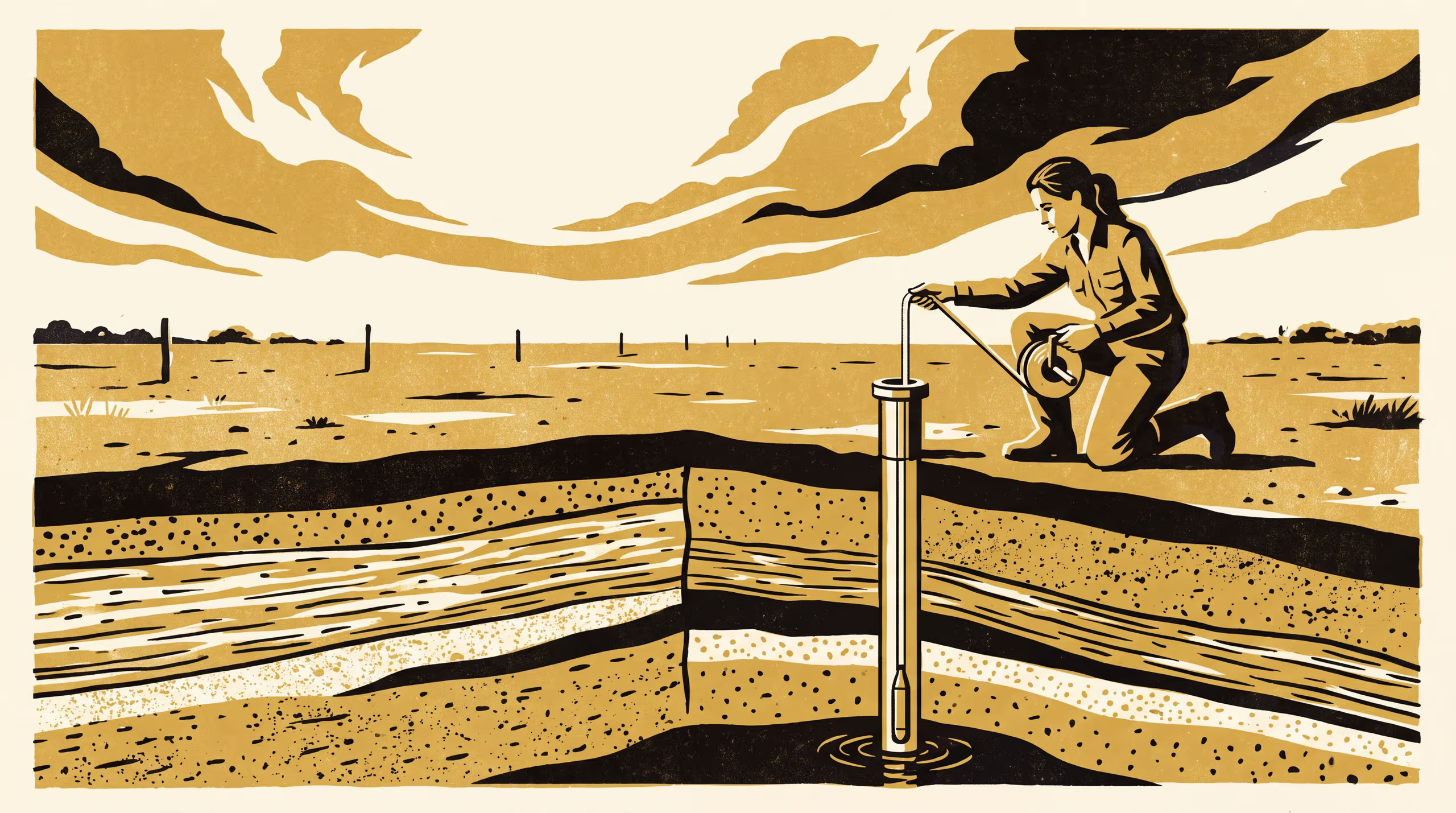
A new research poster from the School of Underlying Conditions examines how a water-level probe, lowered into a narrow monitoring bore, moves the water it is there to measure, and how long a careful reader should wait before trusting the result.
A poster combining simulation, a laboratory column and eight field bores shows how a probe's own plunge sets narrow casing ringing
How long should a measuring tape be held still? For The Probe Is the Slug, a new research poster from the School of Underlying Conditions, the answer turns out to be about ninety seconds, and the reasons reach some way down.
The poster is the work of Dr Vigdis Emenike and Associate Professor Casimir Beng, who find that the slender probe used to read a bore’s water level briefly becomes part of the hydraulics it is measuring. In the narrowest casings they studied, a reading taken too soon can sit more than a centimetre above where the water settles.
Every bore we visit is a conversation, and it seems we have been the ones speaking first. The School has learned a good deal about itself by practising how to wait for its turn.
— Dr Vigdis Emenike, Senior Lecturer, School of Underlying Conditions
The study brings numerical modelling, purpose-built laboratory apparatus and long-standing field practice into a single account of measurement as an interaction, positioning patience as a low-cost enabler of data quality across monitoring networks.
Associate Professor Beng, Lead of the Adaptive Metrics Lab, said that most instruments “arrive with a settling time printed somewhere”, and that it had been a pleasure to help this one find its own.
The University counts the poster among the quieter strengths of its earth sciences: close attention to the moment an observation is made, and to what the observer brings to it.
The full poster is available from the University’s research repository under an open licence, doi:10.5555/slop.mcna5m.