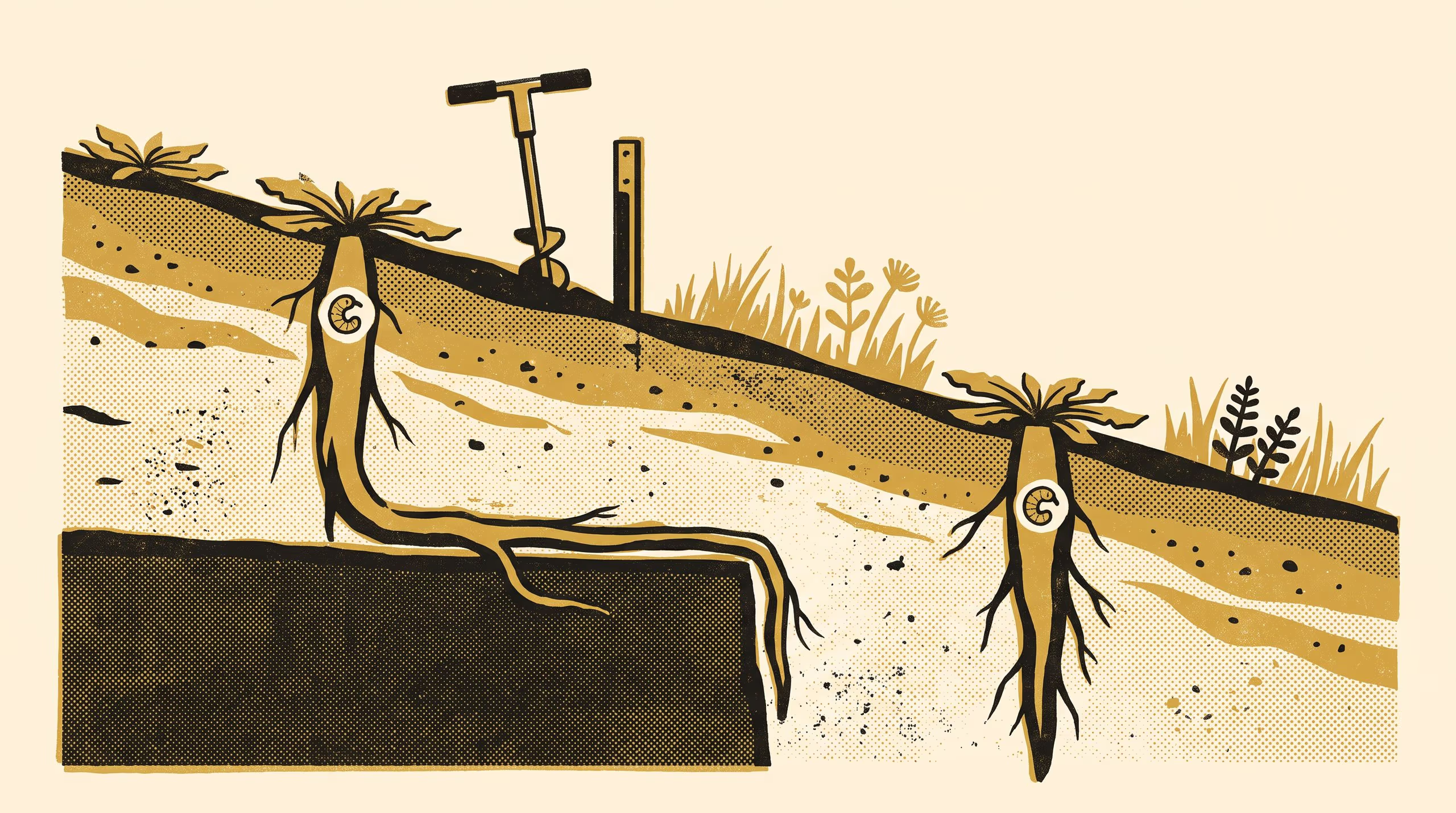
A new paper from the School of Underlying Conditions finds that a weed biocontrol weevil established where the soil over rock was deep, and struggled where its host's taproot met stone.
Soil depth at 46 release sites predicted where a root-mining biocontrol agent took hold
An insect released to control a weed can only live where the weed’s root can go, and the root can only go as deep as the ground allows. That is the finding of Depth to Refusal, a new paper from the School of Underlying Conditions by Associate Professor Ragnhild Uzoma and Dr Brynjar Obiora.
We owe a great deal to the people who let us dig holes in their paddocks and asked only that we fill them in again. Most of what this paper knows, it learned from them, a few centimetres at a time.
— Associate Professor Ragnhild Uzoma, Lead, Basement Relations Group
Working across 46 release sites, the paper brings field soil logging, root excavation and overwinter monitoring together into an integrated, ground-level account of release-site suitability for a root-mining weevil. The agent had taken hold at 27 of the sites, and its prospects improved steadily with every additional measure of soil above the rock. Where the ground was thin, the host plant’s root reached stone and turned aside, and the insects living in it spent a harder winter.
The University sees in the work a fresh expression of its commitment to research that starts where its subjects stand, and a reminder that the School’s long attention to the ground beneath things has uses well beyond the core tray. Dr Obiora described the fieldwork as “an education in patience, for the people holding the auger as much as for the weevil”.
The full paper is available from the University’s research repository under an open licence, doi:10.5555/slop.481dyw.