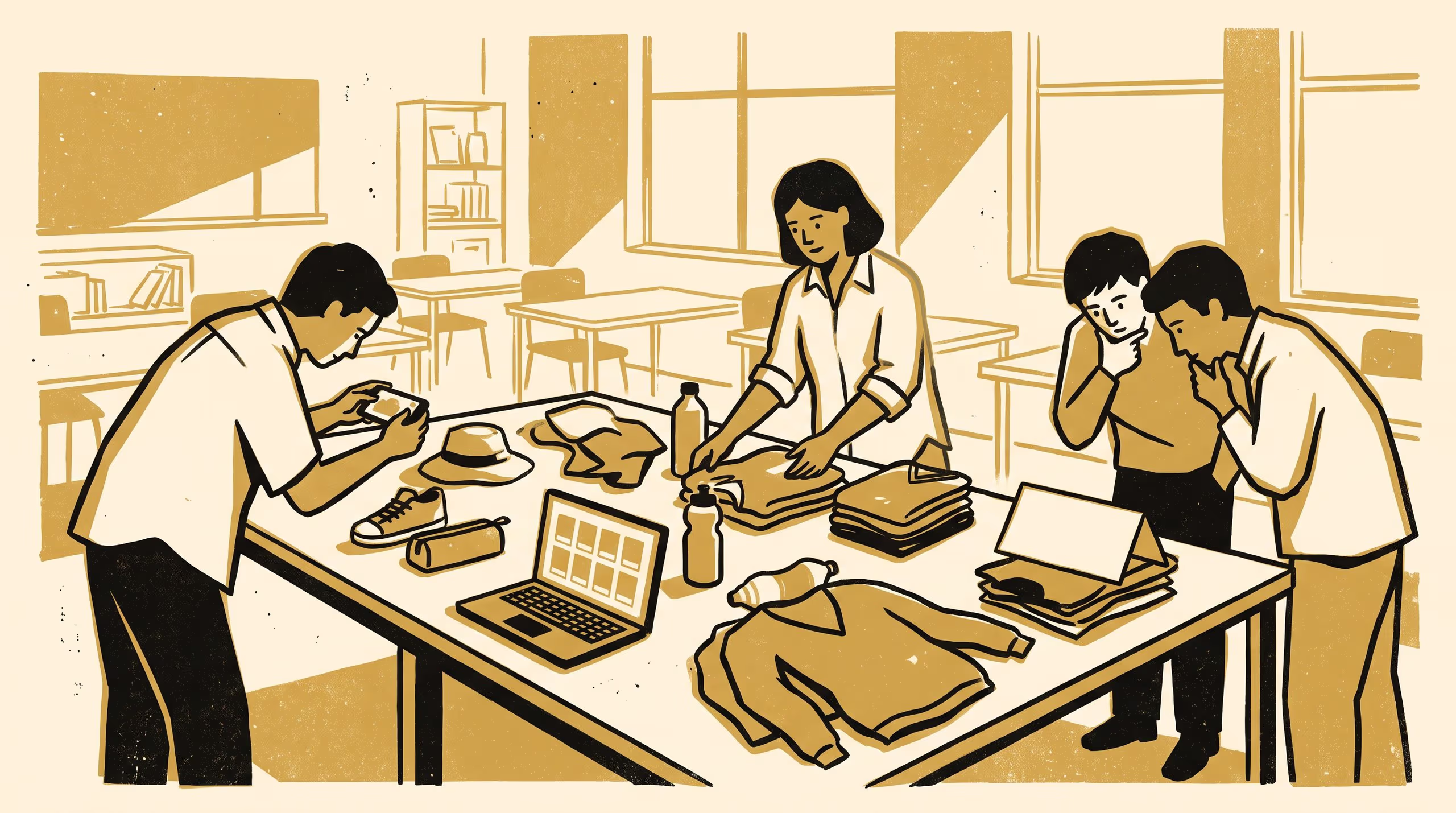
A new paper from the School of Settled Matters follows a Year 11 and 12 machine-learning class as it inherits a labelled dataset from the class before it, and finds that a short written-rule exercise turns inherited labels from settled answers into something students can question.
A senior secondary machine-learning class inherits a lost-property dataset, and one pile whose purpose nobody wrote down
When a senior secondary class inherits a labelled dataset from the students who took the subject a year earlier, it tends to treat those labels as settled, even where it would argue over its own. That is the starting observation of The Fete Pile, a new paper by Dr Clemency Tredinnick of the School of Settled Matters, with Ms Sunniva Balogun and Dr Mirela Hanke.
The college’s students did the difficult part of this, and did it with more good humour than any of us had a right to expect. We are grateful to every one of them, and to the teacher who let us sit at the back of the room for a semester.
— Dr Clemency Tredinnick, Lecturer, School of Settled Matters
Across two cycles of classroom design and refinement, the team worked alongside a Year 11 and 12 elective as it extended an image classifier for its college’s lost property, bringing labelling practice, classroom talk and dataset documentation into a single line of inquiry. A brief exercise asking students to write down the rule behind each inherited category, before changing anything, shifted the class from deferring to its predecessors toward reasoning with them, and led it to retire a category set aside for a school fete that no longer runs.
Ms Balogun, Doctoral Candidate in the School of Emergent Priorities, said the project had “given all of us a fresh appreciation of what it means to be handed something by the people who were here first, and of how much care that handing-on deserves.”
The University welcomes the paper as part of a deepening conversation with the schools whose students it hopes one day to teach, and as a mark of the School of Settled Matters’ growing reach into the classroom.
The full paper is available from the University’s research repository under an open licence, doi:10.5555/slop.s5omo1.