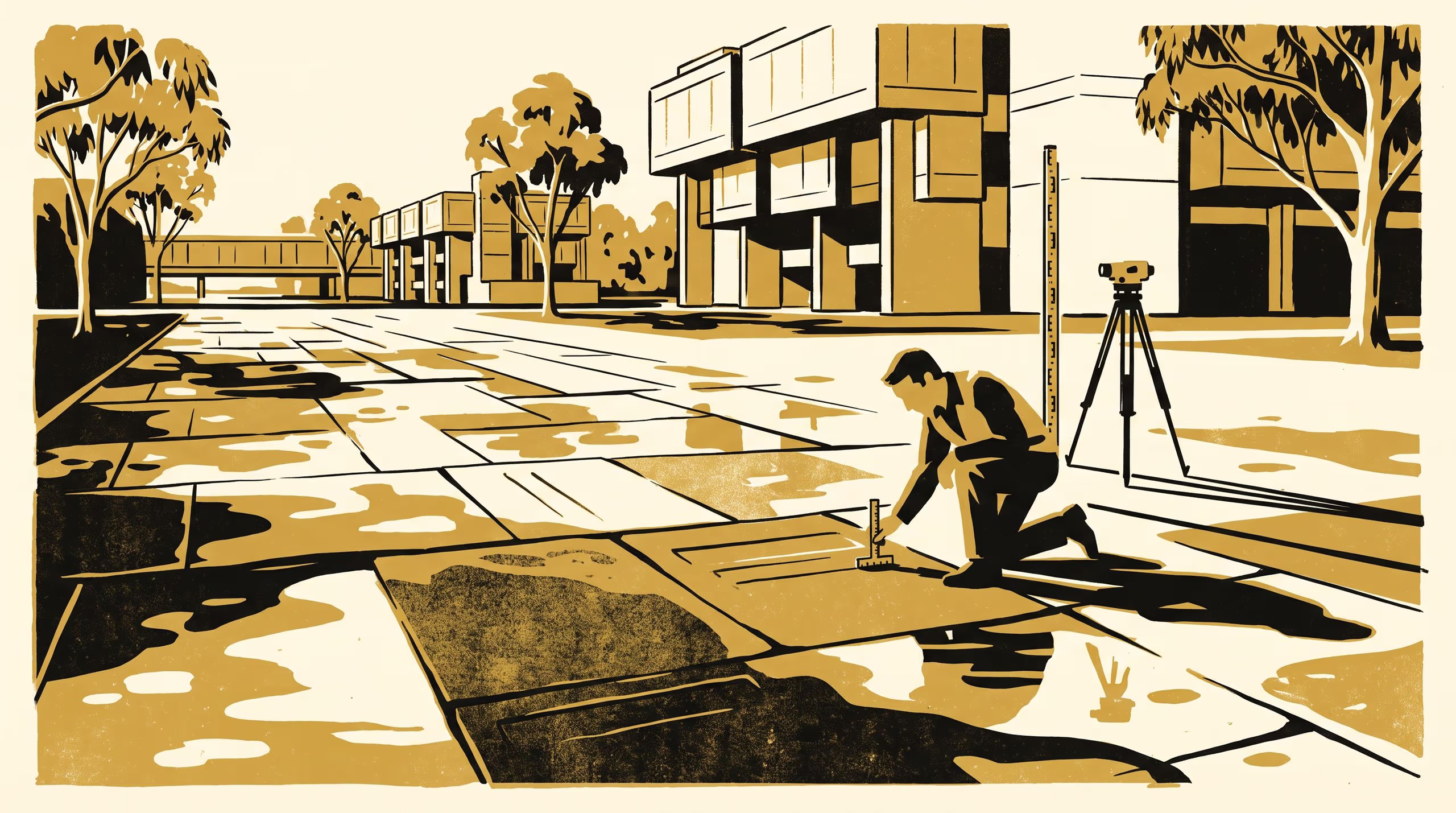
A new paper from the School of Underlying Conditions and the School of Settled Matters times standing water across 1,186 engraved pavers and finds that where the water sits, not when the slab was laid, orders both the loss of stone and the legibility of the inscription cut into it.
Slabs laid in the same year differ fivefold in how much stone they have lost, depending on where the forecourt holds water after rain
Two engraved slabs laid in the same year, cut to the same specification and set two metres apart, can differ almost fivefold in how much stone they have lost. What the Puddles Decide, a new paper led by Dr Vigdis Emenike of the School of Underlying Conditions with Dr Brynjar Obiora and Dr Clemency Tredinnick of the School of Settled Matters, traces that difference to the minutes each slab spends under standing water after rain.
Most of what an institution undertakes to keep is kept by something physical, and the physical thing has a drainage fall. We are interested in the places where those two facts have not yet been introduced to each other.
— Dr Vigdis Emenike, School of Underlying Conditions
The study brings levelling, timed observation of standing water and measurement of surface loss together across a single paved forecourt, pairing each slab’s record of laying with the conditions it has actually met since. The approach anchors a broader School interest in the settings where a surface is asked to hold a record over the long term, and in the conditions that quietly govern whether it can.
“A register tells you which bay a gift sits in,” said Dr Clemency Tredinnick of the School of Settled Matters. “Putting that beside where the water goes is the kind of patient, unglamorous alignment the University is glad to support.”
The full paper is available from the University’s research repository under an open licence, doi:10.5555/slop.4m2vqe.