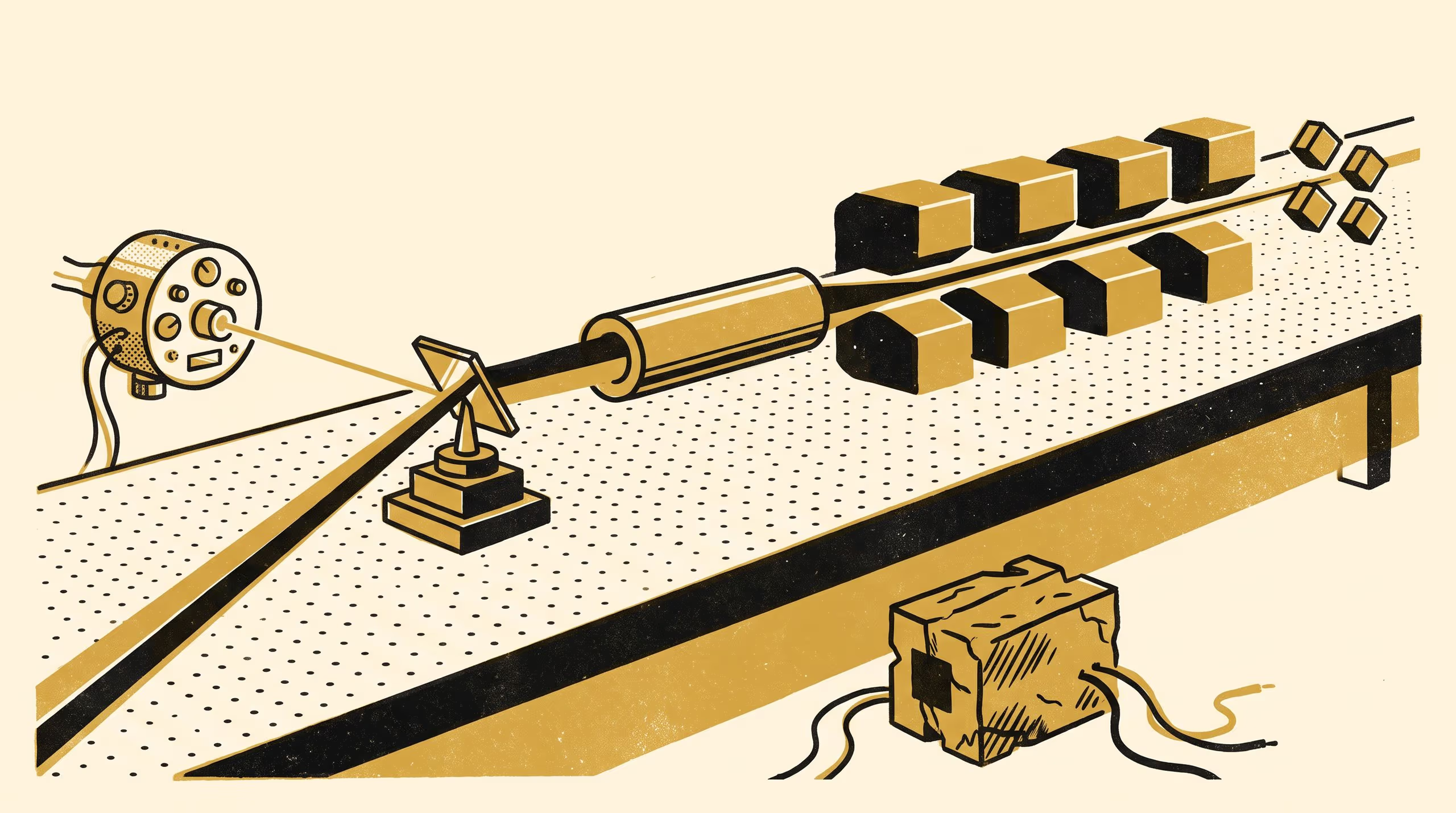
A paper from the School of Settled Matters and the School of Continuous Improvement reports a laser heater that runs on the light a photocathode laser's frequency conversion leaves behind, and a feedforward that keeps the heating steady when the beam's charge is changed.
Infrared once sent to a beam dump now warms the beam it helped to make, and steadies it ahead of compression
Rerouting a stream of light that had long been sent to a dump, a team from two of the University’s Schools has given a compact electron linac a laser heater that costs its cathode nothing. The Light the Cathode Left, a new paper led by Dr Odalys Penhallow of the School of Settled Matters with Associate Professor Casimir Beng and Dr Bram Ntuli of the School of Continuous Improvement, sets out how the arrangement was built, tuned and held steady.
Every machine has a corner where something useful goes quietly to waste. We are glad this one has been found, and we suspect it is the first of several.
— Associate Professor Casimir Beng, Lead, Adaptive Metrics Lab
The work brings an under-used optical resource into alignment with the beam-quality agenda of the linac as a whole, mobilising a shared-pulse architecture to calm an instability that would otherwise build during compression. The team characterises the heater’s response across its full range, maps the coupling between the heater and the cathode that the shared light creates, and closes the loop with a feedforward from the cathode’s own settings, which held the heating through 29 of 32 changes of beam charge.
The University regards the paper as a fine instance of two Schools finding common ground in a place neither had thought to look. Dr Penhallow described the collaboration as “a good reminder that the obvious owner of a problem is not always the one who solves it”, and Dr Ntuli said the next step was “to let the feedback and the feedforward share the work as gracefully as the heater and the cathode now share the light”.
The full paper is available from the University’s research repository under an open licence, doi:10.5555/slop.ub70yc.