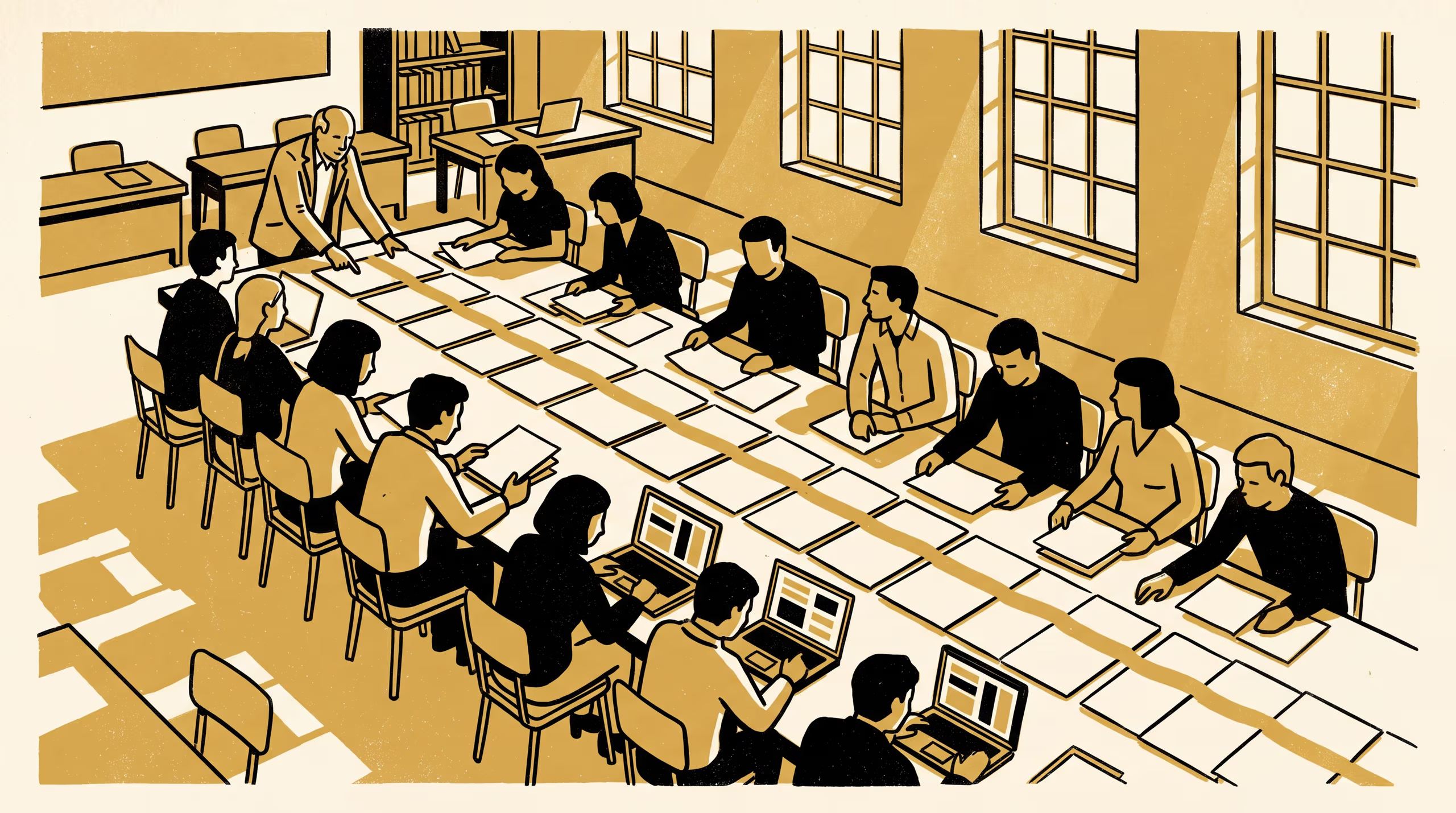
A new research poster from the School of Settled Matters tests three ways for first-year students to read a chain of superseded certificates of title, and finds that the oldest covenants and easements surface when each line carries the dealing that put it there.
A School of Settled Matters poster brings two tools from software version control into the first-year land law tutorial
First-year land law students at Slop University spent a semester reading certificates of title the way software engineers read code, and the oldest burdens on those titles came into view. Diffing the Register, a new poster led by Dr Clemency Tredinnick of the School of Settled Matters, with Dr Mirela Hanke and Ylva Ogunbanjo, sets out what the tutorial room learned.
A title is a long conversation, and most of it happened before any of us arrived. These students found a way to sit down at the end of it and hear the whole thing.
— Dr Clemency Tredinnick, Lecturer, School of Settled Matters
The study placed three reading environments side by side across a cohort of 186 students: the familiar stack of paper certificates, a view showing only what changed from one certificate to the next, and a view in which every line of the current title is annotated with its origin. Working through synthetic chains of earlier certificates, students using the annotated view found 85% of the burdens registered seven or more dealings back, against 58% with paper. The change-only view was the quickest to work through, and the most likely to pass over a covenant that had simply never moved.
The work extends the School’s growing attention to the obligations that travel with land, and brings that attention into the teaching it does every week.
“The software was always the smaller part of this,” said Dr Mirela Hanke, Postdoctoral Fellow and Deputy Convenor of the Living Dashboard. “The School of Settled Matters has been a generous host to it, and the students more generous still.”
The full poster is available from the University’s research repository under an open licence, doi:10.5555/slop.tp6qc4.