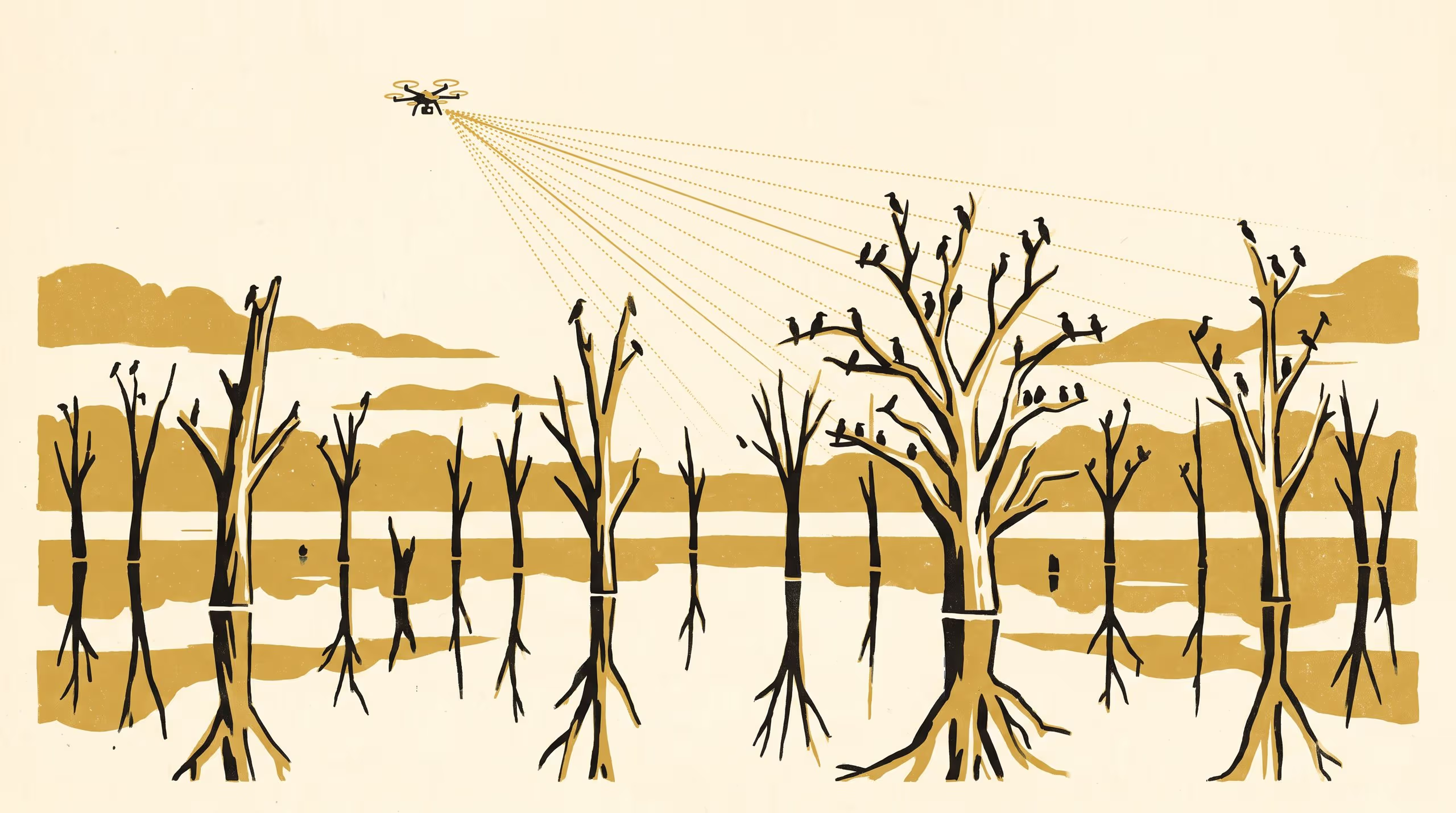
A new paper from the School of Emergent Priorities and the School of Underlying Conditions recovers what a routine filter removed from a season of drone laser scans over a wetland roost, and finds the colony in it.
Waterbirds roosting on a stand of drowned trees were being cleaned out of repeat drone laser scans as noise
What a survey throws away can still be counted. That is the proposal of What the Outlier Filter Removes, a new paper by Dr Fenna Okoro of the School of Emergent Priorities and Dr Brynjar Obiora of the School of Underlying Conditions, which returns to a season of dawn laser scans over a flooded stand of dead trees and finds the waterbirds roosting on them in the points the processing had set aside.
The Horizon Register has always kept its retired entries, on the grounds that nobody can know in advance which of them will be asked for. It has been a pleasure to find a colleague who files a wetland the same way.
— Dr Fenna Okoro, Senior Lecturer and Convenor, Horizon Register
The study repositions the cleaning step of a remote-sensing workflow as an act of record-keeping in its own right, aligning the residue of 22 survey flights with the patient counts of observers in a hide and setting out what an archive retains, and on whose behalf, when only the finished product is kept.
“I spent twelve years writing down what a soil pit showed, and a fair few of those years writing down what it didn’t,” said Dr Obiora, Senior Research Fellow. “It is a comfort to see the same courtesy extended to birds.”
The paper joins the University’s expanding inventory of studies in which the margin of a dataset turns out to be its most occupied part.
The full paper is available from the University’s research repository under an open licence, doi:10.5555/slop.okv112.