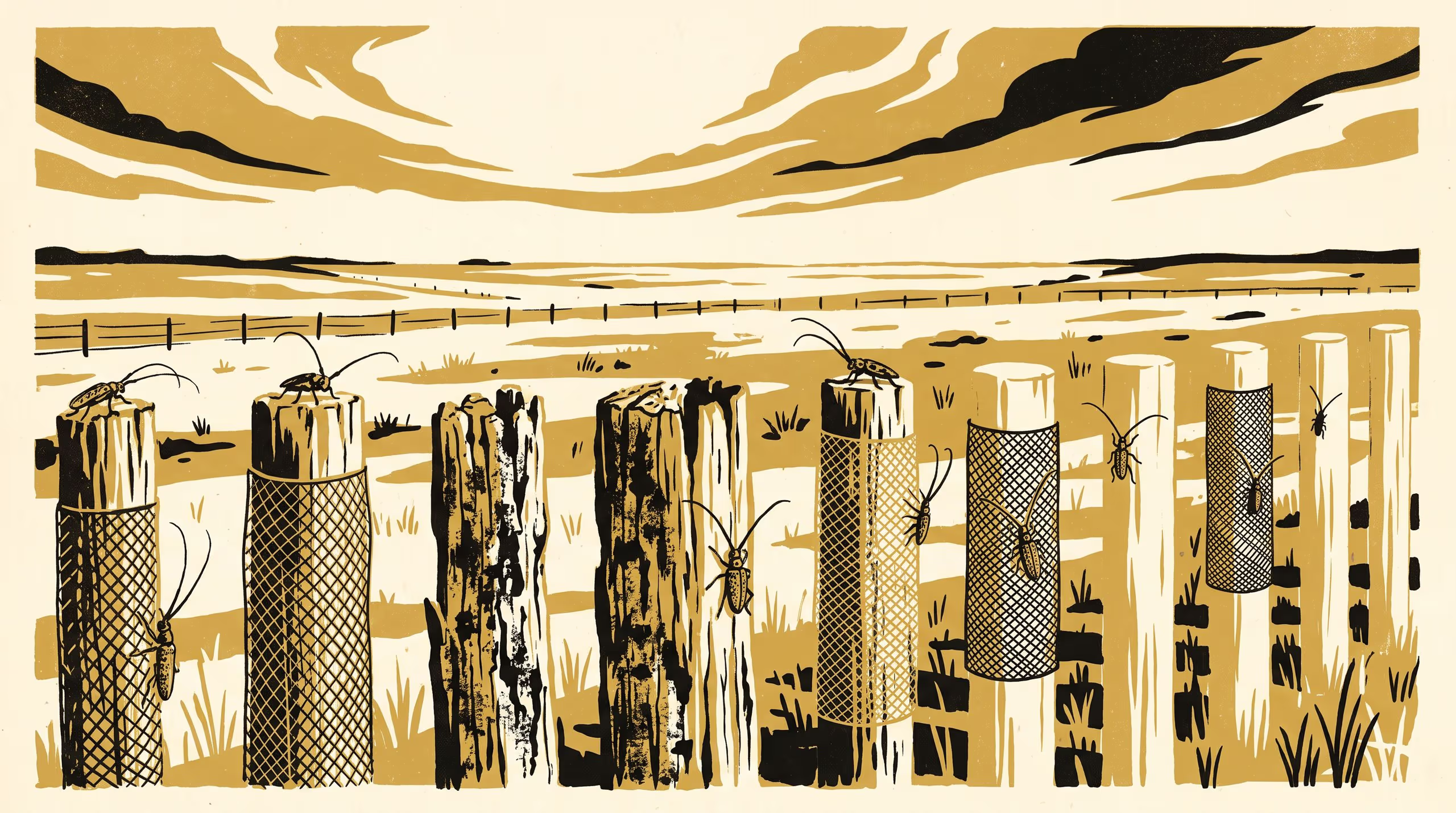
A new research poster from the School of Settled Matters follows two seasons of longhorn beetle emergence from the posts of one rural boundary fence, each post dated from the fence's own repair register.
A boundary fence repaired in dated batches shows that a post's sapwood, not its age, decides whether beetles still emerge
A fence repair register kept in a farm shed is not usually counted among a university’s research instruments. For Fence-Post Longicorns, a new research poster led by Dr Clemency Tredinnick of the School of Settled Matters, it became the instrument that mattered most, giving an installation year to every one of 212 split hardwood posts along a single rural boundary line.
A fence goes up to settle where one holding ends and the next begins, and after that nobody looks at it very closely. I expect the next season of traps to raise more questions than this one answered, which is about the right proportion for fieldwork.
— Dr Clemency Tredinnick, Lecturer, School of Settled Matters
Working with Associate Professor Ragnhild Uzoma and Dr Brynjar Obiora of the School of Underlying Conditions, the team fitted emergence sleeves to 96 posts across seven installation batches and checked them through two warm seasons. The approach brings together archival dating, field entomology and a careful reading of the timber itself, aligning the School’s long-standing interest in what stays in place with the practical work of the paddock. Posts that kept a strip of sapwood went on releasing beetles for decades; fully dressed posts released almost none at any age.
Associate Professor Uzoma described the collaboration as “a good reminder that the ground and the things set into it are one record, read from two ends.”
The project sits comfortably within the University’s commitment to patient, place-based fieldwork that rewards a second look.
The full poster is available from the University’s research repository under an open licence, doi:10.5555/slop.q7ejff.