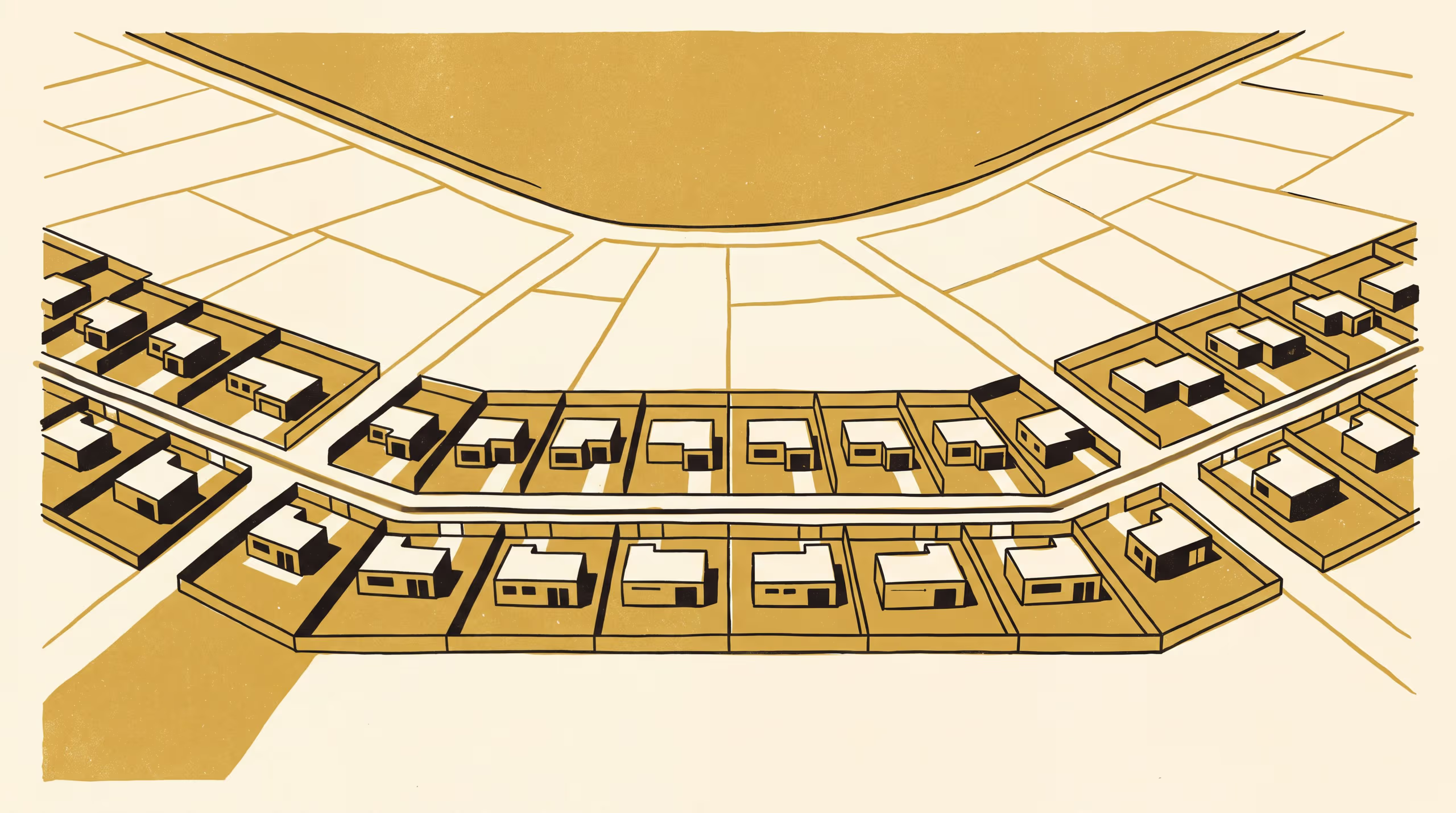
A new research poster from the School of Settled Matters asks whether a model that knows a lot's place in its subdivision tree can tell which easements and covenants the lot still carries.
A research poster teaches a classifier where each subdivided lot came from, and finds the one covenant it cannot trace
The School of Settled Matters has brought machine learning to bear on one of conveyancing’s oldest habits: reading a certificate of title for what it has inherited. What the Parent Lot Leaves, a new research poster led by Dr Clemency Tredinnick with Dr Mirela Hanke and Dr Bram Ntuli of the School of Continuous Improvement, asks whether a model that knows where a lot came from can say which easements and covenants it still carries.
Every model arrives with questions attached, and this one brought several the School had not thought to put to its own titles. We are glad to have them, and in no hurry to answer them all.
— Dr Mirela Hanke, Postdoctoral Fellow and Deputy Convenor, Living Dashboard
The poster situates the architecture of subdivision within a family of geometries drawn from number theory, locating each lot along its line of descent and benchmarking that framing against established embedding approaches across seven classes of burden. Read against more than six thousand hand-read titles, the approach reaches a given standard of performance from a fraction of the labelled data, while surfacing the one class of covenant whose story begins at the moment of subdivision rather than above it.
The collaboration between the two schools is the kind of cross-disciplinary meeting point the University has long set out to cultivate, and one it intends to keep cultivating. Dr Tredinnick described the project as “one more careful reader at a table that has always had room for them.”
The full poster is available from the University’s research repository under an open licence, doi:10.5555/slop.hp2sg8.