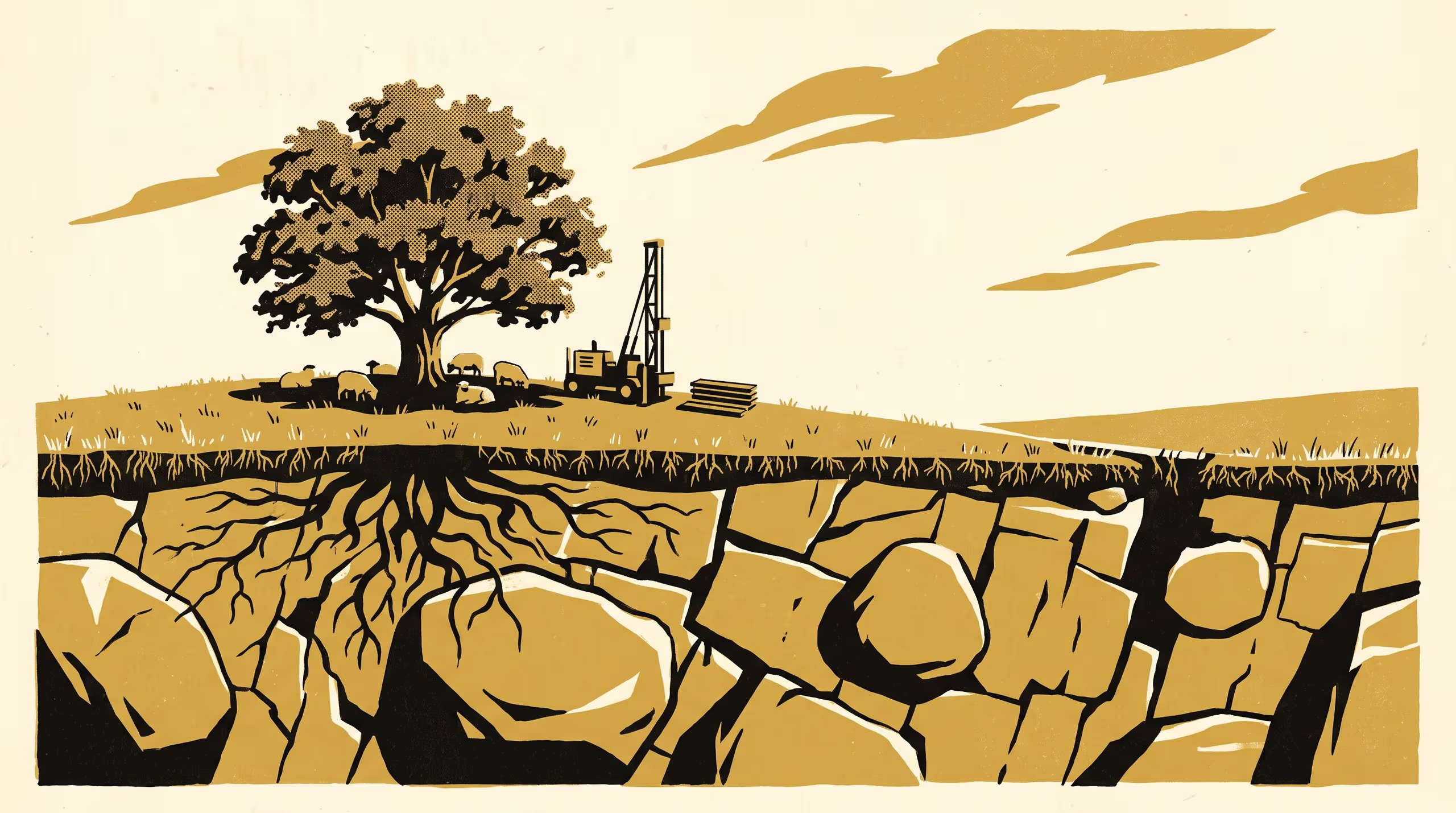
A new paper from the School of Underlying Conditions finds that scattered paddock trees on thin granite soils take most of their dry-season water from weathered rock beyond the reach of the pasture.
On thin granite soils, scattered trees and pasture share their water in the wet season and part ways in the dry
The School of Underlying Conditions has long held that what grows on a paddock depends on what lies under it. In Below the Reach of the Grass, the School takes that conviction ten metres down, beneath the scattered trees of a sheep-grazed paddock where the soil runs out in under a metre.
I came to this paddock expecting to log rock and spent a season counting roots instead. The School has found it has a good deal more to say about grass than any of us had planned.
— Associate Professor Ragnhild Uzoma, Lead, Basement Relations Group
Written with Dr Brynjar Obiora and Dr Vigdis Emenike, the paper aligns a root-by-root census of drill core with a season-by-season account of where each tree and each tussock sources its water, and positions the weathered rock below the soil as an active participant in the paddock’s water economy. Its central observation is one of timing: trees and pasture draw on the same shallow store while it is full, and by the end of the dry season the trees take three-quarters of their water from rock the grass cannot reach.
“The bores on that paddock had been dipped for years before anyone asked what the trees above them were doing,” said Dr Emenike, Senior Lecturer in the School. “We are glad to have been the ones to ask, and gladder still that the trees had an answer.”
The University counts the paper among the clearest signs yet that its earth sciences have something to offer the people who farm above them. The drilling was supported by the Anticipatory Capability Fund.
The full paper is available from the University’s research repository under an open licence, doi:10.5555/slop.czpb6c.