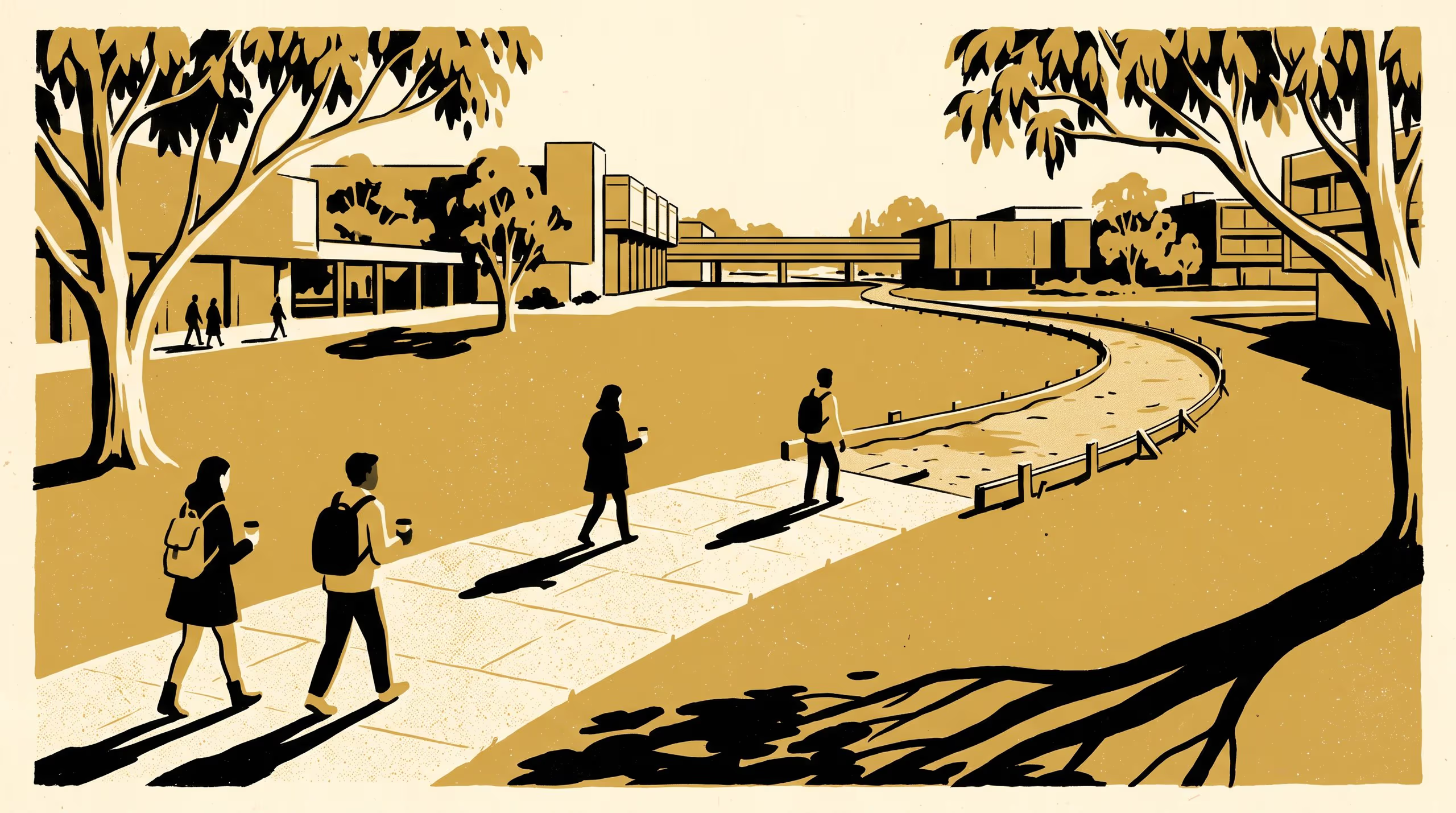
Slop University's new Strategic Plan 2026-2031 commits the University to grow, feed and observe its footpaths and low walls, and to follow every crack on its estate from first sighting to closure.
The Strategic Plan 2026-2031 lays new campus hardscape in bio-cemented soil and opens a register for every crack on the estate
The next footpath laid across Slop University’s central campus will be fed rather than finished. Ground Worth Tending, the University’s Strategic Plan 2026-2031, commits the institution to laying its new non-structural hardscape in bio-cemented soil and self-healing concrete, and to tending that ground as part of its research and teaching.
We are asking everyone who crosses the campus to become a little more curious about where they put their feet. It is a modest request, and we think a hopeful one.
— Dr Solveig Adeyemi, Lecturer and Deputy Convenor of the Review Cadence Observatory
Prepared with Dr Vigdis Emenike and Dr Brynjar Obiora of the School of Underlying Conditions, the Plan aligns the estate, research and education agendas around four focus areas: a campus culture collection of calcifying strains drawn from the University’s own soils, a progressive renewal of paths and edges supported by regular nutrient rounds, a single Crack Register stewarded by the Review Cadence Observatory, and teaching that gives every incoming cohort a stretch of ground to look after across its degree.
In bringing its grounds staff, its researchers and its students into one shared account of the ground beneath them, the University affirms a long-held view that stewardship is a form of scholarship.
“The ground has been keeping its own records for a very long time,” said Dr Obiora, Senior Research Fellow in the School. “It is pleasant to be asked to keep ours alongside it.”
The full plan is available from the University’s research repository under an open licence, doi:10.5555/slop.oxuthl.