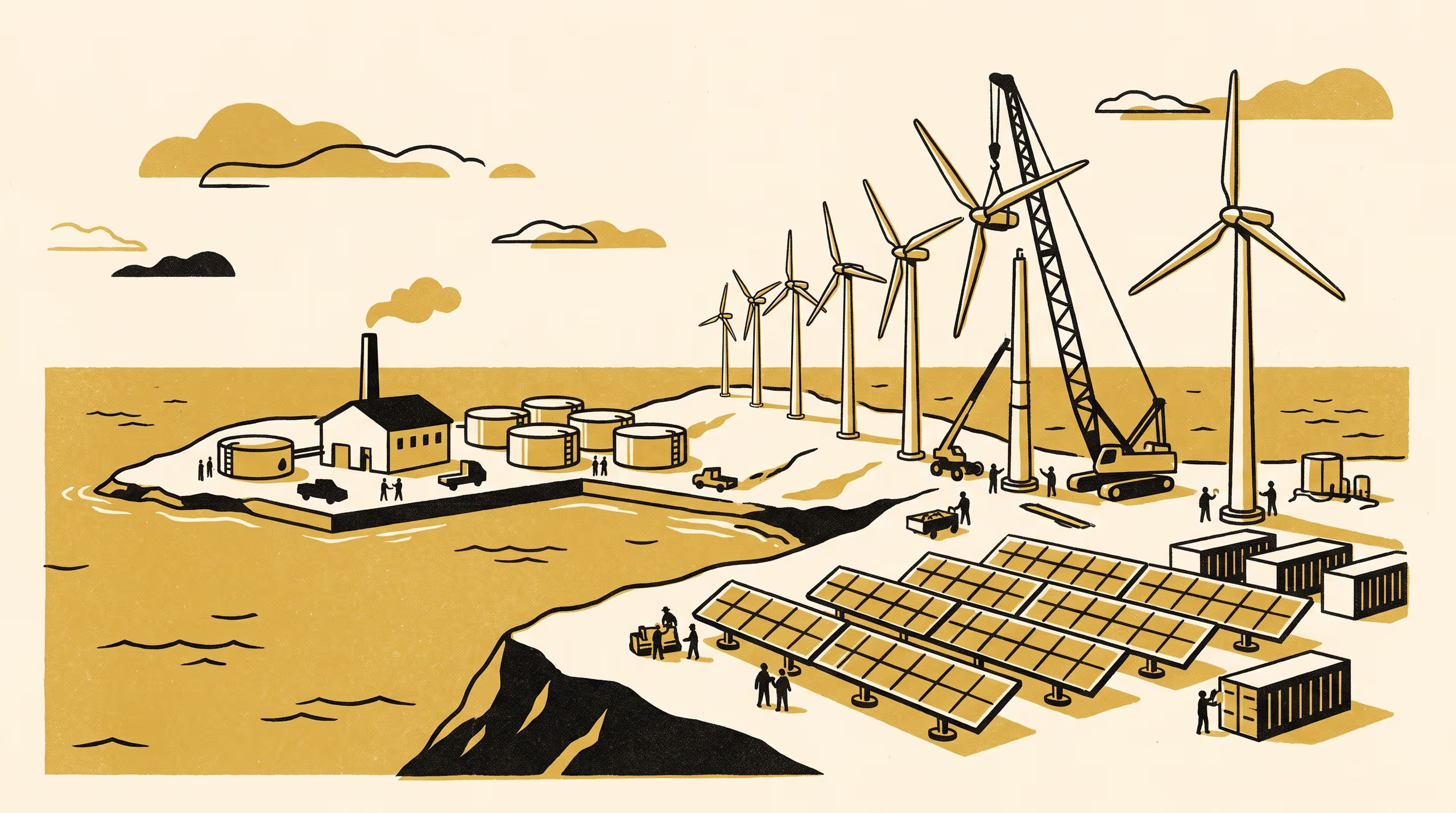
A new paper from the School of Settled Matters and the School of Continuous Improvement models an island grid moving from diesel to wind, solar and storage, and asks what its target year commits it to.
An island grid that brings its target year forward dips deeper on the way, and again a generation later
We are used to reading a target year as a statement of intent. This paper reads it as something closer to a timetable, and I would welcome every question that follows from reading it that way.
— Dr Bram Ntuli, Lecturer and Convenor, Improvement Grand Rounds, School of Continuous Improvement
That question sits at the centre of The Energy Cost of a Deadline, a new paper by Associate Professor Anselm Threlkeld of the School of Settled Matters and Dr Bram Ntuli of the School of Continuous Improvement. The authors model a small island grid that must move from diesel to wind, solar and storage by a year fixed in statute. Each year the target is brought forward enlarges the island’s long-run surplus and deepens the dip in net energy it passes through on the way: under a 2030 target, the first build year leaves the island a third of the net energy diesel alone provided.
Underpinning the result is a dynamic accounting framework that situates construction, retirement and renewal within a single energy ledger, positioning the age of the fleet as a long-horizon consideration in its own right. It also locates a second dip a generation later, when a fleet built quickly falls due for replacement all at once.
Associate Professor Threlkeld said the paper was “a small down payment on a long conversation about when, and not only whether”, and that he hoped it would find readers among colleagues in energy research.
With this paper the University adds a long-horizon voice to its energy research, and a further instance of two Schools finding they had been keeping the same calendar.
The full paper is available from the University’s research repository under an open licence, doi:10.5555/slop.jpwqkz.